By Shikaleke Emonena Evidence
- Introduction
Corruption is the scourge of most under-developed, developing and to a considerable extent, the so-called developed countries. Nigeria epitomizes a classic case of corruption in under-developed countries, hence the need for several solutions advanced in the fight against the menace of corruption and its resulting consequences.[i] Nigeria is a developing country with vast potentials of natural and human resources[ii], industrial and technological skills but corruption is pervasive and widespread in the country. It has permeated all facets of life, and every segment of society is involved[iii] and has deprived many Nigerians of their legitimate rights to ensure better quality life for themselves[iv] and is acknowledged in many quarters that corruption is Nigeria’s worst problem and is largely responsible for its woes.[v] In recent times, Nigeria has held the unenviable record of being considered one of the most corrupt countries among those surveyed.[vi] Thus, the need for the eradication or a genuine strive in reduction of corruption is necessarily imperative for the development of any nation like Nigeria and this cannot be overemphasized. This paper seeks to proffer a purposive approach to the reduction of corruption in public and private institutions, using the Nigerian experience.
- Conceptualizing Corruption
Corruption as a concept has been elusive in many dimensions[vii] although, an ‘improper act’[viii] and is defined to include “bribery, smuggling, fraud, illegal payments, money laundering, drug trafficking, falsification of documents and records, window dressing, false declaration, evasion, under-payment, deceit, forgery, concealment, aiding and abetting of any kind to the detriment of another person, community, society or nation.[ix] It also extends to ‘all the forms of improper or selfish exercise of power and influence attached to a public as well as private office’[x] and the bane of corruption emanates from human greed, laziness, selfishness, and lack of the well-being of others.[xi]
- The Endemic Corruption in Public & Private Institutions
- Public Sector Corruption
There is no compelling reason to assume that political leaders are a main source of corrupt practices, let alone the only source, but there is a real perception- at least in the eyes of the public that along with other public officials, they rank among the chief perpetrators of corruption, offences and other economic crimes, if only because of the power they wield and, more importantly, their ready access to public funds[xii] and this has a long trajectory. Nigeria has unfortunately been managed by corrupt leaders who are visionless, weak, parochial, morally bankrupt, narcissistic, egoistic, greedy and corrupt. The leadership from 1960 has criminally managed the country’s affairs, accumulate wealth at the expense of national development and throwing the people over the precipice where they now wallow in absolute poverty, illiteracy, hunger, rising unemployment, avoidable health crisis and insecurity.[xiii]
Meanwhile, combating corruption and abuse of public office/trust has been ongoing for decades, but has intensified with the return to democracy in 1999.[xiv] Recent findings have shown that as at 2012, Nigeria is estimated to have lost over $400 billion dollars to corruption since independence. Between 2013 and 2015 Nigeria lost about $50 billion dollars to corruption and abuse of public office. This ranges from the $15 billion dollars lost to massive fraudulent and corrupt practices in arms and defence equipment procurement, (including misuse of 3 trillion naira defence budget since 2011 under the guise of fighting Boko Haram or counter-insurgency operations in the North-East region of Nigeria); to $2.2 billion dollars illegally withdrawn from Excess Crude Account to partly finance Jonathan’s Presidential re-election campaign, and about $20 billion dollars of oil revenue which NNPC failed to remit to the federation account because the amount was indeed misappropriated or spent without appropriation.[xv] The examples go on and on.
- Private Sector Corruption
Corruption has been identified as one of the most important constraints to private sector development[xvi] and also it is one of the biggest governance challenges, but it is often widely and erroneously perceived as a public sector problem.[xvii] Most corruption conversations are on the public sector context, and corporate anti-corruption measures and strategies are often designed towards mitigating public sector corruption. This perception has endured over the years despite evidence that private sector actors are essential participants in many corruption acts, and there are multiple forms, including those which are driven by the private sector. In a recent study of 40 grand corruption scandals in Nigeria, it was found that over 80 percent of the acts were transactive and quid-pro-quo kind of exchange involving multinational firms, or their local agents and public officials.[xviii] But very few private sector corruption cases are ever brought before a judge. In the rare cases in which the corporate malfeasance is investigated, the cases tend to be extremely high profile.[xix]
Public procurement, infrastructure and defence are areas in which private firms compete in order to supply goods and services to the government. Given the size of the public sector, companies can benefit immensely from winning a contract in any of these areas.[xx] The private sector acts as a driver of corruption in public procurement issues where they collide with public officials in a bid to get unfairly favoured through bribe]ry. Public procurement is particularly susceptible to corruption because of the vast sums of money governments spend on such projects, the relatively high degree of discretion public officials and politicians typically have in such matters in comparison with other areas of public expenditure, and the difficulty in detecting and investigating cases of corruption.[xxi]
Bribery is not the only form of corruption by which private sectors can be affected. Embezzlement by a company’s own employees, corporate fraud, and insider trading can be very damaging to enterprises too. As the size of a firm increases, controlling the actions of its employees is increasingly more difficult. In a 2007 survey of more than 5,400 companies in 40 countries, almost one-third reported having suffered asset misappropriation.[xxii]
- Nigeria Legal & Institutional Frameworks for Combating Corruption: An Overview
The legal regime for combating corruption in Nigeria stems from the provision of Section 15(5) of the 1999 Constitution[xxiii] which provides that “the State shall abolish all corrupt practices and abuse of power”.[xxiv] Happily several legislations aimed at curbing corruption exist in the country[xxv]. Meanwhile, they are divided into general and specific legislations. The general legislations include the Penal & Criminal Codes.
However, the embarrassing rate of corruption has made Nigeria to move beyond the general legislations above to adopting specific anti-corruption Laws because it has continually brought Nigeria into global spotlight[xxvi]. These include the Independent Corrupt Practices Commission (ICPC) Act, 2000, Economic and Financial Crimes Commission (EFCC) Act, 2004, Money Laundering (Prohibition) Act, 2004 (Amended 2011), Public Procurement Act, 2007, Fiscal Responsibility Act, 2007, Code of Conduct and Tribunal Act, 1989 (now part of the 1999 Constitution), Failed Banks (Recovery of Debts & Financial Malpractices) in Banks Act, 1994, Advance Fee Fraud Act, 1995, Nigerian Extractive Industries Transparency Initiative Act No. 69, 2007[xxvii], Miscellaneous Offences Act, Cyber Crimes Act, 2015, Debt Management Office (Establishment) Act, Dishonored Cheque (Offences) Act, Recovery of Public Properties Act etc. These Laws established various anti-corruption frameworks or agencies.
- Reducing Corruption in Public & Private Institutions: Towards a Purposive Approach
The reduction of corruption in public institutions should be a collective responsibility of all the citizens because it serves as a betrayal to the progressive realization of the social contract pact between the Government and the people, where the latter surrendered to be ruled by the former.[xxviii] The effect further extends to private institutions. Consequently, we recommend the following approach to the reduction of corruption in both institutions:
- Lessons from other Jurisdiction: To reduce corruption, lessons from other civilized jurisdictions/climes is necessary.
- Synergy & Strengthening Institutions: This paper makes a case for a strong synergy between the relevant anti-corruption agencies.
- Enforcement of Anti-corruption Laws: For it is a thing to have sound Laws, while another to implement them. Implementing them will reduce the bane of corruption and we recommend an amendment of the ones violating fundamental freedoms.[xxix]
- Whistle-blower (Protection) Policy Regime : This involves coming out publically to expose ills in either public or private institutions and has been regarded to be dangerous.[xxx] Through whistle blowing accidents and disasters could be saved and huge financial loss could be barred. It could also deter other potential wrong doers.[xxxi]
- No Sacred Cow: Efforts to reduce corruption should be pervasive in the public and private institutions, for the scorecard of the anti-corruption agencies to be high, their enforcement drive must be vigorous and sustained. No sacred cow syndrome and no untouchables.[xxxii] Thus, no politicking on the altar of corruption fight and no corruption case should be trivialized.
- Incentivizing for Work-done; & no usage of official property outside working hours and Internal Checks.
- Transparency in Public Procurement Process: As stated that this process fosters public-private sectors corruption process, we urge the enforcement of the Public Procurement Act to the letter.
- Continuing Lectures/Symposium: Institutions like National Orientation Agency & others should continuously organize public lectures on the dangers of corruption in nation building.
- The Judiciary & Special Court/Tribunal: The success of a nation is dependent on an effective judicial system. Thus, we make a case for fair, transparent & quick justice delivery in corruption cases.
- Public Complaints Commission: This institution should always be ready to listen to petitions from the public.
- Leadership by example & Accountability: To reduce corruption, we enjoin people in public trust positions to lead by example through self-assessment.
- We recommend a consideration of scholarly works from academics & ors on how to curb corruption; this extends to conference reports, seminars etc.
- The NGOs, CSOs & Human Rights Community equally have their roles to play to make this possible.
- Family, Peer Groups & Schools: These are the starting points in the evolvement of a person, thus, we recommend a close monitoring of children through parents, guardians, teachers etc in deconstructing the notion of corrupt practice at the early days of their lives.
- The Social Media: Being in a global village, Government and other institutions should not pay deaf hears to all allegations circulating on social media, although we acknowledge that it has been the easiest avenue for fake peddlings.
- Foreign Watchdog: While we acknowledge the sovereignty of a nation, foreign watchdogs equally serve as a catalyst in reducing corruption through their monitoring of events.
- Local Government: Scant attention are paid to the corruption going on at this level and it is noted that some ‘local government officials own properties and are living life incompatible with their status’.[xxxiii] Thus, we urge that anti-corruption agencies should extend their tentacles to this tier.
- The Role of Corporate Regulatory Bodies: Corporate Affairs Commission, Securities and Exchange Commission, Central Bank and other regulatory bodies through effective checks can reduce corruption within the private sector.[xxxiv]
- The private sector as an institution also has a role to play in curbing corruption both within itself and public sector.
- Conclusion
Corruption is the altar on which national development is slaughtered. National Development is an act, process or result of the systemic approach to the progress of a nation in terms of economic, social, political and culture. Therefore, corruption goes beyond financial implications but has social-economic, cultural and political drawbacks that have overall consequences on the development of the nation.[xxxv] Hence, the necessity to tackle this scourge.
SHIKALEKE EMONENA EVIDENCE is a student of College of Law, Western Delta University, Oghara, Delta State. Nenashiks@gmail.com or 08072156148
[i]‘The Review of the Legal Regime for Fighting Corruption in Nigeria’, < THE-REVIEW-OF-THE-LEGAL-REGIME-FOR-FIGHTING-CORRUPTION-IN-NIGERIA – PROJECTS.ng> accessed 30th April, 2021.
[ii] The abundant resources made Nigeria to be declared as a “Paradox” by the World Bank. The paradox is that, the poverty level in Nigeria contradicts the country’s immense wealth and it still remains the “poverty capital of the world”. See Dankofa,Y, “Poverty Eradication as a tool for National Development: Nigeria’s March Towards an Egalitarian State”, Democracy, Rule of Law and the National Question: Legal Essays in Honour of Alhaji Ibrahim S. Shema, Public Law Department, Faculty of Law, ABU Zaria, 2010, p. 165.
[iii] Dahiru, J. U, Reassessing the Role of Anti-Corruption Agencies in Combating Corruption in Contemporary Nigeria, ABUJPIL, Vol. 1 No. 5, 2011, p. 163.
[iv] Ibid, p. 164.
[v] Idiat, F. A, Synergising the Effect of Corruption on Law and Policy in National Development, An Inaugural Lecture delivered at ABU Zaria on Wednesday, 24th March, 2021, p. 8.
[vi] Ogbu, O. N, ‘Combating Corruption in Nigeria: A Critical Appraisal of the Laws, Institutions, and the Political Wil’l, Annual Survey of International & Comparative Law: Vol. 14: Iss. 1, Article 6. <http://digitalcommons.law.ggu.edu/annlsurvey/vol14/iss1/6> accessed 30th April, 2021.
[vii] Ibid, p. 6.
[viii] As said by Bairamian J in Biobaku v. Police[1951] 20 N.L.R. 30.
[ix] Rotimi E. B., Lawal A., & Iseolorunkanmi J., ‘Analysis of Corruption & Economic Growth in Nigeria’ Afro Asian Journal of Social Sciences, Vol. 4, No. 4 (2013)
[x] Akinseye, G.Y., ‘Legal System, Corruption and Governance in Nigeria’, New Century Law
Publishers Ltd. Lagos, (2000) p. 9
[xi] Ladan, M. T., Enhancing Access to Justice in Criminal Matters: Possible Areas for Reform in Nigeria, p. 48.
[xii] Idenyi I, Towards Giving Impetus to the Current Fight against Corruption & Economic Crimes in Nigeria, CJPPL, Vol. 2, Pt. 1, 2009, pp.1-2
[xiii] ‘Corruption in the Nigeria Public Sector: An Impediment to Good Governance and Sustainable Development’, <https://www.arabianjbmr.com/pdfs/RPAM_VOL_4_8/8.pdf> accessed 23rd May, 2021.
[xiv]Ladan, M.T, Money Laundering, Terrorism, Corruption, Human Trafficking in Nigeria, (Lambert Academic Publishing, 2016) p. 218.
[xv] Ibid.
[xvi] Gonzalo F. F, ‘Corruption and the Private Sector: A review of issues’, < http://www.businessenvironment.org/dyn/be/docs/262/Corruption_and_the_Private_Sector_EPS_PEAKS_2013.pdf> accessed 23rd May, 2021.
[xvii] Olusegun D. S, ‘Reducing corruption: Is the private sector doing enough?’, < https://businessday.ng/opinion/article/reducing-corruption-is-the-private-sector-doing-enough/ > accessed 23rd May, 2021.
[xviii] Olusegun D. S, op.cit.
[xix] ‘Corruption’, <https://african.business/2019/07/economy/time-to-crack-down-on-private-sector-corruption/> accessed 23rd May, 2021.
[xx] Gonzalo F. F, op.cit, p.8.
[xxi] Francesco D, and Marco F, ‘Public Procurement and Corruption in Africa: A Literature Review’, < (PDF) Public Procurement and Corruption in Africa: A Literature Review (researchgate.net)> accessed 30th April, 2021.
[xxii] Gonzalo F. F, op.cit, p. 6.
[xxiii] Idiat F. A, op.cit, p. 17.
[xxiv] See A.G.,Ondo State v.A.G.,Fed (2002) 9 NWLR (Pt.772) 222.
[xxv] Dahiru J.U, op.cit, p. 165.
[xxvi] Idiat F.A, op.cit, p. 22.
[xxvii] For an analysis of the implication of this Law on corruption, see A.O, Dari, Fighting Corruption with the NEITI Act, 2007: Any Perceived Disability?, ABUJPCL, Vol. 8, 2015, p. 284.
[xxviii] For a discussion on the meaning and evolution of Social Contract, see ‘Social Contract Theory’, < https://iep.utm.edu/soc-cont/> accessed 27th May, 2021 or ‘Social contract: political philosophy’, < https://www.britannica.com/topic/social-contract> accessed 27th May, 2021.
[xxix] Idenyi, I, op.cit, p. 10.
[xxx] Muhammad N, Legal and Human Rights Issues in Freedom of Information Act 2011, Human Rights Review, Vol. 3, 2012, p. 188.
[xxxi] Ibid.
[xxxii] Dahiru, J .U, op.cit, p. 165.
[xxxiii] Idenyi, I, op.cit, p. 6.
[xxxiv] Agom, A.R, Corporate Governance and National Development: The Cadbury Scam and the Lessons for Corporate Regulation in Nigeria, 2010, p. 273.
[xxxv] Idiat, F .A, op.cit, p. 23-24.
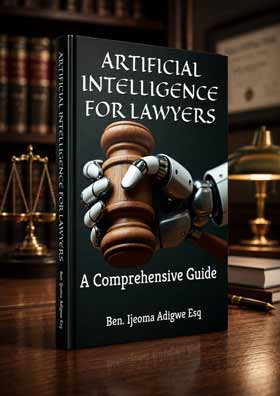 The book also examines Nigeria's legal ecosystem, focusing on the LPELR and NBA AI Guidelines. As a bonus, every purchase comes with a FREE eBook titled: How to Use the AI Features in LegalPedia and LawPavilion.
Ohio Books Ltd praises the publication, stating:
"....this is the only Nigerian book I know of on the topic."
How to Order:
📞 Call, Text, or WhatsApp: 08034917063 | 07055285878
📧 Email: benadigwe1@gmail.com
🌎 Website: www.benadigwe.com
Ebook Version: Access it directly online at https://selar.com/prv626
Authored by Ben Ijeoma Adigwe Esq., ACIarb (UK), LL.M, Dip. in Artificial Intelligence, Director at the Delta State Ministry of Justice, Asaba, Nigeria.
_______________________________________________________________________
“Enhance Legal Practice With Authoritative Reports” — Alexander Payne Offers Comprehensive Law Reports, Spanning Over A Century Of Nigerian Jurisprudence
The book also examines Nigeria's legal ecosystem, focusing on the LPELR and NBA AI Guidelines. As a bonus, every purchase comes with a FREE eBook titled: How to Use the AI Features in LegalPedia and LawPavilion.
Ohio Books Ltd praises the publication, stating:
"....this is the only Nigerian book I know of on the topic."
How to Order:
📞 Call, Text, or WhatsApp: 08034917063 | 07055285878
📧 Email: benadigwe1@gmail.com
🌎 Website: www.benadigwe.com
Ebook Version: Access it directly online at https://selar.com/prv626
Authored by Ben Ijeoma Adigwe Esq., ACIarb (UK), LL.M, Dip. in Artificial Intelligence, Director at the Delta State Ministry of Justice, Asaba, Nigeria.
_______________________________________________________________________
“Enhance Legal Practice With Authoritative Reports” — Alexander Payne Offers Comprehensive Law Reports, Spanning Over A Century Of Nigerian Jurisprudence
 Interested buyers are encouraged to place their orders and enquiries via:
0704 444 4777, 0704 444 4999, 0818 199 9888
Website: www.alexandernigeria.com
Interested buyers are encouraged to place their orders and enquiries via:
0704 444 4777, 0704 444 4999, 0818 199 9888
Website: www.alexandernigeria.com