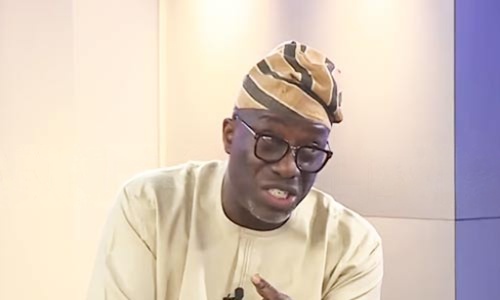
A former spokesperson for the People’s Democratic Party, Segun Sowunmi, has drawn a contrast between the political conduct of the South West and that of the South East, describing his own region as the only part of the country where democracy is remotely working, in an appearance on Channels Television’s Politics Today.

Explaining what he said observers overlook about the South West, Sowunmi said: “The South Western part of our country, Nigeria, is the only location where democracy is actually remotely working. From the days of the Premier, our people have been very Republican, and their Republican nature means that everybody will have some space.”
He asked: “Why do you think we’re the most inclusive, even in terms of people living in the zone, apart from small skirmishes?”
Put to him by the anchor that this suggested the region was more democratic than what was described as the Republican South East, he replied: “Let me explain. The Republican sisters, I hope they will change. They usually just make up their mind they are going in the wrong direction, and when they go in the wrong direction they are not part of the national, and then they start complaining. But that’s their business. I’m not here for them.”
He then turned to his own region. “I don’t see anything that will affect the President in the South West except the management of his own people within his own party.”
Sowunmi also responded to arguments advanced by northern commentators, including a previous guest on the programme, that the President could not carry the region.
“Every time I listen to top-level supposed northern intellectuals, one thing always bothers me,” he said. “In all of the years that this country has stayed, do they even have the courage to look at the developmental and human capital indices in the north and speak to the issues? Why do they hyperventilate only when they’re talking about the federal government?”
He cautioned against generalising the region’s mood. “There is the danger of assuming that because you are angry, you are political, you are interested in one candidate or the other, it totally means that everybody in the north is angry.”
He said his own assessment was based on ground work. “I’ve been in this game of trying to win an election, and if you know how to lose you must know how to look at where the winning numbers are,” he said, adding that in Katsina “everybody that matters is almost there,” including the former Secretary to the Government of the Federation.
He said he had examined Kano closely because of the significance of its vote, listing among those aligned a former governor and senator who once led the teachers’ union, holding what he described as the largest senatorial district in the state with more than three million registrable votes, as well as the state’s political and business figures.
He clarified his position when pressed. “I didn’t say he’s going to win. I said anybody who appropriates the totality of the numbers in the north to himself is deluding himself. Those personalities that I mentioned are Kano people, and elections yield to their own peculiar management situation.”
Notwithstanding his defence of the President’s prospects, Sowunmi offered a candid reading of the South West.
“There are six states in South West Nigeria. I’m taking you to Bola Tinubu’s home region,” he said. “Look at Lagos, the last time he lost an election. Historically speaking, Tinubu’s legs are wobbling in his home state.”
He worked through the region, saying the President stands a slim chance in one state, has little or no chance in another, might be given a good pass in a third, and might get a large number in Osun because of what he called a delicate factor.
He summed it up: “So the question is, where do you get the big numbers from? Tinubu’s chances are slim even in the South West, where he is supposed to have the bigger numbers. Things are not looking very bright.”
Sowunmi said the ruling party’s greatest danger in the region comes from within.
“In the South West as a structure today, the APC is the only one that can do damage to the APC,” he said. “If they ignore all their election giants, and they insist that one individual will not manage the complexity of other people’s hearts, and they insist that they are going to be smart by half and leave out their heavy punchers, sorry.”
He urged the President to conduct an honest assessment. “Imagine for a second if the President were just to do a proper review, not the ones that his friends are telling him, a proper review of the potential day of the vote, and who can contribute to an election minus federal might.”
He warned against sidelining sitting legislators, saying of one four-term member of the House of Representatives: “I pray to God Almighty they don’t. That guy, cross my heart, hope to die, is phenomenal when it comes to giving back to the grassroots. Why would anybody say a four-time rep should not go back, so that he will be a potential leader?”
On the difficulty facing aspirants challenging incumbents for tickets, he said: “How will a governor lose primaries to you? He will have all his local government people there. So that’s almost a fait accompli,” attributing the position to what he called the mistake of 1999 in treating governors as leaders of their parties.
He said he had raised the alarm before. “The challenge for the President, which I have been screaming even before they got to this level, is that you cannot, if you’re interested in your election, have potential friends screaming and scrambling among themselves and you haven’t called all the stakeholders. What are your people telling you? I would have expected you to call all the stakeholders and tell them, gentlemen, this is what is at stake. They are not kids.”
Asked pointedly whether he believed the President could win the election, Sowunmi framed his answer around the acceptance of results.
“Let me tell you what I think. I pity him, because after he wins they’re going to start saying he rigged. And the biggest challenge for the stability of this country going forward is not so much who will win or who will lose, but how they will accept outcomes,” he said.
He continued: “Because if you do an election and people can vote for you, they can vote for your rival. And if they do happen to vote for your rival and he wins, if you insist that all you are going to be doing is screaming up and down and instigating the society, how does the winner become the victim of the votes people gave him?”
Opening the interview, he described the coming election as the most consequential the country has held.
“First of all, we have to thank God Almighty that in our history this is the longest reign of civil rule,” he said. “Ironically, from the buildup going towards 2027, I think this is the most important and consequential election of all the elections we’ve had in the past. The energy level, the rhetoric, what is at stake, the balance of the country is a bit on the high side.”
He said he had sung a Yoruba song naming the President, which he explained as a prayer that God would help him carry the burden of the journey successfully.
Challenged on campaigning while still in the PDP, Sowunmi did not accept the premise of the objection.
“Have I ever told you I’ve left?” he said, adding that he had backed the President in two elections previously.
He rejected the suggestion that he had been induced. “It’s an insult on me to even think I’ve been sorted. If it is sorting, I know where money is and I know how to get it. I’m just too passionate about the direction I see the country go.”
He set out a structural argument for the coalitions now forming.
“Every nation will plan their democracy around their circumstance,” he said. “The circumstance of the Nigerian nation that you see, about rainbow coalition, people being sympathetic to the President and others including Wike and co, is based on only one principle: how do we balance the democracy of Nigeria in an environment where the demography, the way population is growing in each of the zones, is different?”
He continued: “It therefore follows that for us to have a modicum of predictability and stability, we must walk along the principle of the pendulum. The reason is that if we don’t do that, we will then be victims of where the numbers are. Now, if we become the victims of where the numbers are, how long can we go before it becomes extremely offensive?”
He defended the creation of the six geopolitical zones on the same footing. “It was not exactly silly when the zones were created, because it is clear to anybody who loves the country that you must balance the technicality and intricacies of a multicultural, multiethnic country.”
Asked whether he was a supporter of the President’s policies, Sowunmi listed what he considered the administration’s case.
“Any sensible person who loves our country and who has followed it for some time will ask himself: if you had a tax situation that was written in 1923, and the others who have been president before now, are they blind? Why did it have to be this one to rearrange it?”
He continued the pattern through the education loan fund, policing reform and the zonal development commissions. “If you had a situation where you wanted to plan around zonal advantage, and somebody creates a zonal development commission, instead of people screaming on the zonal development commission of their zone that gentlemen, we cannot be lagging behind, why didn’t the others do it?”
He also pointed to subnational finances. “If you had a situation where your monies are now such that your governors are getting more, your local governments are getting more, even the federal government has more, and you are leaders of the place, you are not talking about what’s happening at the base.”
Put to him that more Nigerians are poor, with almost 30 million reported hungry, he questioned the framing of the data.
“One of the things that tells a nation that it has come of age is when it is no longer mesmerised by the data of Bretton Woods, IMF, World Bank and all that. No nation has developed significantly by allowing the IMF to be pulling it back,” he said, citing China and Indonesia. “This country has come of age, and we must be able to say that what is before us now is consensus around development and stability.”
On the poverty figures, he said: “To be able to look at the poverty number in a nation like ours is to diagnose. I blame the statistical bureau and the National Orientation Agency. You have to disaggregate the data. If you disaggregate the data, you will be able to see how the zones are doing, where they are pulling their weight, where they need help, where we need to do more. Those are the thinkings behind the zonal development commission, because what you would consider an economic policy that is good for maybe the South West and Lagos may not be the right policy for others.”
Asked finally whether he was saying the President could win, he declined to call the result.
“Any vote that has not been counted should not be called,” he said. “But if what the deep-dive data we were looking at, what are the others even saying is the alternative policies? Why do they want to take advantage of the ignorance and illiteracy of some of their people?”
He closed with an image. “If you want to do a narrative for a nation, there are two ways. There are those who will come and be surgical like a surgeon and remove the problem, and there are those who will come like a butcher and start smashing everything and make it worse.”
[A MUST HAVE] Evidence Act Demystified With Recent And Contemporary Cases And Materials

Available now for NGN 40,000 at ASC Publications, 10, Boyle Street, Onikan, Lagos. Beside High Court, TBS. Email publications@ayindesanni.com or WhatsApp +2347056667384. Purchase Link: https://paystack.com/buy/evidence-act-complete-annotation
______________________________________________________________________ “Enhance Legal Practice With Authoritative Reports” — Alexander Payne Offers Comprehensive Law Reports, Spanning Over A Century Of Nigerian Jurisprudence Interested buyers are encouraged to place their orders and enquiries via:
0704 444 4777, 0704 444 4999, 0818 199 9888
Website: www.alexandernigeria.com
Interested buyers are encouraged to place their orders and enquiries via:
0704 444 4777, 0704 444 4999, 0818 199 9888
Website: www.alexandernigeria.com