

Senior Advocate of Nigeria, Jibrin Samuel Okutepa, SAN, has stated that a person cannot lawfully be convicted of a completed criminal offence merely because he confessed to committing it where credible evidence establishes that the alleged offence never occurred.

Okutepa explained that although a voluntary and credible confessional statement can sustain a conviction under Nigerian law, such a confession cannot substitute for proof of an offence whose essential elements have been shown not to exist.
The senior lawyer, in a legal commentary shared on his X account, examined the evidential value of confessional statements under the Evidence Act, 2011, and relevant Supreme Court decisions, stressing that criminal responsibility must be established through credible evidence rather than mere admissions of wrongdoing.
Raising the question of whether a confession can establish an offence that never occurred, Okutepa maintained that the fact that an accused person admitted committing a crime does not automatically establish that the alleged crime actually took place.
“A man cannot lawfully be convicted of a completed offence merely because he confessed to committing it, where the evidence establishes that the alleged offence never occurred. A confession is evidence to be evaluated; it cannot create an act that was never done,” he stated.
He emphasised that the central consideration in every criminal trial remains whether the prosecution has proved the offence charged and the defendant’s responsibility for it beyond reasonable doubt.
Examining the statutory framework governing confessional statements, Okutepa referred to Section 28 of the Evidence Act, 2011, which defines a confession as an admission stating or suggesting that the person making it committed a crime.
He also cited Section 29 of the Act, which regulates the admissibility of confessions, including safeguards against oppression and circumstances capable of producing unreliable statements.
According to him, the provisions governing the admissibility of confessions do not mean that every confessional statement admitted in evidence must necessarily be accepted as true.
He explained that the admissibility of a confession and its truthfulness are separate legal considerations which courts must carefully distinguish when determining criminal responsibility.
“A statement may have been made voluntarily and still contain a false account of events,” Okutepa observed.
The senior advocate, however, clarified that Nigerian criminal jurisprudence recognises the evidential value of voluntary confessional statements and permits convictions based solely on such statements in appropriate circumstances.
He explained that a voluntary, direct, positive and unequivocal confession, which a court accepts as true, can sustain a conviction even without independent corroborative evidence.
Consequently, he said the absence of eyewitness testimony or other independent evidence does not automatically invalidate the prosecution’s case where a reliable confession sufficiently establishes the elements of the offence.
Okutepa nevertheless stressed that the legal principle permitting conviction on a confession alone presupposes that the confession is credible and worthy of belief.
He maintained that the principle cannot be extended to justify a conviction based on an account that has been affirmatively demonstrated to be false.
In support of his position, the senior lawyer cited the Supreme Court decision in Fatai Busari v. The State, SC.364/2012, explaining that the apex court reaffirmed both the evidential significance of confessional statements and the continuing responsibility of the prosecution to establish guilt beyond reasonable doubt.
According to him, the obligation to prove the ingredients of an offence remains with the prosecution notwithstanding an admission made by an accused person.
He further referred to the Supreme Court’s decision in Kasa v. The State (1994) 5 NWLR (Pt. 344) 269, where the court explained that not every confessional statement admitted in evidence can properly support a conviction.
Okutepa noted that the decision emphasised the importance of caution when evaluating confessions and the desirability of examining circumstances outside the statement that make its contents probable.
He also relied on the established judicial tests associated with R. v. Sykes (1913) 8 Cr. App. R. 233, which have been applied in Nigerian judicial decisions when assessing the reliability of confessional statements.
According to him, the tests require courts to examine whether the account contained in the confession is possible, whether its factual assertions withstand scrutiny, whether the accused person had the opportunity to commit the alleged offence and whether the confession is consistent with other established facts.
He explained that a confession describing an incident which has been proved never to have occurred cannot satisfy such an assessment.
To illustrate the distinction, Okutepa cited a hypothetical situation involving a person who confesses to murdering another individual who is subsequently established to be alive.
He argued that such a confession cannot lawfully sustain a conviction for the murder of that individual because an essential ingredient of the alleged offence, namely the death of the supposed victim, is absent.
The senior advocate distinguished that situation from cases in which a victim’s body has not been recovered but other credible evidence establishes that the victim died and that the defendant was responsible.
He explained that the absence of independent confirmation of an offence is fundamentally different from affirmative evidence showing that the alleged criminal act never happened.
In the former situation, a credible confession may provide sufficient evidence to sustain a conviction, while in the latter, the confession cannot establish a completed offence whose essential act or consequence has been disproved.
Okutepa further cautioned that an accused person’s subsequent denial of an earlier confession does not automatically establish that the original statement was false.
He explained that where an accused person retracts a confession or subsequently claims that the alleged incident never occurred, the court must evaluate the original confession, the later denial and the entire body of evidence before reaching a conclusion.
According to him, the prosecution may satisfy its evidential burden through a reliable confession, but it cannot discharge that responsibility merely by tendering a document described as a confessional statement.
The senior lawyer maintained that courts must determine whether the confession is admissible, credible and sufficient to establish all the essential ingredients of the offence charged.
He stressed that a conviction cannot properly stand where the evidence affirmatively establishes that the essential act or consequence constituting the alleged completed offence never occurred.
Summarising his position, Okutepa stated that a confession can prove a criminal offence when it is admissible, credible and sufficient to establish its ingredients, but cannot sustain a conviction for a completed offence that has been shown never to have occurred.
“Criminal justice determines guilt from proved facts; it does not punish a person simply for claiming responsibility for an imaginary crime,” the senior advocate declared.
[A MUST HAVE] Evidence Act Demystified With Recent And Contemporary Cases And Materials
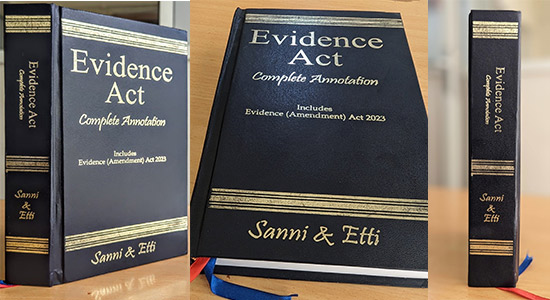
Available now for NGN 40,000 at ASC Publications, 10, Boyle Street, Onikan, Lagos. Beside High Court, TBS. Email publications@ayindesanni.com or WhatsApp +2347056667384. Purchase Link: https://paystack.com/buy/evidence-act-complete-annotation
______________________________________________________________________ “Enhance Legal Practice With Authoritative Reports” — Alexander Payne Offers Comprehensive Law Reports, Spanning Over A Century Of Nigerian Jurisprudence Interested buyers are encouraged to place their orders and enquiries via:
0704 444 4777, 0704 444 4999, 0818 199 9888
Website: www.alexandernigeria.com
“A Comprehensive Guide To Evidence Law” — Releases Second Edition In Three Volumes, Covering 4,051 Cases
For enquiries and orders, contact: 08035526491 Email: jerryamadisilk@gmail.com
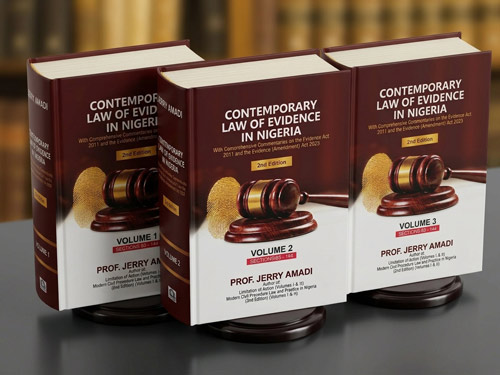 Prof. Jerry Amadi’s Evidence Law, Second Edition (2026), contains 3,314 pages in three volumes, covering the Evidence Act 2011, its 2023 amendment, and 4,051 Nigerian and English cases.