For quite some times, the media houses and the media practitioners have been accused of distrust, dissemination of fake and hate speeches, political partisanship, among other allegations.

Also, some media houses and media practitioners are seen not to be transparent in their Constitutional discharge of responsibilities to the public. This paper is a call for the media houses and the media practitioners to always maintain neutrality in their functions and operations.
First and foremost, on the importance of the media in Nigeria, it is important for me to say that in the area of dissemination of information to the public, the media play great roles especially in the context of Nigeria as a developing country. Many challenges confronting some of the communities in Nigeria would or might not have been to the notice of the citizens if not for the media. Also, it is the constitutional right of the citizens to know and have access to information. Therefore, the media play great roles in their responsibilities to the public.
The online Webster dictionary defines ‘neutrality’ to mean ‘the quality or state of not supporting either side in an argument, fight, war, etc.: the quality or state of being neutral’.
Generally, media is either: print or electronic. The print media refers to any form of writing, words, information, publication or communication usually, but not exclusively made on paper, such as: newspapers, magazines, periodicals, catalogues, brochures, handbills, books, tracts, leaflets, banners, whether or not made with paper, cloth, flex, information or instructions written on the body of any kind of product, such as: plastic plates, gift items, advertisement on the body of motor vehicles, bill boards, and so forth. Electronic media includes every other medium of receiving, publishing, and communicating ideas and information other than paper, that is made by audio-visual publications, transmission or broadcast by means of electronic gadgets and equipment, such as: radio, television, fax, internet on the computer, photocopier, scanner, telephone and so forth. See: Ese Malemi, Mass Media Law, 3rd Edition, Princeton Publishing Co. Ikeja, Lagos, 2009, pg.4. This media in my view, includes communication through social media. In other words, the media is the means through which publication is made. Many online bloggers have emerged in this era to also qualify as media and media personnel/practitioners as the circumstance might dictate.
In Nigeria, the freedom of expression of every citizen is guaranteed under section 39 of the Federal Republic of Nigeria Constitution, 1999-herein after referred to as the Constitution- in Chapter IV. This section provides thus: (1) Every person shall be entitled to freedom of expression, including freedom to hold opinions and to receive and impact ideas and information without interference. (2) Without prejudice to the generality of subsection (1) of this section, every person shall be entitled to own, establish and operate any medium for the dissemination of information, ideas and opinions: provided that no person, other than Government of the Federation or of a State or any other person or body authorized by the President on the fulfillment of conditions laid down by an Act of the National Assembly, shall own, establish or operate a television or wireless broadcasting station for any purpose whatsoever. (3) Nothing in this section shall invalidate any law that is reasonably justifiable in a democratic society- (a) for the purpose of preventing the disclosure of information received in confidence, maintaining the authority and independence of courts or regulating telephony, wireless broadcasting, television or the exhibition of cinematograph; or (b) imposing restrictions upon persons holding office under the Government of the Federation or of the State, members of the armed forces of the Federation or members of the Nigeria Police Force or the Government security services or agencies established by law’. (Underlining is mine for emphasis).
Furthermore, the freedom of the media to disseminate information is guaranteed by the Chapter II of the Constitution in section 22 thus ‘The Press, Radio, Television and other agencies of the mass media shall at all times be free to uphold the fundamental objectives contained in this Chapter and uphold the responsibility and accountability of the Government to the people’. In my humble view, the above sections 39(1) and 22 of the Constitution have guaranteed the independence of the media to uphold the fundamental objectives contained in the said Chapter II of the Constitution and to uphold the responsibility and accountability of the Government to the people without fear or favour. This posits about ‘justice for all’ and what the media are to uphold herein in my humble view are the fundamental and socioeconomic rights of the citizens and holding government to be transparent and accountable to its citizens. The question in my mind is whether the media are actually carrying out these responsibilities?! With due respect, I say ‘NO’ or in the alternative, I say ‘PARTIALLY’! Though, some of the media and the media practitioners are trying to meet up with this target, but not to the expectation yet. The media must therefore take up their responsibilities by ensuring that publication and or dissemination of information and the information disseminated to the public are nothing but the truth. They must stay out of the story. They must say the facts as they are. They must avoid any personal interest or ill feelings towards another or a party or a political party or a situation or a government to cause them to misdirect the public towards losing the trust that the public have in the media. Gone are those days when the public relied so much on the information disseminated to the public by the media either through the print or electronic! Though, I think the period when the electronic media had not gained global recognition enjoyed more of the public’s attention in the dissemination of true information than what the media are at the advent of the electronic media, most especially, the social media era. Nevertheless, the media must wake up and take over their functions and operations in such a way that they are not partisan to anyone or be affected by ill feelings. They must not be selective of any story that they disseminate to the public, else, they only consider those stories that favour them more than those stories that favour the public.
Therefore, the status that the media and the media practitioners must maintain are: disinterest, disinterestedness, equity, evenhandedness, fair-mindedness, fairness, impartiality, justice, neutralism, detachment, nonpartisanship, objectiveness and objectivity. And they must avoid such status as: bias, favour, favouritism, non-objectivity, one-sidedness, partiality, partisanship and prejudice. There are indeed negative implications where the media function and operate in such manner that discourage peoples’ trust, equity, fairness and justice, etc. Some of these implications are in my view, enough to destroy a nation if care is not taken!
Finally, it is my hope that the media and the media practitioners would consider those areas that they have been found to be partial and to correct same and to keep up the good works that they are doing already and improve on more!
Email: hameed_ajibola@yahoo.com

Get your copy today and take the first step toward financial growth:👉 https://selar.co/4f16676016
_______________________________________________________________________ ARTIFICIAL INTELLIGENCE FOR LAWYERS: A COMPREHENSIVE GUIDE
Reimagine your practice with the power of AI “...this is the only Nigerian book I know of on the topic.” — Ohio Books Ltd
Authored by Ben Ijeoma Adigwe, Esq., ACIArb (UK), LL.M, Dip. in Artificial Intelligence, Director, Delta State Ministry of Justice, Asaba, Nigeria.
Bonus:
Get a FREE eBook titled “How to Use the AI in Legalpedia and Law Pavilion” with every purchase.
ARTIFICIAL INTELLIGENCE FOR LAWYERS: A COMPREHENSIVE GUIDE
Reimagine your practice with the power of AI “...this is the only Nigerian book I know of on the topic.” — Ohio Books Ltd
Authored by Ben Ijeoma Adigwe, Esq., ACIArb (UK), LL.M, Dip. in Artificial Intelligence, Director, Delta State Ministry of Justice, Asaba, Nigeria.
Bonus:
Get a FREE eBook titled “How to Use the AI in Legalpedia and Law Pavilion” with every purchase.
How to Order: 📞 Call, Text, or WhatsApp: 08034917063 | 07055285878 📧 Email: benadigwe1@gmail.com 🌐 Website: www.benadigwe.com
Ebook Version: Access directly online at: https://selar.com/prv626
________________________________________________________________________ The Law And Practice Of Redundancy In Nigeria: A Practitioner’s Guide, Authored By A Labour & Employment Law Expert Bimbo Atilola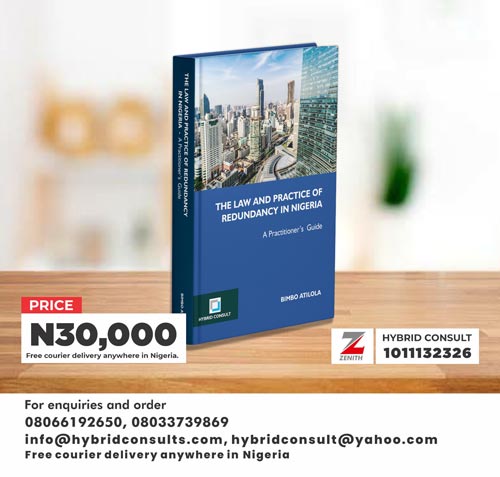 _______________________________________________________________________
[A MUST HAVE] Evidence Act Demystified With Recent And Contemporary Cases And Materials
_______________________________________________________________________
[A MUST HAVE] Evidence Act Demystified With Recent And Contemporary Cases And Materials