By Oliver Azi

Legal principles have always been democratic. In the responsibility of the government, the maxim of Cicero still stands: Salus populi suprema lex esto (Latin): “The welfare of the people shall be the supreme law”. This has been adopted by constitutions across the world. Of course, the Nigerian Constitution is not dissident, deserting or defiant to this holy principle of law. Section 14(2) (b) of the 1999 Constitution of the Federal Republic of Nigeria [As amended)] (which would herein be referred to as “The 1999 Constitution”) provides that; “the security and welfare of the people shall be the primary purpose of government.” For this, the people’s interest comes first.
In democracy it is said that “Government for the people, by the people and for the people” by Abe’ Lincoln. This principle was consistently seen in our electoral jurisprudence. For instance, the law lords at the Supreme Court held in YUSUF v INEC (2021) 3 NWLR (Pt. 1769) 551 that:
An allegation that a person was not duly elected by majority of lawful votes cast at an election is one of the grounds upon which an election can be questioned by virtue of section 138(1)(c) of the Electoral Act, 2010 (as amended).
Similarly, in the jurisprudence of judgment and the “stare decisis” doctrine, it is often said that majority of judgment makes the substantive judgment; minority at best can make a dissenting judgment. It was the Court of Appeal that held in P.I.P Ltd v Trade Bank (Nig) PLC (2009) 13 NWLR (Pt. 1159) 577 that:
Where the judgment of the court is split into plurality or majority and minority positions, what constitutes the judgment of the court is the majority judgment. A lower court is bound by the views of the majority.
In essence, a simple majority wins the votes; the greater number for the greater good. All of this connotes that where the majority interest is at stake, majority focus is given legal consideration, prominence or favour.
The realm of corporate law is not left idle; instead the philosophy of the majority permeates its space. For instance, and of particular importance, is the provision of s. 341 of the Company and Allied Matters Act 2020 [Herein referred to as “CAMA 2020”] where the section spill out that:
Subject to the provision of this Act, where an irregularity is made in the course of a company’s affairs or any wrong is done to the company, only the company can sue to remedy that wrong and only the company can ratify their irregular conduct.
This is the Harbottle rule as propounded in the common law case of FOSS v HARBOTTLE (1843) 2 Hare 461. Besides that, the first point of notice is the strong words used by CAMA 2020: “ONLY”. That is, a Sunday school explanation of the word “ONLY” is: on one or nothing more. Hence, that section implies that “no one else” but the company can rectify any internal wrong in a company and “no one else” but the company can shield against any external wrong done to it.
This principle of law was further given judicial blessings in the case of LADEJOBI v ODUTOLA HOLDINGS LTD (2002) 3 NWLR (753) 121 where the court held that:
The rule in Foss v. Harbottle (1843) 2 Hare 461 is essentially a statement of majority rule and as such where an action is brought by a minority shareholder to remedy a wrong done to the company the court may send the issue back to the company for a majority at a general meeting to decide whether or not to adopt the action.
The question that lies here is: who is the company? Or who constitutes the majority? This question was given judicial rest in MOKWE v EZEUKO (2000) 14 NWLR (Pt. 868) 143 where the penultimate court held that:
A company is an abstraction. It therefore acts through living persons. But it is not the act of every servant of the company that binds the company. Those whose acts bind the company are the alter-ego – those persons who because of the positions are the directing mind and will of the company, the very ego and corporate personality of the company.
By the import of this provision, the members (who are largely shareholders and can partake in the annual general meetings of the company as seen in U.O.O v OKAFOR (2020) 11 NWLR (Pt. 1736) 409) of the company constitute the company. The law might appear unfair if it regards only the interest of the majority as against the minority and so, the exception to the rule. This is called minority protection and it is clearly spelt out under CAMA 2020.
EXCEPTION TO THE RULE IN 341 CAMA 2020
The beauty of law lies in its exception. So no section is sacrosanct, superior or an absolute monarch. In GOMBE v P.W (Nig) Ltd (1995) 6 NWLR (Pt. 402) 402 it was held that:
On Application of rule in Foss v. Harbottle (1943) 2 Hare 461 -The rule in Foss v. Harbottle (1843) 2 Hare 461 precludes a minority shareholder in a company from suing where there is an irregularity in the internal management of the company that is capable of being confirmed by a simple majority of the shareholders. However, there are exceptions to this rule. One of which enables a minority shareholder to sue where there is a fraud on the part of the majority shareholders
The law creates possibility, instances or grounds where minority shareholders can sue the company or sue on behalf of the company; or importantly, where minority shareholders can stop the company from acting in such prohibited grounds. This provision gives the court the power to grant an injunction or declaration prohibiting such act as listed out in s. 343 CAMA 2020 and they are:
Without prejudice to the rights of members under section 346-351 and section 353-355 of this act or any other provisions of this act, the court, on the application of any member, may by injunction or declaration restrain the company or its officers from—
This section permits a minority or any individual who has right within the company to sue the company or sue on behalf of the company on the following grounds:
- Where the company enter into any transactions which is illegal
- Where the company perform by way of ordinary resolution an act which should be done by a special resolution
- Any act or omission which affects an individual right as a member of the company
- Where the company commits fraud on either the company or the minority shareholders and where the director does not take due action to address such act
- Where the company meeting cannot be called in time to be practical use in redressing a wrong done to the company or to minority shareholders
- Where the directors are likely to derive profit or benefit, or have profited or benefited from their negligence or from their breach of duty
- Any other act or omission where the interest of justice demands
By all of this ground can a minority shareholder or individual member of the company can sue the company or sue on behalf of the company. Similarly, s. 353 and 354 CAMA 2020 provides other grounds where a minority shareholder can bring an action in court against the company or its proxies.
On bringing action to court, this can be done either personally or via a representative action as shown in s. 344 CAMA 2020 and such person is entitled to damages [s. 344(a)] or declaration or injunction [s. 344(b)]. Also, derivative action which is simply to tag along or bring on a suit is permitted by the provision of s. 346 (1) CAMA 2020 and justified by the test set forth in s. 346 (2) CAMA 2020.
As a means of throw back, legal jurisprudence has not only glorified the majority but seeks also to justify the minority. The exceptions to the law are soft ways of admitting the possible mistakes of rigid legal principles.
Oliver Azi Law Graduate | Legal Writer, Researcher & Tutor Lead, Varex
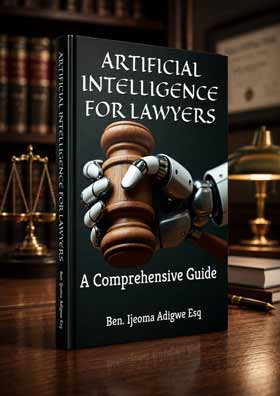 The book also examines Nigeria's legal ecosystem, focusing on the LPELR and NBA AI Guidelines. As a bonus, every purchase comes with a FREE eBook titled: How to Use the AI Features in LegalPedia and LawPavilion.
Ohio Books Ltd praises the publication, stating:
"....this is the only Nigerian book I know of on the topic."
How to Order:
📞 Call, Text, or WhatsApp: 08034917063 | 07055285878
📧 Email: benadigwe1@gmail.com
🌎 Website: www.benadigwe.com
Ebook Version: Access it directly online at https://selar.com/prv626
Authored by Ben Ijeoma Adigwe Esq., ACIarb (UK), LL.M, Dip. in Artificial Intelligence, Director at the Delta State Ministry of Justice, Asaba, Nigeria.
_______________________________________________________________________
“Enhance Legal Practice With Authoritative Reports” — Alexander Payne Offers Comprehensive Law Reports, Spanning Over A Century Of Nigerian Jurisprudence
The book also examines Nigeria's legal ecosystem, focusing on the LPELR and NBA AI Guidelines. As a bonus, every purchase comes with a FREE eBook titled: How to Use the AI Features in LegalPedia and LawPavilion.
Ohio Books Ltd praises the publication, stating:
"....this is the only Nigerian book I know of on the topic."
How to Order:
📞 Call, Text, or WhatsApp: 08034917063 | 07055285878
📧 Email: benadigwe1@gmail.com
🌎 Website: www.benadigwe.com
Ebook Version: Access it directly online at https://selar.com/prv626
Authored by Ben Ijeoma Adigwe Esq., ACIarb (UK), LL.M, Dip. in Artificial Intelligence, Director at the Delta State Ministry of Justice, Asaba, Nigeria.
_______________________________________________________________________
“Enhance Legal Practice With Authoritative Reports” — Alexander Payne Offers Comprehensive Law Reports, Spanning Over A Century Of Nigerian Jurisprudence
 Interested buyers are encouraged to place their orders and enquiries via:
0704 444 4777, 0704 444 4999, 0818 199 9888
Website: www.alexandernigeria.com
Interested buyers are encouraged to place their orders and enquiries via:
0704 444 4777, 0704 444 4999, 0818 199 9888
Website: www.alexandernigeria.com