The Taliban pledged to build an inclusive government, protect the rights of women “within the bounds of Shariah law,” and prevent Afghan territory from being used to target any other country, seeking to allay concerns the group intends to reimpose Islamic fundamentalism on Afghanistan.

The rhetoric from the militant group on Tuesday fits a pattern of reassuring comments since the Taliban seized the capital of Kabul on Sunday. But history argues against it: Their prior stint in power, until they were ousted by the U.S. military in 2001, was marked by an extremely conservative interpretation of Shariah laws that saw women face stoning or execution for non-compliance.
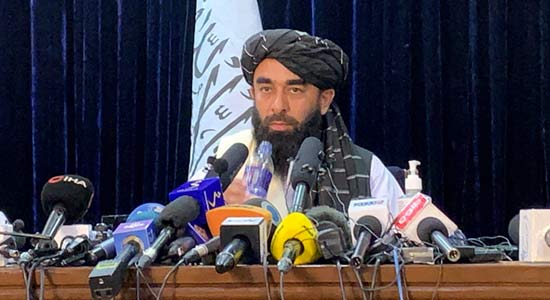
“We assure the international community and especially the U.S. and neighboring countries that Afghanistan won’t be used against them,” Taliban spokesman Zabihullah Mujahed said in Kabul, his first fully public appearance after 20 years spreading the Sunni fundamentalist movement’s message from secret locations as it fought NATO and Afghan forces.
The sudden pragmatism likely reflects the realization within Taliban ranks that officials need to present a more moderate image if they hope to gain tacit recognition from the U.S. and its allies as the new rulers of Afghanistan. Alongside rolling back the advances in freedoms enjoyed by some women, a key concern is the Taliban will let terrorist groups like al-Qaeda rebuild a base in the country.
Already there are doubts the Taliban charm offensive will be sustained, especially in rural parts of the country. Militants in northern areas have in recent weeks told some female employees of Afghanistan International Bank, the country’s largest by assets, to leave and go home, a bank official said.
Reports have also emerged of forced marriages and orders for men to grow beards. Thousands of residents have fled to neighboring countries in an attempt to escape life under the insurgents.
“After consultations we will witness the formation of a strong inclusive Islamic government,” Mujahed said, dodging questions of who would lead the country. He added that a Taliban-run Islamic Emirate of Afghanistan wouldn’t seek retribution against those who worked with the U.S. and the ousted administration or fought the movement.
“All of them have been pardoned,” he said during a more than hour-long press conference, dressed in the Taliban’s usual black turban. Mujahed said the group’s fighters would collect weapons in a country awash with guns, and crack down on opium production.
He sat in front of a cluster of microphones, and a hand sanitizer bottle, with the white Taliban flag and blue velvet curtains behind him. A translator sat to his left, often leaning in to translate questions from the foreign press or to relay his answers. It was the first time that people had seen Mujahed with his face uncovered.
Earlier Tuesday, Taliban representatives, Afghan officials and leaders in Qatar — where the two sides held now-stalled peace talks — were thought to have begun discussions in an effort to formalize the transition of power.
Baradar Arrival
Details of the meetings were sketchy and later a senior Taliban delegation led by deputy chief Mullah Abdul Ghani Baradar, tipped by some observers to be Afghanistan’s next leader, flew from the Qatari capital of Doha to Kandahar, the southern Afghan city that was the austere movement’s stronghold when it previously ruled over the country.
Kabul was reported to be largely calm. U.S. forces restored security at the capital’s Hamid Karzai International Airport, where some military evacuation flights resumed as nations withdraw their personnel.
Al Jazeera said the airport would reopen to civilians on Saturday, citing an unidentified security official. German defense officials said for now the militant group had sealed off the facility and was only letting through members of the international community.
[A MUST HAVE] Evidence Act Demystified With Recent And Contemporary Cases And Materials

Available now for NGN 40,000 at ASC Publications, 10, Boyle Street, Onikan, Lagos. Beside High Court, TBS. Email publications@ayindesanni.com or WhatsApp +2347056667384. Purchase Link: https://paystack.com/buy/evidence-act-complete-annotation
______________________________________________________________________ “Enhance Legal Practice With Authoritative Reports” — Alexander Payne Offers Comprehensive Law Reports, Spanning Over A Century Of Nigerian Jurisprudence Interested buyers are encouraged to place their orders and enquiries via:
0704 444 4777, 0704 444 4999, 0818 199 9888
Website: www.alexandernigeria.com
Interested buyers are encouraged to place their orders and enquiries via:
0704 444 4777, 0704 444 4999, 0818 199 9888
Website: www.alexandernigeria.com