A fresh batch of financial records for justices of the U.S. Supreme Court was published by the federal judiciary on Wednesday, which shed some light on their income and affiliations outside the court but did not include key details that critics said will contribute to an elevated atmosphere of mistrust.

These highly anticipated disclosures, which cover all of 2022, arrive in the wake of revelations about Justice Clarence Thomas’ financial ties to Texas billionaire and GOP megadonor Harlan Crow, which critics have called an overt breach of rules and norms – and have prompted renewed calls for more robust transparency and enforcement.
But on Wednesday afternoon, when the records were published online, Thomas’ were not among them, suggesting that the conservative firebrand requested an extension. Justice Samuel Alito’s documents were also unavailable online. A court spokesperson was not immediately available for comment.
Even so, experts said that financial disclosures for the other seven justices would draw more attention than normal under the weight of plummeting public trust and questions about their ethical requirements.
“These will definitely be the most scrutinized Supreme Court disclosures since the disclosure law went into effect 40 years ago,” Gabe Roth, executive director of Fix the Court, a leading Supreme Court watchdog, told ABC News. “That said, I think what people will take away from them is how many unanswered questions remain about the justices’ lives outside of the courtroom and their potential entanglements.”
The records released Wednesday offer a glimpse into the personal finances of the justices, including income they received last year from book sales, teaching gigs and investments. And this year in these disclosures, for the first time, justices will also have to share information about the sources of free trips, meals and hospitality, under new guidelines minted by the Judicial Conference, the body that sets and enforces policies for U.S. courts.
Sen. Sheldon Whitehouse, D-R.I., in March called the new rules “big step toward closing the loopholes that kept the public in the dark about who was paying for justices’ lavish lifestyles.”
Chief Justice John Roberts defended the integrity of the court in May amid slumping public approval and growing political pressure to tweak the guidelines.
“I want to assure people that I am committed to making certain that we as a Court adhere to the highest standards of conduct,” Roberts said at the time.
But to critics, the new supplemental reporting requirements remain insufficient. Justices, for example, will not be required to put a dollar amount of reimbursements for travel expenses or meals, unlike members of Congress and other government officials.
“The public should know that sort of thing,” Roth said. “There’s a big difference between the Hardee’s star and a Michelin star, and between the Ritz and the Radisson.”
In April, ABC News reported on how some law schools have sought to leverage their financial resources for opportunities to access Supreme Court justices, often footing the bill for justices and their families to travel around the world for speaking engagements without the justices having to include most details of those trips on disclosure reports.
Advocacy groups and lawmakers have pushed to change that. A bill proposed by Whitehouse would require the court to adopt a “code of conduct” akin to what is imposed on members of Congress, who must report specific dollar amounts of gifts within a month of receiving them.
Sens. Angus King, I-Maine, and Lisa Murkowski, R-Alaska, introduced a separate bill this week that would require the court to appoint an official to handle any violations of a code of conduct.
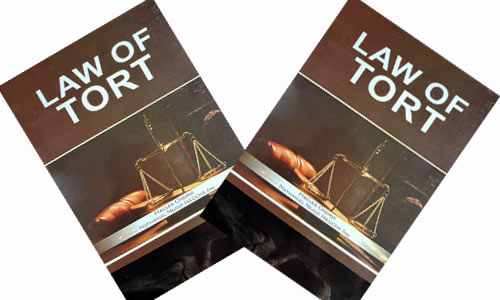 The book, titled The Law of Torts in Nigeria: A Functional Approach, authored by Professor Hagler Sunny Okorie Ph.D and Ikeocha, Nathaniel Ngozi Esq, offers law students, practitioners, and academics a comprehensive guide to understanding and applying tort law in Nigerian courts. Interested buyers can place orders via the following contact numbers: 08028636615, 08037667945, 08032253813, or +234 902 196 2209.
______________________________________________________________________
[A MUST HAVE] Evidence Act Demystified With Recent And Contemporary Cases And Materials
The book, titled The Law of Torts in Nigeria: A Functional Approach, authored by Professor Hagler Sunny Okorie Ph.D and Ikeocha, Nathaniel Ngozi Esq, offers law students, practitioners, and academics a comprehensive guide to understanding and applying tort law in Nigerian courts. Interested buyers can place orders via the following contact numbers: 08028636615, 08037667945, 08032253813, or +234 902 196 2209.
______________________________________________________________________
[A MUST HAVE] Evidence Act Demystified With Recent And Contemporary Cases And Materials

 ARTIFICIAL INTELLIGENCE FOR LAWYERS: A COMPREHENSIVE GUIDE
Reimagine your practice with the power of AI “...this is the only Nigerian book I know of on the topic.” — Ohio Books Ltd
Authored by Ben Ijeoma Adigwe, Esq., ACIArb (UK), LL.M, Dip. in Artificial Intelligence, Director, Delta State Ministry of Justice, Asaba, Nigeria.
Bonus:
Get a FREE eBook titled “How to Use the AI in Legalpedia and Law Pavilion” with every purchase.
ARTIFICIAL INTELLIGENCE FOR LAWYERS: A COMPREHENSIVE GUIDE
Reimagine your practice with the power of AI “...this is the only Nigerian book I know of on the topic.” — Ohio Books Ltd
Authored by Ben Ijeoma Adigwe, Esq., ACIArb (UK), LL.M, Dip. in Artificial Intelligence, Director, Delta State Ministry of Justice, Asaba, Nigeria.
Bonus:
Get a FREE eBook titled “How to Use the AI in Legalpedia and Law Pavilion” with every purchase.
How to Order: 📞 Call, Text, or WhatsApp: 08034917063 | 07055285878 📧 Email: benadigwe1@gmail.com 🌐 Website: www.benadigwe.com
Ebook Version: Access directly online at: https://selar.com/prv626
________________________________________________________________________ The Law And Practice Of Redundancy In Nigeria: A Practitioner’s Guide, Authored By A Labour & Employment Law Expert Bimbo Atilola _______________________________________________________________________
“Enhance Legal Practice With Authoritative Reports” — Alexander Payne Offers Comprehensive Law Reports, Spanning Over A Century Of Nigerian Jurisprudence
_______________________________________________________________________
“Enhance Legal Practice With Authoritative Reports” — Alexander Payne Offers Comprehensive Law Reports, Spanning Over A Century Of Nigerian Jurisprudence
 Interested buyers are encouraged to place their orders and enquiries via:
0704 444 4777, 0704 444 4999, 0818 199 9888
Website: www.alexandernigeria.com
Interested buyers are encouraged to place their orders and enquiries via:
0704 444 4777, 0704 444 4999, 0818 199 9888
Website: www.alexandernigeria.com