
A group operating under the name Concerned Nigerian Citizens has petitioned the National Judicial Council (NJC), demanding an independent investigation into allegations of political interference and possible compromise surrounding the Supreme Court judgment that affirmed the election of Kano State Governor, Abba Kabir Yusuf, in January 2024.

The group specifically asked the Council to invite Governor Yusuf to confirm or deny, on oath, claims attributed to him in a recent BBC Hausa interview concerning an alleged political arrangement under which he would defect to the All Progressives Congress (APC) if President Bola Tinubu ensured that the Supreme Court delivered judgment in his favour.
The petition, dated November 24, 2026, and signed by K. Suleiman of Malali, Kaduna State, was addressed to the Chairman of the National Judicial Council through the Chief Justice of Nigeria.
The petitioners said their complaint was brought pursuant to the disciplinary powers of the NJC under Paragraph 21, Part I, Third Schedule to the 1999 Constitution of the Federal Republic of Nigeria, as amended, and the Revised Code of Conduct for Judicial Officers.
According to the group, the petition was motivated by the need to protect the integrity, independence and credibility of the judiciary following reports concerning statements allegedly made by Governor Yusuf about the circumstances surrounding the determination of the 2023 Kano State governorship election dispute.
The petitioners recalled that the governorship election was contested between Yusuf, who was the candidate of the New Nigeria Peoples Party (NNPP), and Nasiru Yusuf Gawuna of the APC.
They noted that the Governorship Election Petition Tribunal and the Court of Appeal had nullified Yusuf’s election before the Supreme Court overturned the decisions of the lower courts in January 2024 and restored him as the duly elected governor of Kano State.
The group explained that concerns arose following reports of a recent interview purportedly granted by the governor to BBC Hausa.
According to the petitioners, Yusuf allegedly disclosed during the interview that his political mentor instructed him to negotiate with the President of the Federal Republic of Nigeria concerning the pending Supreme Court judgment.
They further alleged that the governor claimed to have sworn with the Holy Qur’an that, if the President ensured the delivery of a favourable Supreme Court judgment, he and his political associates would defect to the APC.
The petitioners claimed that the subsequent delivery of judgment in Yusuf’s favour and his reported defection to the APC had raised questions requiring an independent institutional examination.
However, the group did not establish that any such political agreement influenced the Supreme Court’s decision, and the alleged statements attributed to Yusuf remain subject to authentication.
The petitioners maintained that the allegations, if verified, could raise serious questions concerning judicial independence, compliance with the judicial oath and public confidence in the administration of justice.
They identified the possible issues as breaches of the judicial oath, interference with judicial independence, breaches of the Code of Conduct for Judicial Officers and erosion of public confidence in the judiciary.
The group was careful to state that it was not asserting that any Justice of the Supreme Court had been compromised or had engaged in misconduct.
Rather, it argued that the seriousness of the allegations made it necessary for the NJC to investigate and establish the facts.
According to the petitioners, failure to examine allegations of such gravity could further weaken public confidence in the judiciary, irrespective of whether the claims were eventually substantiated.
They emphasised that the petition was not intended to reopen the Kano governorship election dispute or challenge the finality of the Supreme Court’s decision.
The group specifically acknowledged Section 235 of the 1999 Constitution, which provides for the finality of decisions of the Supreme Court.
It explained that its objective was not to re-litigate, review for the purpose of reversal, or set aside the judgment delivered in favour of Yusuf.
Instead, the petitioners requested an institutional investigation into the allegations to determine whether any judicial misconduct occurred and whether the integrity of the judicial process had been compromised.
The group consequently urged the NJC to exercise its constitutional investigative and disciplinary powers by constituting an independent panel to examine the circumstances surrounding the allegations.
As part of the proposed investigation, the petitioners requested that the Council obtain the complete, unedited recording of the BBC Hausa interview in which the statements were allegedly made.
They also asked the Council to obtain and authenticate a certified transcript of the interview to establish precisely what Yusuf said and the context in which the statements were made.
According to the petition, the authentication of the interview was necessary to prevent the investigation from being based on incomplete, inaccurate or misleading accounts of the governor’s remarks.
The group further requested that Yusuf be formally invited to appear before the investigative panel and state, on oath, whether he made the statements attributed to him.
The petitioners asked that the governor be given an opportunity to confirm or deny the allegations and explain the complete circumstances surrounding any remarks he may have made concerning the Supreme Court judgment and the alleged political arrangement.
They also called for any other person mentioned or implicated in the alleged discussions to be invited to respond to the claims.
The petitioners maintained that hearing from all relevant persons would help ensure that the investigation was comprehensive and fair.
The group additionally urged the NJC to examine the judgment and proceedings in Appeal No. SC/CV/1179/2023.
It explained that the examination should be undertaken strictly for the purpose of determining whether the proceedings and decision complied with applicable law and due process, and for institutional learning rather than altering the final judgment.
According to the group, such an examination could assist the Council in assessing the allegations and identifying any issues affecting judicial standards or institutional accountability.
The petitioners further requested that if the investigation established that any judicial officer breached the judicial oath or the applicable Code of Conduct, appropriate disciplinary sanctions should be recommended in accordance with the law.
They maintained that judicial officers found to have engaged in misconduct should be subjected to the relevant disciplinary procedures.
However, the group also made provision for the possibility that the allegations could be found to be unsubstantiated.
It urged the NJC to issue a clear and reasoned public statement exonerating the Justices concerned if an investigation established that no judicial misconduct occurred.
According to the petitioners, such a statement would help restore public confidence in the Supreme Court and reaffirm the independence of the judiciary.
The group emphasised that its request was aimed at protecting the judicial institution rather than prejudging the conduct of individual judges.
It maintained that public confidence in the administration of justice required serious allegations affecting the highest court in the country to be addressed through appropriate institutional processes.
The petitioners reiterated that an investigation could either establish misconduct warranting disciplinary action or clear the judicial officers concerned of any wrongdoing.
They argued that both outcomes would serve the larger objective of strengthening confidence in the judicial system.
The group also stressed that the finality of Supreme Court judgments did not, in its view, remove the need for the NJC to consider allegations of possible judicial misconduct within its constitutional disciplinary mandate.
According to the petitioners, the distinction between challenging the validity of a final judgment and investigating allegations against judicial officers was central to their request.
The petition was copied to the Chief Justice of Nigeria, the President of the Nigerian Bar Association (NBA), the Attorney-General of the Federation and the National Assembly Committee on Judiciary.
The petitioners called on the NJC to treat the matter with the seriousness required by the allegations and take appropriate steps to establish the facts.
They maintained that the integrity of the judiciary and public confidence in its independence should remain paramount.
As of the time of the petition, no finding of judicial compromise had been established in the material presented, and the claims attributed to Governor Yusuf in the purported BBC Hausa interview had not been independently authenticated.
The petition therefore remains a request for investigation into allegations surrounding the Supreme Court’s January 2024 judgment, rather than proof that the judgment was improperly influenced or that any judicial officer engaged in misconduct.
[A MUST HAVE] Evidence Act Demystified With Recent And Contemporary Cases And Materials
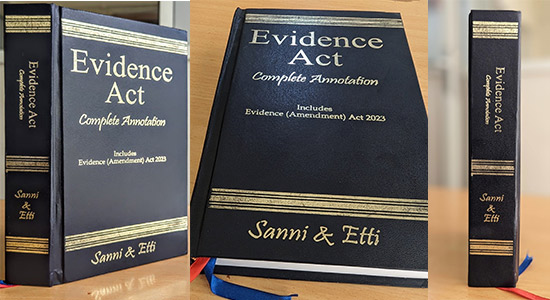
Available now for NGN 40,000 at ASC Publications, 10, Boyle Street, Onikan, Lagos. Beside High Court, TBS. Email publications@ayindesanni.com or WhatsApp +2347056667384. Purchase Link: https://paystack.com/buy/evidence-act-complete-annotation
______________________________________________________________________ “Enhance Legal Practice With Authoritative Reports” — Alexander Payne Offers Comprehensive Law Reports, Spanning Over A Century Of Nigerian Jurisprudence Interested buyers are encouraged to place their orders and enquiries via:
0704 444 4777, 0704 444 4999, 0818 199 9888
Website: www.alexandernigeria.com
“A Comprehensive Guide To Evidence Law” — Releases Second Edition In Three Volumes, Covering 4,051 Cases
For enquiries and orders, contact: 08035526491 Email: jerryamadisilk@gmail.com
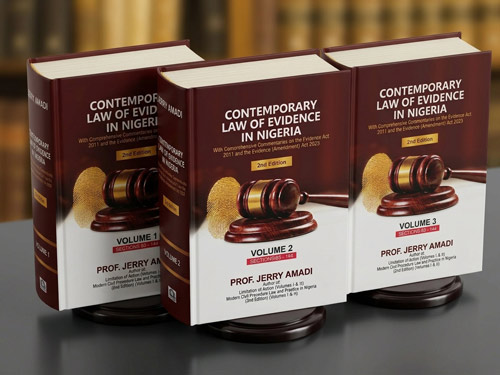 Prof. Jerry Amadi’s Evidence Law, Second Edition (2026), contains 3,314 pages in three volumes, covering the Evidence Act 2011, its 2023 amendment, and 4,051 Nigerian and English cases.