

The Federal High Court sitting in Abuja has dismissed the ₦10 billion fundamental rights enforcement suit filed by Nollywood actor Emeka Ike against Lere Olayinka, spokesperson to the Minister of the Federal Capital Territory, Nyesom Wike, and the Independent National Electoral Commission (INEC), ruling that the action was incompetent, improperly constituted and unsupported by sufficient evidence.

Delivering judgment on Wednesday, Justice Salim Ibrahim upheld the preliminary objections raised by the respondents, who challenged the competence and proper constitution of the suit.
The judge also dismissed the substantive claims for lack of proof, thereby rejecting Ike’s allegations that the publication of his voter registration information on social media amounted to a violation of his constitutional right to privacy and protection of personal data.
The court’s decision brought to an end the fundamental rights proceedings instituted by the actor in suit number FHC/ABJ/CS/1272/2026, in which he demanded ₦10 billion in aggravated and general damages against Olayinka and INEC, jointly and severally.
The dispute arose from a publication made by Olayinka on his X account in May 2026, following Ike’s unsuccessful attempt to secure the Nigerian Democratic Congress (NDC) ticket for the AMAC/Bwari Federal Constituency seat in the House of Representatives ahead of the 2027 general elections.
Ike alleged that Olayinka published screenshots containing his personal voter registration information, including details relating to the transfer of his registration from Imo State to the Federal Capital Territory.
He maintained that the publication was made without his consent and exposed personal information that ought to have been protected from unauthorised disclosure.
Through his counsel, L. T. Adeh, the actor approached the Federal High Court seeking declarations that the publication violated his fundamental right to privacy and the protection of personal data.
He relied on Section 37 of the Constitution of the Federal Republic of Nigeria, 1999, as amended, which guarantees the privacy of citizens, their homes, correspondence, telephone conversations and telegraphic communications.
Ike also invoked Article 12 of the Universal Declaration of Human Rights and Sections 24 and 39 of the Nigeria Data Protection Act, 2023, in support of his claim that his personal information had been unlawfully disclosed.
He specifically asked the court to declare that Olayinka’s decision to publish his voter registration information on X without his approval “amounts to gross breach and violation of the applicant’s fundamental right to privacy and the protection of personal data.”
The actor further sought a declaration that INEC owed him and other registered voters a statutory duty of care to protect personal information supplied during voter registration against unauthorised access and disclosure.
He argued that the electoral commission was responsible for maintaining the confidentiality and security of voters’ personal information within its custody.
Ike also asked the court to interpret INEC’s press statement of June 2, 2026, issued following the circulation of his voter registration information, as a tacit admission of responsibility for the alleged disclosure.
According to him, the commission’s response to the controversy demonstrated its awareness of the publication and supported his allegation that his personal information had been improperly exposed.
In addition to the ₦10 billion damages, the actor sought an order compelling Olayinka to immediately retract and remove the disputed publication from his X account, @OlayinkaLere.
He also requested an order directing the FCT minister’s aide to tender an unreserved written apology for the alleged violation of his fundamental rights.
However, INEC and Olayinka opposed the application through separate counter-affidavits, maintaining that the suit lacked merit and should be dismissed.
In its response, INEC argued that the voter registration information complained about by Ike was neither classified, sensitive nor confidential within the context of the commission’s statutory responsibility to maintain and publish the register of voters.
The commission maintained that the Constitution and Electoral Act, 2026, empowered it to compile, maintain, display, publish, certify and manage voter registration information in accordance with the law.
INEC further argued that the performance of those statutory duties did not require the individual consent of every registered voter whose information appeared in the voters’ register.
In its counter-affidavit deposed to by Anthonia Makwe, an Assistant Director and Data Protection Officer in its Legal Drafting and Clearance Department, the commission maintained that it possessed the “statutory and constitutional power to make available information of its voters to the general public without the consent of any registered voter.”
It explained that the publication and display of voter information formed part of the statutory electoral process intended to ensure transparency and facilitate public scrutiny of the register.
The commission also denied that the information allegedly published by Olayinka originated from its restricted database.
INEC maintained that it had not breached its statutory obligations concerning the custody, security and protection of voters’ personal information.
“The 2nd respondent, as a data controller, has never breached its statutory duty of care, custody and protection of personal voter information and data, it owes the applicant and other voters under its secured portal and restricted database,” the commission stated.
INEC further relied on its June 2 statement denying any compromise of its continuous voter registration database or information technology infrastructure.
The statement, as quoted in the proceedings, maintained that “there was no external breach of its CVR database, no hacking incident and no unauthorised external access to the commission’s ICT infrastructure.”
On his part, Olayinka denied unlawfully accessing or disclosing confidential information belonging to the actor.
In his counter-affidavit, which he personally deposed to, the FCT minister’s spokesperson maintained that the material he published contained only Ike’s name and passport photograph.
He argued that the information was already publicly accessible and had not been obtained through unlawful means.
Olayinka contended that Ike, as a Nollywood actor and an aspiring political officeholder, had already placed his identity and photograph in the public domain.
According to him, the publication of information that was already publicly available could not, without more, establish a violation of the actor’s right to privacy.
He also argued that he owed Ike no independent duty of confidentiality requiring his consent before publishing the information.
The respondent relied on Section 19(1) of the Electoral Act, 2026, contending that the law required INEC to publish voter registration information within the prescribed period before general elections.
He maintained that the statutory publication of voter information was intended to promote transparency and enable members of the public to scrutinise electoral records.
Olayinka further explained that the publication was intended to draw attention to Ike’s recent transfer of voter registration from Imo State to the Federal Capital Territory.
He alleged that the actor had previously led a group of persons to disrupt activities at an INEC office after declaring his intention to contest the election.
That allegation formed part of Olayinka’s defence and was not identified in the account of the judgment as a finding made by the court.
The FCT minister’s aide also argued that he was not a data controller under the Nigeria Data Protection Act, 2023, and therefore did not owe the actor the statutory obligations alleged in the suit.
He maintained that the actor had failed to establish any injury directly attributable to the publication.
Olayinka described the ₦10 billion damages claim as excessive and brought in bad faith.
He argued that the demand was “an indication that the applicant is a gold digger, who wants to reap where he did not sow.”
He consequently urged the court to dismiss the action.
In determining the matter, Justice Ibrahim upheld the respondents’ preliminary objections concerning the competence and proper constitution of the fundamental rights proceedings.
The judge also found that the substantive allegations had not been proved, leaving the court without a sufficient evidential basis to grant the declarations and remedies sought by the applicant.
The judgment therefore rejected Ike’s demand for ₦10 billion in damages, alongside his requests for the removal of the social media publication and a written apology.
The decision also meant that the actor failed to obtain a judicial declaration that INEC had breached its statutory obligations or that its June 2 press statement constituted an admission of liability.
The dispute raised questions about the relationship between the constitutional right to privacy, the protection of personal data and the statutory obligation of INEC to publish certain voter registration information.
Section 37 of the Constitution guarantees privacy rights, while the Nigeria Data Protection Act, 2023, regulates the processing and protection of personal data.
At the same time, electoral legislation imposes obligations on INEC concerning the compilation, display and publication of the register of voters.
The respondents relied on those electoral obligations to argue that information lawfully made available to the public could not automatically be treated as confidential merely because it related to an identifiable individual.
However, the judgment, as disclosed, was based on the competence of the proceedings and the failure to prove the alleged infringement.
It did not establish a general rule that all voter registration information is exempt from privacy or data protection safeguards.
[A MUST HAVE] Evidence Act Demystified With Recent And Contemporary Cases And Materials
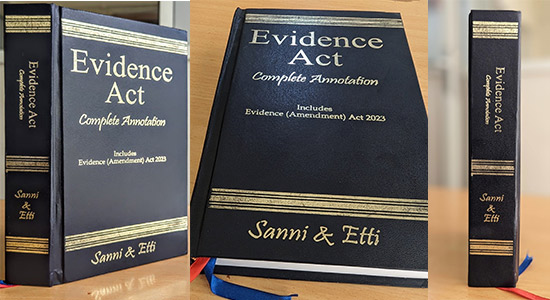
Available now for NGN 40,000 at ASC Publications, 10, Boyle Street, Onikan, Lagos. Beside High Court, TBS. Email publications@ayindesanni.com or WhatsApp +2347056667384. Purchase Link: https://paystack.com/buy/evidence-act-complete-annotation
______________________________________________________________________ “Enhance Legal Practice With Authoritative Reports” — Alexander Payne Offers Comprehensive Law Reports, Spanning Over A Century Of Nigerian Jurisprudence Interested buyers are encouraged to place their orders and enquiries via:
0704 444 4777, 0704 444 4999, 0818 199 9888
Website: www.alexandernigeria.com