An advocacy group, Prisoners’ Rehabilitation and Welfare Action, has called on the governments of Lagos, Abia, Enugu and Kano states as well as the Federal Capital Territory, Abuja, to review their practice of jailing petty offenders, including street hawkers.

PRAWA said following a survey it conducted in the four states and the FCT, it realised that there were certain laws in the states which seem to target the economically and socially disadvantaged persons in the society, thus criminalising poverty.
In its “Baseline Report on Decriminalisation and Declassification of Petty Offences,” which it published with the support of Open Society Initiative of West Africa and presented to the public last Friday, PRAWA lamented that most of the people being arrested for petty offences, such as loitering, wandering, inadequate dressing/behaviours, etc, were people who have no shelter and are unemployed.
The group contended that security reasons could not be a justification to arrest and imprison such people as it would seem that the states were further oppressing the poor people rather than empowering them economically.
It, therefore, called on the states to devise an approach to profitably engage these vulnerable groups so that they could become economically viable.
It said, “Declassifying and decriminalising these petty offences would be a much needed initiative for the promotion of a better society devoid of discrimination and segregation of the socially and economically disadvantaged.
“In the real sense, some existing laws are practically criminalising poverty as those petty offences, such as loitering, wandering, inappropriate dressing/behaviours, etc, are common among the poor who lack shelter and are unemployed.
“This raises the question as to whether it is justified to further oppress the economically and socially maginalised population in our society.”
PRAWA called on the government to “wake up to its responsibility of protecting the citizens, most especially the vulnerable population and to responsibly act on the content of the African Charter on Human and Peoples’ Rights.”
The Chief Judge of the FCT, Justice I.U. Bello, who wrote the forward to the 31-page report, said there was a responsibility on the government and developmental partners “to assist the poor and those in vulnerable situations by using the instrument of the law to lessen their exposure and vulnerability to legal, economic and social challenges.”
“We must and should work together to implement programmes and policies not only to end poverty in all its dimensions but to also decriminalise and declassify those offences that seem to target the poor and marginalised persons,” Justice Bello stressed.
In her remarks during the public presentation of the baseline report in Ikeja on Friday, PRAWA’s founder, Dr Uju Agomo, said it was morally wrong for government to criminalise economic activities that poor people engage in as a means of earning their daily bread and jail them as a result.
She said, “When we criminalise petty offences, when we arrest people who have little means to survive and process them in such a way that makes them worse off, we are actually shooting ourselves in the foot. It is criminalisation of poverty and criminalisation of poverty cannot be a good way to go for any country. There are social and economic responses that any given nation ought to put in place to ensure that those who require help, in terms of enhancing their economic power, are catered to, rather than pushing them into places of detention.”
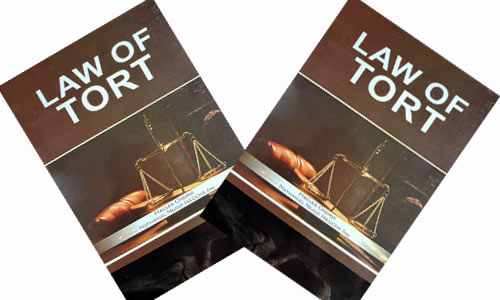 The book, titled The Law of Torts in Nigeria: A Functional Approach, authored by Professor Hagler Sunny Okorie Ph.D and Ikeocha, Nathaniel Ngozi Esq, offers law students, practitioners, and academics a comprehensive guide to understanding and applying tort law in Nigerian courts. Interested buyers can place orders via the following contact numbers: 08028636615, 08037667945, 08032253813, or +234 902 196 2209.
______________________________________________________________________
[A MUST HAVE] Evidence Act Demystified With Recent And Contemporary Cases And Materials
The book, titled The Law of Torts in Nigeria: A Functional Approach, authored by Professor Hagler Sunny Okorie Ph.D and Ikeocha, Nathaniel Ngozi Esq, offers law students, practitioners, and academics a comprehensive guide to understanding and applying tort law in Nigerian courts. Interested buyers can place orders via the following contact numbers: 08028636615, 08037667945, 08032253813, or +234 902 196 2209.
______________________________________________________________________
[A MUST HAVE] Evidence Act Demystified With Recent And Contemporary Cases And Materials

 ARTIFICIAL INTELLIGENCE FOR LAWYERS: A COMPREHENSIVE GUIDE
Reimagine your practice with the power of AI “...this is the only Nigerian book I know of on the topic.” — Ohio Books Ltd
Authored by Ben Ijeoma Adigwe, Esq., ACIArb (UK), LL.M, Dip. in Artificial Intelligence, Director, Delta State Ministry of Justice, Asaba, Nigeria.
Bonus:
Get a FREE eBook titled “How to Use the AI in Legalpedia and Law Pavilion” with every purchase.
ARTIFICIAL INTELLIGENCE FOR LAWYERS: A COMPREHENSIVE GUIDE
Reimagine your practice with the power of AI “...this is the only Nigerian book I know of on the topic.” — Ohio Books Ltd
Authored by Ben Ijeoma Adigwe, Esq., ACIArb (UK), LL.M, Dip. in Artificial Intelligence, Director, Delta State Ministry of Justice, Asaba, Nigeria.
Bonus:
Get a FREE eBook titled “How to Use the AI in Legalpedia and Law Pavilion” with every purchase.
How to Order: 📞 Call, Text, or WhatsApp: 08034917063 | 07055285878 📧 Email: benadigwe1@gmail.com 🌐 Website: www.benadigwe.com
Ebook Version: Access directly online at: https://selar.com/prv626
________________________________________________________________________ The Law And Practice Of Redundancy In Nigeria: A Practitioner’s Guide, Authored By A Labour & Employment Law Expert Bimbo Atilola _______________________________________________________________________
“Enhance Legal Practice With Authoritative Reports” — Alexander Payne Offers Comprehensive Law Reports, Spanning Over A Century Of Nigerian Jurisprudence
_______________________________________________________________________
“Enhance Legal Practice With Authoritative Reports” — Alexander Payne Offers Comprehensive Law Reports, Spanning Over A Century Of Nigerian Jurisprudence
 Interested buyers are encouraged to place their orders and enquiries via:
0704 444 4777, 0704 444 4999, 0818 199 9888
Website: www.alexandernigeria.com
Interested buyers are encouraged to place their orders and enquiries via:
0704 444 4777, 0704 444 4999, 0818 199 9888
Website: www.alexandernigeria.com