By Philip Ibitoye

Nearly six months since 11 governors instituted a suit against the Tinubu administration for suspending democratically elected officials in Rivers State, the Supreme Court has yet to schedule a hearing for the case. In this piece, PHILIP IBITOYE examines the constitutional and democratic implications of the apex court’s failure to decide the case until the suspensions lapsed.
WHEN 11 governors elected on the platform of the People’s Democratic Party (PDP) filed a case at the Supreme Court in April challenging President Bola Tinubu’s suspension of Rivers State Governor Similayi Fubara and members of the state House of Assembly, many critics of the President’s action looked to the apex court to settle whether the 1999 Constitution (as amended) grants a President the power to suspend an elected official. Nearly six months later, however, the court has left those critics disappointed, having failed to hear the case throughout the period of the officials’ suspension.
At the time President Tinubu imposed the suspension on the elected state officials in Rivers on March 18, 2025, he relied on Section 305 of the Constitution, which grants him the power to proclaim a state of emergency if, among other reasons, there is “an occurrence or imminent danger, or the occurrence of any disaster or natural calamity, affecting the community or a section of the community in the Federation.” However, many lawyers quickly dismissed the President’s rationale, noting that no part of the Constitution, including Section 305 which he cited, grants him the power to suspend or remove from office a democratically elected governor or lawmaker. They argued that only the state House of Assembly and the courts have the power to suspend or remove an elected official following due legal processes.
One of the lawyers opposing the suspension of elected officials, Principal Partner of Iris Attorneys LP, Ridwan Oke, noted that the suspension of Fubara, his deputy, and the state lawmakers lacked merit and was unconstitutional. “The 1963 Constitution provides for the suspension of a sitting governor, not the 1999 Constitution (as amended). The President cannot suspend the governor, deputy governor, and state House of Assembly lawmakers,” Oke said.
Notwithstanding the opposition to the suspension of the Rivers governor and other elected officials in the state, the Attorney-General of the Federation (AGF) and Minister of Justice, Lateef Fagbemi, defended the President’s action. Briefing State House correspondents at the Aso Rock Presidential Villa, Abuja, on March 19, Fagbemi made a political case for why President Tinubu had to act, but even he could not name the provision of the Constitution that granted his principal the power to suspend elected officials. Nevertheless, the National Assembly, in controversial circumstances, approved the suspension of Fubara, his deputy, and state lawmakers. Although the Constitution mandates a two-thirds majority of all the members of each house of the National Assembly to approve the President’s proclamation, both chambers endorsed the declaration of emergency rule and suspension of elected officials in Rivers through voice votes, leaving no room to ascertain whether the validation met the constitutional requirements.
Like Obasanjo, like Tinubu
Interestingly, when former President Goodluck Jonathan declared a state of emergency in Borno State during the tenure of Tinubu’s deputy, Vice-President Kashim Shettima, as governor in 2013 due to the Boko Haram insurgency, he did not suspend the then-Borno governor, even though the idea of a suspension was considered. Shettima himself has confirmed that Jonathan could have suspended him, but decided not to because the Constitution did not grant him that power as President. At a book launch in July 2025, Shettima said Jonathan mooted the idea of his removal at a meeting of the Federal Executive Council (FEC), but was advised by then-AGF Mohammed Bello Adoke that he (Jonathan) had no power to do so. Eventually, the former President allowed the then-Borno governor to keep his job under the state of emergency. Ironically, Shettima’s July comment came as Fubara and other Rivers State officials were under suspension by his (Shettima’s) current boss.
While current AGF Fagbemi could not give a legal or constitutional rationale for the suspension of Fubara and other Rivers elected officials, the AGF in the Jonathan administration was able to convince his boss not to suspend a democratically elected governor. Since 2011, when Adoke successfully advised Jonathan against taking the unconstitutional action of suspending an elected official, the provisions of the 1999 Constitution regarding the removal of elected officials have not changed. In essence, if Jonathan could not suspend Shettima because he had no constitutional power to do so, Tinubu also lacked the authority to remove Fubara from office and appoint a sole administrator.
But Tinubu’s action was not without precedent. In 2004, former President Olusegun Obasanjo responded to violent ethnic and religious clashes in Plateau State by declaring a state of emergency, suspending the state governor, Joshua Dariye, and the state lawmakers, and appointing a former Chief of Army Staff, Chris Alli, as the sole administrator. Aggrieved by their suspension, the Plateau State Government and the state legislature filed a suit before the Supreme Court on June 24, 2004. However, the apex court did not issue a ruling until January 19, 2006, 20 months after the proclamation and 14 months after the suspension had expired. Even when the Supreme Court ruled, it appeared to chicken out of making a difficult decision. Instead of ruling on the merits of the plaintiffs’ case—which asked the court to declare the suspensions “unconstitutional, null, and void as a violation of the provisions of Sections 176 and 90” of the 1999 Constitution—the justices instead ruled on a technicality: that the suspended officials could not bring the case on behalf of the Plateau Government because the sole administrator did not consent to the suit.
In a recent op-ed, a former Chairman of the National Human Rights Commission (NHRC) and lawyer, Prof. Chidi Anselm Odinkalu, described that Supreme Court ruling as illogical. “This was diabolical judicial capitulation… The most charitable anyone could be about the idea that the fate of the case should hang on the consent of the Military Administrator, the legality of whose appointment was in question, was that it was cynical jurisprudence,” Odinkalu wrote, slamming the logic that a sole administrator would have agreed to a suit trying to throw him out of office.
Oke also agreed that the 2006 Supreme Court ruling was unfortunate, noting that the court’s decision to waste “a golden opportunity” to decide the case on its merits was “quite problematic.” “With due respect to the Learned Justices of the Supreme Court, the Dariye case was resolved on technicality. Relying on the fact that the sole administrator didn’t give consent to sue was not good enough. No administrator will give consent to sue in a case that will take him out of power,” he said.
With the Supreme Court tacitly allowing the Obasanjo precedent to stand, it enabled Tinubu to follow the exact playbook nearly two decades later.
Supreme Court inaction on Fubara suspension stirring unease
There is near-universal acknowledgement in legal and political circles that President Tinubu lacked the constitutional authority to suspend Fubara and other elected officials in Rivers. Even the President’s most vocal supporters, including the Vice-President who inadvertently criticised his boss’s unconstitutional power grab, have been unable to provide any constitutional basis for the suspension of an elected official. Hence, the decision of the Supreme Court not to take up the case of the PDP governors challenging Tinubu’s suspension of Fubara and others has raised eyebrows. In Tinubu’s statement of September 17 announcing the winding down of the emergency rule, he acknowledged that at least 40 cases had been filed in court regarding his actions, but no court, whether lower or higher, had made a definitive ruling on the merits of the cases.
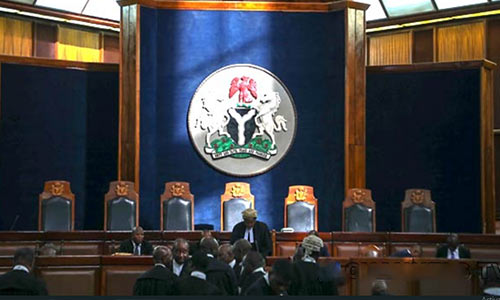
For more than 150 days (and throughout the period the suspension lasted), the Supreme Court has shown little interest in resolving the constitutional question of suspending democratically elected officials, leading to questions about whether the court is able or willing to check the excesses of an out-of-control or lawless executive. Notably, unlike the United States (US), where the Supreme Court has a process known as an emergency docket—consisting of applications seeking immediate action from the court—Nigeria’s apex court does not have a process for fast-tracking crucial cases.
In an interview with Sunday Tribune, the former Chairman of the Nigerian Bar Association Section on Public Interest and Development Law (NBA-SPIDEL), Dr Monday Ubani (SAN), said the Nigerian Supreme Court does not have a US-style emergency docket. “We don’t have that [US-style emergency docket]. For political cases, there’s a timeline within which they hear those cases,” Ubani said, suggesting that the apex court has discretion over other cases without specific timelines in law.
The former NBA vice-president also explained that justices embarked on their annual vacation in July and only recently resumed after democracy had already been restored in Rivers State, impacting their ability to hear and decide the case brought by the PDP governors and others. But findings by Sunday Tribune revealed that the Supreme Court commenced its annual vacation on Monday, July 21, 2025, and resumed on Monday, September 22, 2025. Before the justices embarked on the two-month vacation, they had more than three months to hear and decide the PDP governors’ case from April 8 when it was filed to July 21 when they proceeded on vacation. Considering the apex court’s speed in dispensing rulings in the 2023 Naira redesign and the 2024 local government (LG) autonomy cases, it has baffled many that the apex court failed to hear arguments and rule on a consequential case such as the suspension of a governor, deputy, and lawmakers in a timely manner.
But Odinkalu said the Supreme Court’s failure to schedule a hearing nearly six months after the PDP governors’ case was brought was itself a decision, not an omission. “The refusal of the Supreme Court to even attempt to schedule a hearing of the original jurisdiction case on Emergency Rule in Rivers State is not an omission. It’s itself a decision, which will go down in infamy in the annals of judicial politics in Nigeria,” the human rights activist said.
However, a self-described public interest lawyer, Olajuwon Ogunbiyi, disagreed with Odinkalu’s assessment, stating that it was not true that the Supreme Court does not want to adjudicate the case before it. “The Court is at liberty to look at issues and reliefs sought by parties to determine the urgency to apply. There are many cases before the Supreme Court currently between some states and FG that are still pending before the court,” Ogunbiyi said.
The lawyer also explained that the apex court’s silence so far does not amount to an endorsement of the President’s perceived unconstitutional actions in suspending democratically elected officials. “The matter is still pending before the Court and the Court will adjudicate upon it according to the rules of Court. It is the parties who had approached the Court that should apply to the Court for accelerated hearing,” he added.
CSOs and others criticise Supreme Court for inaction
Nevertheless, civil society organisations and other individuals have condemned the Supreme Court for not hearing the case against the suspension of the Rivers officials. While some accuse the apex court of complicity and cowardice, others warn that its inaction risks further eroding constitutional norms.
In an interview with Sunday Tribune, a citizen engagement and accountability-in-governance group, Enough is Enough (EiE) Nigeria, said the Supreme Court’s silence so far “exposes a fragility in Nigeria’s democracy.”
“At its core, democracy depends on institutions that can check excesses and protect the sanctity of the ballot. Avoiding the substantive question [of whether the suspension of elected officials is constitutional] signals that even the highest democratic guardrails can bend under political pressure. This undermines constitutionalism and emboldens executives to test the limits of power,” the group’s Senior Media Associate, Akindeji Aromaye, said.
EiE Nigeria further warned that inaction in politically sensitive cases creates a perception of bias or timidity, adding that selective judicial intervention weakens accountability. “When the courts appear hesitant to confront the executive directly, it weakens citizens’ faith that the judiciary can serve as a genuine check on power,” the group said. It also questioned whether the court is still the hope of the common man, saying it must embrace consistency, courage and timely justice to reclaim its reputation as the bastion of justice.
Similarly, the Human Rights Writers Association of Nigeria (HURIWA) slammed what it described as the judiciary’s dangerous dereliction of duty in a constitutional matter of grave national importance. “This deafening silence by the judiciary over a brazen constitutional assault is a ticking time bomb for Nigeria’s democracy,” the group said in a statement.
Also, the Coalition of United Political Parties (CUPP) said the Supreme Court’s refusal to hear the case filed by the PDP governors challenging the suspension of the Rivers officials “allowed an illegal act to persist, exposing the Court’s complicity in prioritising political interests over the rule of law. Such hypocrisy weakens the judiciary’s credibility and endangers Nigeria’s democratic foundation.”
Meanwhile, in its reply to the Supreme Court, the Tinubu administration said the PDP governors were meddlesome interlopers who lacked legal standing to bring the case. While it is not clear how the apex court will rule, some legal observers have speculated that the justices may again decide on a technicality and avoid the main question of constitutionality, further enabling a lawless executive to redeploy the unconstitutional playbook in the future.
[A MUST HAVE] Evidence Act Demystified With Recent And Contemporary Cases And Materials

Available now for NGN 40,000 at ASC Publications, 10, Boyle Street, Onikan, Lagos. Beside High Court, TBS. Email publications@ayindesanni.com or WhatsApp +2347056667384. Purchase Link: https://paystack.com/buy/evidence-act-complete-annotation
______________________________________________________________________ “Enhance Legal Practice With Authoritative Reports” — Alexander Payne Offers Comprehensive Law Reports, Spanning Over A Century Of Nigerian Jurisprudence Interested buyers are encouraged to place their orders and enquiries via:
0704 444 4777, 0704 444 4999, 0818 199 9888
Website: www.alexandernigeria.com
Interested buyers are encouraged to place their orders and enquiries via:
0704 444 4777, 0704 444 4999, 0818 199 9888
Website: www.alexandernigeria.com