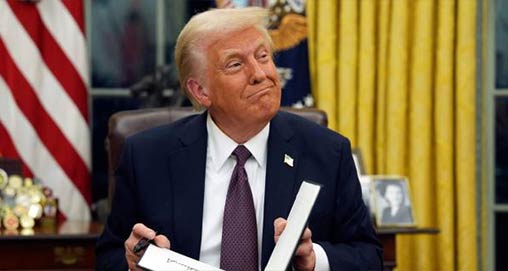
President Trump claimed to end birthright citizenship on the first day of his second term. Trump’s executive order is unconstitutional, in direct conflict with the plain language of the 14th Amendment and over a century’s worth of Supreme Court case law. It will be litigated immediately and its prospects of surviving those court fights are slim, even before a Supreme Court stacked with conservative justices and Trump appointees.

Before getting into the merits of the constitutional case against Trump’s executive order, it’s worth pausing to stress the brazenness of what he has done. Every new president swears to uphold the Constitution. Only minutes after taking that oath, President Trump violated it — flagrantly.
Turning to the history and text of the 14th Amendment: Before that amendment was ratified, America had a racialized class system in which enslaved people were denied the most basic rights granted by our founding documents. The Supreme Court blessed this system with its infamous Dred Scott decision, which ruled that enslaved people and their children could never be citizens. The Civil War was waged to put an end to this state of affairs. And, as a condition of their readmission to the Union, former slaveholding states were required to accept the principles reflected in the 14th Amendment. Among them, a plain statement of who is a citizen: “All persons born or naturalized in the United States, and subject to the jurisdiction thereof, are citizens of the United States and of the State wherein they reside.” In other words, if you’re born here, you’re one of us. It doesn’t matter who your parents were, whether they were free or enslaved, American citizens or not: You’re one of us. There is no other way to understand those words.
The Supreme Court affirmed this interpretation nearly 130 years ago in an 1898 case called United States v. Wong Kim Ark. The plaintiff in that case, Wong Kim Ark, was born in San Francisco in 1873. As an adult, he left the country to visit his Chinese-citizen parents in their homeland. He was, however, denied reentry to the United States by government officials who disputed his status as a U.S. citizen. Citing principles that stretched back through 17th-century English law and the clear language of the 14th Amendment, the Supreme Court recognized that birthright citizenship is “ancient and fundamental.” The Court has continued to endorse this understanding since, including in 1982’s Plyler v. Doe, which affirmed that undocumented immigrants and their children are entitled to all the 14th Amendment’s protections.
Trump’s order contends — as opponents of birthright citizenship long have — that the children of undocumented immigrants can’t be citizens, because they allegedly aren’t “subject to the jurisdiction” of the United States. That’s nonsense. Undocumented immigrants and their children are required to follow the same laws as everyone else on U.S. soil, including paying taxes. (As distinct from the primary example of people not subject to the federal government’s jurisdiction: foreign diplomats.)
It’s reasonable to wonder whether the current Supreme Court will defy Trump on an issue about which he has campaigned so aggressively. It’s undoubtedly true that the justices have bent American jurisprudence into novel shapes to avoid direct conflict with Trump. But backing birthright citizenship doesn’t require some unprecedented feat of progressive jurisprudence. Just look at the Fuller Court, which decided Wong Kim Ark. Two years earlier, it issued Plessy v. Ferguson, one of the most notoriously racist rulings in U.S. history. Even those justices — who embraced the two-tiered “separate but equal” regime of race relations that ruled the United States for generations — couldn’t find an honest way around the 14th Amendment’s plain language. This precedent will loom — rightly and heavily — over any move the Court makes.
When we ratified the 14th Amendment, we rejected the idea that some people born here are less than others in the eyes of the law. We reject that idea again today. We say that out loud — for everyone to hear — because protecting our Constitution requires all of us to speak and act like we still have one. No matter what kinds of orders might come off a president’s desk.
Why it matters: Trump is acting on a once-fringe belief that U.S.-born children of undocumented immigrants have no right to U.S. citizenship and are part of a conspiracy (rooted in racism) to replace white Americans.
The big picture: The executive order is expected to face immediate legal challenges from state attorneys general since it conflicts with decades of Supreme Court precedent and the 14th Amendment — with the AGs of California and New York among those indicating they would do so.
- Ratified in 1868, the 14th Amendment was passed to give nearly emancipated and formerly enslaved Black Americans U.S. citizenship.
- “All persons born or naturalized in the United States, and subject to the jurisdiction thereof, are citizens of the United States and of the State wherein they reside,” it reads.
Zoom in: Trump signed the order on Monday, just hours after taking office.
Reality check: Thanks to the landmark Wong Kim Ark case, the U.S. has since 1898 recognized that anyone born on United States soil is a citizen.
- The case established the Birthright Citizenship clause and led to the dramatic demographic transformation of the U.S.
What they’re saying: California Attorney General Rob Bonta told Axios the state will immediately challenge the executive order in federal court.
- “[Trump] can’t do it,” Bonta said. “He can’t undermine it with executive authority. That is not how the law works. It’s a constitutional right.”
- New York Attorney General Letitia James said in an emailed statement the executive order “is nothing but an attempt to sow division and fear, but we are prepared to fight back with the full force of the law to uphold the integrity of our Constitution.”
Flashback: San Francisco-born Wong Kim Ark returned to the city of his birth in 1895 after visiting family in China but was refused re-entry.
- John Wise, an openly anti-Chinese bigot and the collector of customs in San Francisco who controlled immigration into the port, wanted a test case that would deny U.S. citizenship to ethnic Chinese residents.
- But Wong fought his case all the way to the Supreme Court, which ruled on March 28, 1898, that the 14th Amendment guaranteed U.S. citizenship to Wong and any other person born on U.S. soil.
Zoom out: Birthright Citizenship has resulted in major racial and ethnic shifts in the nation’s demographic as more immigrants from Latin America and Asia came to the U.S. following the Immigration and Nationality Act of 1965.
- The U.S. was around 85% white in 1965, according to various estimates.
- The nation is expected to be a “majority-minority” by the 2040s.
Yes, but: That demographic changed has fueled a decades-old conspiracy theory, once only held by racists, called “white replacement theory.”
- “White replacement theory” posits the existence of a plot to change America’s racial composition by methodically enacting policies that reduce white Americans’ political power.
- The conspiracy theories encompass strains of anti-Semitism as well as racism and anti-immigrant sentiment.
Trump has repeated the theory and said that immigrants today are “poisoning the blood of our country,” language echoing the rhetoric of white supremacists and Adolf Hitler.
Of note: Military bases are not considered “U.S. soil” for citizenship purposes, but a child is a U.S. citizen if born abroad and both parents are U.S. citizens.
[A MUST HAVE] Evidence Act Demystified With Recent And Contemporary Cases And Materials

Available now for NGN 40,000 at ASC Publications, 10, Boyle Street, Onikan, Lagos. Beside High Court, TBS. Email publications@ayindesanni.com or WhatsApp +2347056667384. Purchase Link: https://paystack.com/buy/evidence-act-complete-annotation
______________________________________________________________________ “Enhance Legal Practice With Authoritative Reports” — Alexander Payne Offers Comprehensive Law Reports, Spanning Over A Century Of Nigerian Jurisprudence Interested buyers are encouraged to place their orders and enquiries via:
0704 444 4777, 0704 444 4999, 0818 199 9888
Website: www.alexandernigeria.com
Interested buyers are encouraged to place their orders and enquiries via:
0704 444 4777, 0704 444 4999, 0818 199 9888
Website: www.alexandernigeria.com