*As Iran Says US Blockade Is “Piracy”

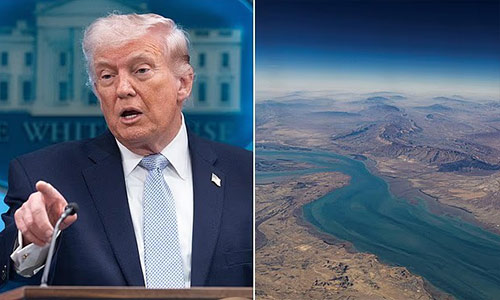
Iran’s Islamic Revolutionary Guard Corps has reclosed the Strait of Hormuz — the world’s most critical oil shipping chokepoint less than 24 hours after declaring it open to all commercial vessels, with Iranian forces firing on at least two merchant ships attempting to transit the waterway, as the crisis between Washington and Tehran over the US naval blockade of Iranian ports escalated sharply with President Donald Trump threatening to resume bombing if a deal is not reached by the end of the ceasefire.
The dramatic reversal plunged global energy markets back into uncertainty and brought the United States and Iran closer to a resumption of the military conflict that a fragile ceasefire had temporarily paused, with both sides accusing the other of violating the terms of the agreement and neither showing willingness to back down.
Iran’s military operational command, Khatam Al-Anbiya, announced on Saturday that the Strait of Hormuz has “reverted to its previous state” — meaning it is back under strict Iranian military control and effectively closed to unrestricted commercial traffic.
The announcement came less than 24 hours after Iran had declared the waterway open to all commercial vessels, a move that had briefly raised hopes of de-escalation in the crisis that has disrupted global oil shipments and sent energy prices soaring.
Iranian authorities described the ongoing US naval blockade of Iranian ports as “piracy” and said the reversal was a direct response to Washington’s refusal to lift the blockade.
“For this reason, control of the Strait of Hormuz has reverted to its previous state, and this strategic waterway is under the strict management and control of the armed forces,” the Iranian military stated.
The reclosure was accompanied by violent enforcement. Reuters reported that at least two merchant vessels were hit by gunfire as they attempted to cross the Strait of Hormuz.
The United Kingdom’s Maritime Trade Operations confirmed one of the incidents, reporting that a tanker was approached by two IRGC gunboats near the strait, approximately 20 nautical miles northeast of Oman.
“The Master of a Tanker reports being approached by two IRGC gunboats, no VHF challenge, and then being fired upon,” the UKMTO reported, adding that the tanker and crew were reported safe.
BBC Verify independently tracked two Indian-flagged vessels — the cargo ship JAG ARNAV and the oil tanker SANMAR HERALD — that were forced to change their routes after being denied access to the strait by IRGC officials.
Tracking data from MarineTraffic showed both vessels slowing down and making U-turns after passing Larak Island along the agreed shipping route. The SANMAR HERALD was navigating with a full cargo of oil, likely loaded in Iraq based on recent tracking data, indicating the disruption’s direct impact on regional oil supplies.
Iran’s Conditions
Iran’s Supreme National Security Council, the country’s top security body, laid out Tehran’s position in a statement broadcast on state television.
The council said Iran is “determined to enforce monitoring and control over transit through the Strait of Hormuz until the definitive end of the war and the establishment of lasting peace in the region.”
This enforcement would include collecting full information from vessels passing through, issuing transit certificates, and requiring payment of service fees for “security, safety, and environmental protection services” — effectively establishing Iranian sovereignty over the international waterway.
On the US naval blockade, the council stated: “Until the US restores the complete freedom of navigation for vessels from an Iranian origin to a destination, and from a destination back to Iran, the situation in the Strait of Hormuz will remain strictly controlled and in its previous state.”
The council also revealed that new proposals had been put forward by the US for negotiations to end the war, which Tehran is “currently reviewing and has not yet responded to.”
On the ceasefire itself, the council described the US naval blockade as a “violation of the ceasefire,” warning that “as long as the enemy intends to disrupt the passage of vessels and apply its naval blockade, Iran will view that as a violation of the ceasefire and prevent the conditional and limited reopening of the Strait of Hormuz.”
Trump: “We’ll Start Dropping Bombs Again”
Speaking to media in the Oval Office while signing executive orders, President Trump addressed the crisis with characteristically blunt language.
He said there are “very good conversations going on” with Iran but described Iranian leaders as acting “a little cute as they have for 47 years.”
Trump stated that Iran wants to close the Strait of Hormuz but that the US would not let them “blackmail us,” adding that the US is “taking a tough stand.”
In his most direct threat, Trump warned that if a deal is not reached by the end of the ceasefire agreement, military action would resume.
“Unfortunately, we’ll have to start dropping bombs again,” Trump stated.
He said the US blockade of Iranian ports would remain in place until a deal is reached, and indicated there would be “some information by the end of the day” on Iran — though he did not take direct questions on the conflict before ending the session.
Iran’s Deputy Foreign Affairs Minister, Saeed Khatibzadeh, responded to Trump’s threats with dismissive defiance.
He described the US blockade of Iranian ports as “unjustifiable” and declared that Iran would not accept orders from Washington regarding its ports or any other matters.
“There will never be any blockade in the future. The era of colonialism must come to an end. The US cannot dictate orders to other nations,” Khatibzadeh stated.
When asked about Trump’s threat to resume bombing, the deputy minister was contemptuous: “He talks too much. He said contradictory things within the same statement. I don’t know exactly what he meant.”
Khatibzadeh also warned that the US-Israel war with Iran “cannot lead to any positive outcome” but made clear that Tehran would not capitulate.
“Iran remains ready to keep defending itself if under attack. We will fight until the last Iranian soldier,” Khatibzadeh declared.
The crisis centres on a fundamental disagreement about the terms of the ceasefire that paused the military conflict between the US (allied with Israel) and Iran.
Iran argues that the US naval blockade of Iranian ports constitutes a violation of the ceasefire, since it prevents Iranian vessels from conducting normal commerce and effectively maintains economic warfare even as military operations have been paused.
The US position is that the blockade is a separate enforcement mechanism that will remain until Iran agrees to broader terms including, reportedly, restrictions on its nuclear programme and regional activities that go beyond the immediate cessation of hostilities.
The result is a paradox: both sides claim the other is violating the ceasefire, and both are taking escalatory actions Iran by reclosing the strait and firing on vessels, the US by maintaining its blockade that move the situation further from resolution.
The crisis unfolds against the backdrop of Trump’s extraordinary public feud with Pope Leo XIV, who has been one of the most prominent international critics of the war in Iran.
Leo has condemned Trump’s threats against Iranian civilisation as “unacceptable” and stated he has “no fear” of the Trump administration and would continue speaking out against the conflict.
Trump described the pope as “terrible for foreign policy” and “weak on crime” — comments that have split the Republican Party, with several vulnerable midterm candidates distancing themselves from the president.
The pope’s criticism has resonated with American Catholic voters, a key constituency, with former Governor Chris Christie warning that Trump has done “real damage to his standing with Catholic voters.”
Senate Majority Leader John Thune weighed in after Vice President JD Vance warned the pope to “be careful when he talks about matters of theology,” responding pointedly: “Isn’t that his job?”
The intraparty tensions over the pope add a domestic political dimension to the Iran crisis, potentially constraining Trump’s ability to escalate militarily without facing significant political backlash at home particularly among Catholic voters ahead of the midterm elections.
The Strait of Hormuz is the world’s most important oil chokepoint, with approximately 20 per cent of global oil supplies transiting the narrow waterway daily. Its closure or restricted access directly impacts global energy prices, shipping insurance costs, and the stability of oil-dependent economies worldwide.
The reclosure after just 24 hours of reopening sends a signal that the strait will remain a bargaining chip in the broader conflict, with Iran using its geographic control of the waterway as leverage against the US naval blockade.
For global markets, the uncertainty is the most damaging element. The rapid oscillation between opening and closing makes it impossible for shipping companies, oil traders, and energy planners to make reliable forecasts driving prices higher through risk premiums even when oil is physically flowing.
The situation stands at a dangerous inflection point. Iran has reclosed the strait and fired on vessels. The US maintains its blockade and threatens renewed bombing. Both sides describe the other’s actions as violations of the ceasefire. New US proposals are under review in Tehran.
Trump indicated that information would come “by the end of the day” raising the possibility of either a diplomatic breakthrough or a further escalation.
Iran’s statement that it will maintain control of the strait “until the definitive end of the war and the establishment of lasting peace” suggests Tehran is prepared for a prolonged standoff.
Trump’s threat to “start dropping bombs again” suggests Washington’s patience with the ceasefire is limited.
Between these two positions lies the fate of global energy supplies, the lives of sailors transiting the world’s most dangerous waterway, and the question of whether a ceasefire designed to prevent wider war will instead become the prelude to its resumption.
[A MUST HAVE] Evidence Act Demystified With Recent And Contemporary Cases And Materials

Available now for NGN 40,000 at ASC Publications, 10, Boyle Street, Onikan, Lagos. Beside High Court, TBS. Email publications@ayindesanni.com or WhatsApp +2347056667384. Purchase Link: https://paystack.com/buy/evidence-act-complete-annotation
______________________________________________________________________ “Enhance Legal Practice With Authoritative Reports” — Alexander Payne Offers Comprehensive Law Reports, Spanning Over A Century Of Nigerian Jurisprudence Interested buyers are encouraged to place their orders and enquiries via:
0704 444 4777, 0704 444 4999, 0818 199 9888
Website: www.alexandernigeria.com
Interested buyers are encouraged to place their orders and enquiries via:
0704 444 4777, 0704 444 4999, 0818 199 9888
Website: www.alexandernigeria.com