
The Senate on Wednesday passed for second reading a bill seeking sweeping reforms to the Legal Practitioners Act, 2004, including the introduction of a compulsory two-year pupillage for lawyers newly called to the Nigerian Bar.

The proposed amendment is part of a broader effort to modernise the regulation of legal practice in Nigeria and align it with global standards in jurisdictions such as the United Kingdom, Canada, South Africa, and Kenya.
Debated during plenary and sponsored by the Leader of the Senate, Senator Opeyemi Bamidele, the bill aims to overhaul the country’s nearly 60-year-old legal regulatory framework, which lawmakers said no longer reflects the complexities and demands of contemporary legal practice.
Presiding over the session, the Deputy Senate President, Senator Barau Jibrin, put the bill to a vote after extensive deliberations, with the chamber unanimously approving it for further legislative action.
The Committee on Judiciary, Human Rights and Legal Matters was mandated to organise a public hearing and report back within two weeks.
In his lead debate, Bamidele described the existing Legal Practitioners Act as “almost six decades old in context and structure,” stressing that the evolution of technology, digital court processes, cross-border commercial transactions, and heightened expectations for ethical conduct had rendered the current framework inadequate.
“The nature of legal practice today has drastically evolved,” he said. “Accordingly, our regulatory framework must evolve to meet these new realities.”
A major plank of the proposed legislation is the restructuring and empowerment of the Body of Benchers as the apex regulatory institution for the legal profession.
The bill seeks to grant the body corporate legal personality, financial autonomy, a strengthened secretariat, clear rule-making powers, and a more robust institutional structure for committees and oversight.
Bamidele also flagged persistent weaknesses in the existing disciplinary mechanism for lawyers, noting that the current system is slow, centralised, and incapable of responding effectively to professional misconduct.
The bill therefore proposes a restructured Legal Practitioners Disciplinary Committee (LPDC), with multiple panels sitting across the country, clearer sanctioning powers—ranging from suspension and striking-off to restitution, compensation, and formal apology—and mandatory publication of disciplinary decisions for transparency. Aggrieved practitioners will retain the right of appeal to the Supreme Court.
Another innovation in the bill is the creation of an Ethics, Adherence, and Enforcement Committee, which would serve as a professional investigative body empowered to inspect law offices, demand documents, investigate public complaints, enforce compliance with regulatory standards, and prosecute cases before the LPDC.
A key highlight of the reform package is the introduction of a mandatory two-year pupillage programme for newly called lawyers, except where special circumstances apply.
This, Bamidele said, would ensure young practitioners acquire practical skills, professional grounding, and mentorship before operating independently.
The bill also introduces compulsory continuing professional development as a requirement for the renewal of practising licences, a measure designed to keep lawyers up-to-date throughout their careers.
In addition, the legislation criminalises unauthorised legal practice a response to growing concerns about impostors posing as lawyers and defrauding unsuspecting members of the public.
It clearly defines what constitutes legal practice and sets penalties for violators.
Beyond discipline and training, the proposed law also touches on the regulation of foreign lawyers, reforms to the conferment of the rank of Senior Advocate of Nigeria (SAN), and enhanced safeguards to protect clients and their finances.
BILLS 2025- LEGAL PRACTITIONERS BILL- SENATEaContributing to the debate, the Chief Whip of the Senate, Senator Mohammed Tahir Monguno, who recalled his experiences at the bar more than three decades ago, said the reforms were long overdue.
He maintained that Nigeria’s legal profession must adapt to the realities of the digital age if it is to remain competitive and credible.
“This bill is apt and germane,” Monguno said. “We are in a digital age, and our legal profession must reflect these realities.”
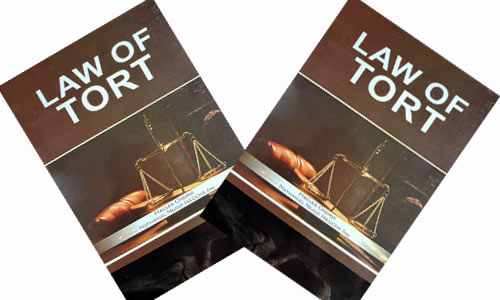 The book, titled The Law of Torts in Nigeria: A Functional Approach, authored by Professor Hagler Sunny Okorie Ph.D and Ikeocha, Nathaniel Ngozi Esq, offers law students, practitioners, and academics a comprehensive guide to understanding and applying tort law in Nigerian courts. Interested buyers can place orders via the following contact numbers: 08028636615, 08037667945, 08032253813, or +234 902 196 2209.
______________________________________________________________________
[A MUST HAVE] Evidence Act Demystified With Recent And Contemporary Cases And Materials
The book, titled The Law of Torts in Nigeria: A Functional Approach, authored by Professor Hagler Sunny Okorie Ph.D and Ikeocha, Nathaniel Ngozi Esq, offers law students, practitioners, and academics a comprehensive guide to understanding and applying tort law in Nigerian courts. Interested buyers can place orders via the following contact numbers: 08028636615, 08037667945, 08032253813, or +234 902 196 2209.
______________________________________________________________________
[A MUST HAVE] Evidence Act Demystified With Recent And Contemporary Cases And Materials

 ARTIFICIAL INTELLIGENCE FOR LAWYERS: A COMPREHENSIVE GUIDE
Reimagine your practice with the power of AI “...this is the only Nigerian book I know of on the topic.” — Ohio Books Ltd
Authored by Ben Ijeoma Adigwe, Esq., ACIArb (UK), LL.M, Dip. in Artificial Intelligence, Director, Delta State Ministry of Justice, Asaba, Nigeria.
Bonus:
Get a FREE eBook titled “How to Use the AI in Legalpedia and Law Pavilion” with every purchase.
ARTIFICIAL INTELLIGENCE FOR LAWYERS: A COMPREHENSIVE GUIDE
Reimagine your practice with the power of AI “...this is the only Nigerian book I know of on the topic.” — Ohio Books Ltd
Authored by Ben Ijeoma Adigwe, Esq., ACIArb (UK), LL.M, Dip. in Artificial Intelligence, Director, Delta State Ministry of Justice, Asaba, Nigeria.
Bonus:
Get a FREE eBook titled “How to Use the AI in Legalpedia and Law Pavilion” with every purchase.
How to Order: 📞 Call, Text, or WhatsApp: 08034917063 | 07055285878 📧 Email: benadigwe1@gmail.com 🌐 Website: www.benadigwe.com
Ebook Version: Access directly online at: https://selar.com/prv626
________________________________________________________________________ The Law And Practice Of Redundancy In Nigeria: A Practitioner’s Guide, Authored By A Labour & Employment Law Expert Bimbo Atilola _______________________________________________________________________