Emerging facts have indicated Nigerians’ growing preference for Alternative Dispute Resolution (ADR) in the settlement of commercial and civil legal challenges.

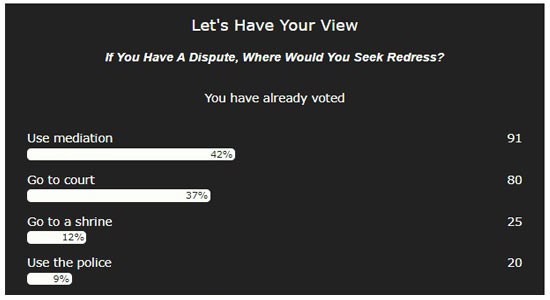
In a recent survey conducted by TheNigeriaLawyers from June 16th to July 16th on its website, readers were asked to select their most preferred means of dispute resolution from multiple choice options, which included going to court, using mediation, involving the police, and visiting a shrine. The poll, which received a total of 216 votes, aimed to gauge public opinion on the most effective means of seeking redress in the event of a dispute.
According to the poll results, 42% of respondents, accounting for 91 votes, favored mediation as their preferred method of dispute resolution. This was followed by 37% (80 votes) who would opt to go to court, 12% (25 votes) who would consider visiting a shrine, and 9% (20 votes) who would involve the police. The outcome of the poll further showed that mediation as a means of dispute resolution has gained a favorable place in the hearts of Nigerians, surpassing the preference for courts.
This shift in preference can be attributed to the fact that Nigerians have lost hope in the judicial system, believing that today’s courts are no longer the last hope of the common man. People lament that the judicial system is very slow in delivering justice to the masses, especially when the complainants do not belong to the upper strata of society, commonly referred to as “big men.” The survey indicated that rather than go to the regular court where they’re not sure of getting justice or where it takes an eternity before matters are decided, the current preference is to resort to ADR. This sorry state of affairs appears to have diminished public confidence in the formal justice system.
Renowned human rights advocate and former chairman of the Human Rights Commission, Prof. Chidi Odinkalu, addressed this issue in one of his articles, stating, “If corruption has got up to the Supreme Court, you have to acknowledge that if you have a Judiciary in which Judges of the Supreme Court are saying that the Supreme Court itself is a problem, then you have a credible problem. It can no longer be described as the last hope of the common man. We have to address it.”
It is necessary to point out that going to the police is not the proper place to settle disputes. The law, specifically s. 8(2) of the Administration of Criminal Justice Act 2015 (ACJA 2015) and s. 32(2) of the Nigerian Police (Establishment Act) 2020, prohibits the police from interfering in disputes or arresting anyone on merely a civil wrong or breach of contract, unless on the order of a competent court. Similarly, seeking redress at a shrine is not an appropriate or legal means of settling disputes, as such practices are rooted in superstition and have no place in a modern, law-abiding society.
One of the primary reasons for the popularity of mediation is its cost-effectiveness compared to litigation, which can be an expensive and time-consuming process. Mediation is generally more affordable, as it involves fewer legal formalities and can be completed in a shorter timeframe. Moreover, mediation allows for greater flexibility and control over the outcome of the dispute, enabling the parties involved to have a direct say in crafting a mutually acceptable resolution.
This collaborative approach fosters a more amicable settlement and helps maintain business relationships, which is crucial in the commercial world. Additionally, mediation offers a higher degree of confidentiality compared to court cases, which is particularly important for businesses that wish to protect their reputation and avoid negative publicity.
The poll results serve as a clear indication that the Nigerian public is increasingly recognizing the value of alternative dispute resolution methods, particularly mediation, in settling commercial disputes. As more people become aware of its benefits, it is likely that the popularity of mediation will continue to grow, leading to a more efficient and effective means of resolving conflicts in the business world.
 Interested buyers are encouraged to place their orders and enquiries via:
0704 444 4777, 0704 444 4999, 0818 199 9888
Website: www.alexandernigeria.com
Interested buyers are encouraged to place their orders and enquiries via:
0704 444 4777, 0704 444 4999, 0818 199 9888
Website: www.alexandernigeria.com
 Reimagine your practice with the power of AI “...this is the only Nigerian book I know of on the topic.” — Ohio Books Ltd
Authored by Ben Ijeoma Adigwe, Esq., ACIArb (UK), LL.M, Dip. in Artificial Intelligence, Director, Delta State Ministry of Justice, Asaba, Nigeria.
Bonus:
Get a FREE eBook titled “How to Use the AI in Legalpedia and Law Pavilion” with every purchase.
Reimagine your practice with the power of AI “...this is the only Nigerian book I know of on the topic.” — Ohio Books Ltd
Authored by Ben Ijeoma Adigwe, Esq., ACIArb (UK), LL.M, Dip. in Artificial Intelligence, Director, Delta State Ministry of Justice, Asaba, Nigeria.
Bonus:
Get a FREE eBook titled “How to Use the AI in Legalpedia and Law Pavilion” with every purchase.
How to Order: 📞 Call, Text, or WhatsApp: 08034917063 | 07055285878 📧 Email: benadigwe1@gmail.com 🌐 Website: www.benadigwe.com
Ebook Version: Access directly online at: https://selar.com/prv626
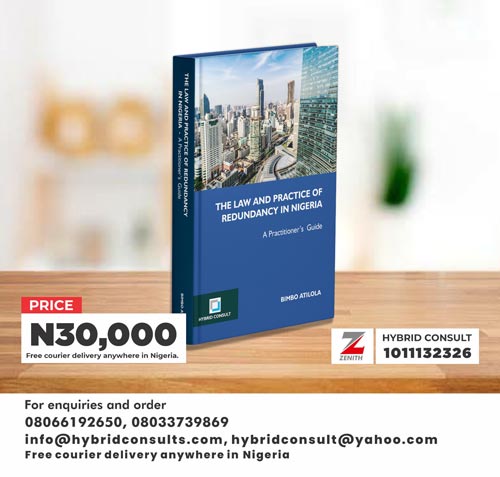
_______________________________________________________________________ [A MUST HAVE] Evidence Act Demystified With Recent And Contemporary Cases And Materials
 ______________________________________________________________________
“Bridging Theory And Courtroom Practice” — Hagler Sunny Okorie, Nathaniel Ngozi Ikeocha Unveil ‘Functional’ Tort Law Book For Nigerian Legal System
______________________________________________________________________
“Bridging Theory And Courtroom Practice” — Hagler Sunny Okorie, Nathaniel Ngozi Ikeocha Unveil ‘Functional’ Tort Law Book For Nigerian Legal System
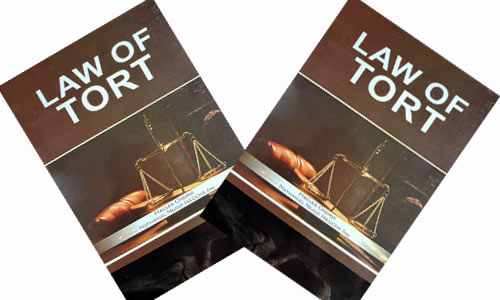 The book, titled The Law of Torts in Nigeria: A Functional Approach, authored by Professor Hagler Sunny Okorie Ph.D and Ikeocha, Nathaniel Ngozi Esq, offers law students, practitioners, and academics a comprehensive guide to understanding and applying tort law in Nigerian courts. Interested buyers can place orders via the following contact numbers: 08028636615, 08037667945, 08032253813, or +234 902 196 2209.