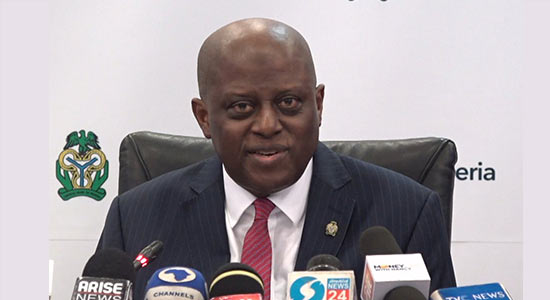
In response to mounting public frustration over Nigeria’s economic challenges the Central Bank of Nigeria’s (CBN) Governor, Yemi Cardoso, to insufficient diversification, has attributed the horror to insufficient diversification efforts, excess liquidity, and global economic pressure.

He stated this yesterday at a media briefing to mark the conclusion of the Monetary Policy Committee (MPC)’s 296th meeting in Abuja.
According to him, the MPC increased interest rates by 50 basis points from 26.25 per cent to 26.75 per cent in an effort to manage inflation.
The apex bank adjusted the asymmetric corridor from +100/-300 to +500/-100 basis points, Cash Reserve Ratio (CRR) of deposit money banks at 45 per cent and merchant banks at 14 per cent while retaining Liquidity Ratio at 30 per cent.
Justifying the decisions, Cardoso explained that the MPC acknowledged the detrimental impact of rising prices on households and businesses across Nigeria and reiterated its commitment to maintaining price stability,
He expressed optimism that recent monetary policy measures, coupled with fiscal interventions aimed at addressing food inflation, would help stabilise prices in the near term.
Cardoso highlighted the persistent challenge of food inflation, which is worsened by insecurity in key agricultural areas and high transportation costs, and emphasised the urgent need to enhance food supply within Nigeria.
He said: “It was observed that while monetary policy has been moderating aggregate demand, rising food and energy costs continue to exert upward pressure on price development. The prevailing insecurity in food producing areas and high cost of transportation of farm produce are also contributing to this trend. Members were therefore not oblivious to the urgent benefit of addressing these challenges as it will offer a sustainable solution to the persistent pressure on food prices.
“Also noted in its consideration is the increasing activities of middlemen who often finance smallholder farmers, aggregate, hoard and move farm produce across the border to neighboring countries. The committee suggested the need to put in check such activities in order to address the food supply deficit in the Nigerian market to moderate food prices.
The MPC therefore resolved to sustain collaboration with the fiscal authority to ensure that inflationary pressure is subdued.
Reacting, Nigeria’s first professor of the capital markets Prof Uche Uwaleke said: “Having done 750 basis points between February and May this year, I had predicted they would do a minimum of 50bps or a max of 100bps in July.
“I am glad to note that they chose the floor which is a sign that a complete halt is most likely in their next scheduled meeting in September.
But the adjustment to the asymmetric corridor around the MPR is a major source of concern for me.
“The MPC communique did not provide any explanation for increasing the SLR from +100 to +500 and the SDR from -300 to -100.
“By implication, with an MPR of 26.75 per cent, banks will now get loans from the CBN at 31.75 per cent while they will be remunerated for their excess deposits at 25.75 per cent. This will further squeeze liquidity from the banking system and jerk up cost of credit with adverse consequences on output and the equities market.
“The MPC communique should have made it clear why it was better to mask the tightening in the asymmetric corridor than reveal it in the MPR.
“May I observe that unlike previous MPC communiques, recent ones are silent regarding how the members voted. This information is useful at this stage even before their personal statements are published.
“I submit that as far as taming the current elevated inflation in Nigeria is concerned in view of its major non-monetary drivers, the fiscal side holds the ace”, he said.
[A MUST HAVE] Evidence Act Demystified With Recent And Contemporary Cases And Materials

Available now for NGN 40,000 at ASC Publications, 10, Boyle Street, Onikan, Lagos. Beside High Court, TBS. Email publications@ayindesanni.com or WhatsApp +2347056667384. Purchase Link: https://paystack.com/buy/evidence-act-complete-annotation
______________________________________________________________________ “Enhance Legal Practice With Authoritative Reports” — Alexander Payne Offers Comprehensive Law Reports, Spanning Over A Century Of Nigerian Jurisprudence Interested buyers are encouraged to place their orders and enquiries via:
0704 444 4777, 0704 444 4999, 0818 199 9888
Website: www.alexandernigeria.com
Interested buyers are encouraged to place their orders and enquiries via:
0704 444 4777, 0704 444 4999, 0818 199 9888
Website: www.alexandernigeria.com