

The Federal High Court sitting in Warri, Delta State, has nullified the Nigeria Democratic Congress (NDC) primary election held on May 29, 2026, for the Delta Central Senatorial District, declaring that the participation of former Deputy Senate President, Senator Augustine Ovie Omo-Agege, violated the provisions of the Electoral Act, 2026.

The court consequently restrained Omo-Agege from presenting himself as the NDC candidate for the Delta Central senatorial election in 2027 and ordered the Independent National Electoral Commission (INEC) not to recognise him or any other candidate emerging from the invalidated primary election.
In a 167-page judgment delivered on Tuesday, November 24, 2026, Justice H.A. Nganjiwa held that the NDC breached Sections 77(4), (5) and (6) of the Electoral Act, 2026, by allowing Omo-Agege to participate in its primary election when his name was not contained in the party membership register submitted to INEC within the period prescribed by law.
The judge declared the entire primary election invalid, null and void, holding that a political party could not lawfully produce a candidate through a nomination process conducted in disregard of mandatory statutory requirements.
The decision followed a pre-election suit filed by Alexander Osondu Akpodiete, an NDC member and aspirant for the Delta Central senatorial ticket, against INEC, the NDC and Omo-Agege.
The suit, marked FHC/WR/CS/120/2026, was commenced by originating summons dated June 9 and filed on June 10, 2026.
Akpodiete challenged the legality of Omo-Agege’s participation in the NDC primary, maintaining that the former Deputy Senate President was not a member of the party as reflected in the register submitted to INEC at least 21 days before the exercise.
He argued that allowing a person whose name was not contained in the prescribed register to participate in a party primary amounted to a violation of the Electoral Act and rendered the resulting nomination unlawful.
The plaintiff consequently sought declarations invalidating the primary election, setting aside Omo-Agege’s nomination and restraining the NDC and INEC from recognising him as the party’s candidate.
Click to Download the Judgment
The court was also asked to determine whether the party could validly sponsor a candidate whose nomination resulted from a primary election conducted in breach of the statutory provisions governing party membership registers.
In determining the dispute, Justice Nganjiwa examined the provisions of Section 77 of the Electoral Act, 2026, particularly the requirement that political parties submit their membership registers to INEC not later than 21 days before conducting primaries.
The judge explained that Section 77(5) expressly restricts participation in party primaries to persons whose names appear in the relevant membership register.
Quoting the provision, the court stated:
“Only members whose names are contained in the register shall be eligible to vote and be voted for in party primaries, congresses and conventions.”
The judge further relied on Section 77(6), which prohibits political parties from conducting their primaries with a register different from the one submitted to INEC.
“A political party shall not use any other register for party primaries, congresses and conventions except the register submitted to the Commission,” the provision states.
Justice Nganjiwa held that the language of the law was clear and mandatory, leaving political parties without discretion to substitute another membership register during their nomination exercises.
The central issue before the court was therefore whether Omo-Agege’s name appeared in the register submitted to INEC within the prescribed period before the NDC primary election of May 29, 2026.
In establishing his case, Akpodiete tendered documents relating to his membership of the NDC, his expression of interest in the senatorial primary, the party’s membership register and correspondence with INEC.
The plaintiff also presented documents concerning Omo-Agege’s previous membership of the All Progressives Congress (APC), his involvement in that party’s senatorial nomination process and the circumstances surrounding his movement to the NDC.
The court identified a dispute over the date on which Omo-Agege left the APC.
While the plaintiff relied on a resignation letter dated May 22, 2026, Omo-Agege maintained that he resigned from the APC on May 5, 2026.
The judge observed that the two letters contained substantially identical wording but bore different dates. He consequently considered the need for corroborating evidence and held that resolving the resignation-date controversy alone would not determine the central issue in the suit.
The court also examined the plaintiff’s allegation that Omo-Agege had participated in the APC senatorial primary held on May 18, 2026, before subsequently contesting the NDC primary.
Justice Nganjiwa observed that the former Deputy Senate President’s response to the allegation did not amount to a direct and unequivocal denial of the plaintiff’s assertion.
The judge referred to established judicial authorities requiring parties to respond specifically to material allegations made against them, explaining that evasive denials could leave facts effectively unchallenged.
However, the court made clear that the decisive question was not merely when Omo-Agege resigned from the APC or whether he had participated in its primary election.
Rather, the issue was whether his name was contained in the NDC membership register lawfully submitted to INEC at least 21 days before the party’s May 29 primary.
On that question, the court examined the competing membership registers tendered by the parties.
Justice Nganjiwa identified four copies of NDC membership registers presented during the proceedings.
Two were submitted by the plaintiff as Exhibits 7 and 14, with Exhibit 14 being a certified copy of the earlier document.
The NDC presented another register, marked Exhibit PAO1, while Omo-Agege tendered a certified register marked Exhibit A004.
The NDC maintained that Exhibit PAO1 was the membership register used for the conduct of its May 29 primary and that Omo-Agege’s name appeared in it.
Omo-Agege similarly insisted that his name was contained in the party’s membership register and that he had lawfully participated in the nomination exercise.
However, the judge distinguished between the register actually used by the NDC during its primary election and the register submitted to INEC within the statutory period.
The court found that the plaintiff had specifically stated that the party submitted its membership register to INEC on May 6, 2026.
Justice Nganjiwa observed that the NDC and Omo-Agege failed to provide a direct, clear and unequivocal denial of that assertion.
The judge further noted that neither defendant supplied a definite alternative date establishing when the registers relied upon by them had been submitted to INEC.
In evaluating the evidence, the court also examined letters written on behalf of the NDC and Omo-Agege requesting certified copies of the party’s membership register.
Justice Nganjiwa observed that the letters concerned a register in INEC’s custody as of May 10, 2026, a date the court calculated as falling only 19 days before the primary election.
The judge held that the defendants failed to establish that the register containing Omo-Agege’s name had been submitted within the required 21-day period.
The court also considered the fact that the NDC did not establish that the membership register initially submitted to INEC had subsequently been updated within a legally permissible period.
According to the judge, the defendants did not sufficiently assist the court in identifying where Omo-Agege’s name appeared in the lengthy registers they relied upon.
Justice Nganjiwa stated that he had examined Exhibits 7 and 14 but could not find Omo-Agege’s name in either document.
The court consequently preferred the evidence contained in the plaintiff’s membership registers over the competing documents presented by the defendants.
The judge held that the register submitted to INEC within the prescribed statutory period was the one reflected in Exhibits 7 and 14, and that Omo-Agege’s name was absent from it.
Having made that finding, the court ruled that Omo-Agege was not eligible to participate in the NDC primary election under Section 77(5) of the Electoral Act, 2026.
The judge further held that the NDC breached Section 77(6) by conducting its primary election with a different membership register.
Justice Nganjiwa explained that the requirement was not a mere procedural formality that political parties could disregard.
He held that strict compliance with the statutory provisions was necessary to guarantee lawful participation in party primaries and preserve the integrity of candidate nominations.
The court relied on judicial authorities concerning the mandatory meaning of the word “shall” in legislation, stressing that statutory commands must be obeyed where the law has expressly prescribed the procedure to be followed.
Having found that Omo-Agege was not eligible to participate in the primary election, the judge concluded that the party’s nomination exercise was invalidated by his participation.
The court further held that a primary election conducted in breach of Sections 77(5) and (6) could not produce a lawful candidate for the general election.
Justice Nganjiwa also considered Section 84 of the Electoral Act, 2026, which prescribes consequences for political parties that fail to comply with the law in conducting their primaries.
The judge relied particularly on Section 84(3), which provides that where a court finds that a political party has failed to comply with the Electoral Act in conducting its primary election, the party’s candidate shall not be included in the election for the office concerned.
The court stated that the consequences of non-compliance were mandatory and could not be avoided merely because a political party had declared a winner or forwarded a candidate’s name to INEC.
Justice Nganjiwa referred to the Supreme Court’s decision in Yerima v. Balami in explaining that a political party cannot lawfully nominate a candidate through an invalid primary election.
The judge observed that the law might permit another primary election in appropriate circumstances where the relevant statutory timetable had not expired.
However, he examined the timetable for the 2027 general elections and the statutory deadlines governing the submission of candidates’ names to INEC.
The court found that the prescribed periods for conducting party primaries and submitting nominations had elapsed.
Consequently, the judge held that the NDC’s invalid primary could not provide a lawful foundation for sponsoring Omo-Agege or another candidate for the Delta Central senatorial election.
The court rejected the argument that the issues raised by Akpodiete were matters concerning the internal affairs of a political party and therefore outside its jurisdiction.
The NDC and Omo-Agege had filed preliminary objections challenging the competence of the suit, the plaintiff’s legal standing and the jurisdiction of the Federal High Court.
They argued, among other grounds, that the nomination of candidates and the maintenance of party membership registers fell within the domestic affairs of political parties.
The defendants also contended that Section 77 of the Electoral Act could not create additional constitutional qualifications or disqualifications for election to the Senate.
Click to Download the Judgment
Justice Nganjiwa rejected those arguments.
The judge held that although courts ordinarily refrain from interfering in the internal administration of political parties, they are empowered to intervene where a party’s actions allegedly violate statutory or constitutional requirements.
The court relied on the Supreme Court’s decision in PDP v. Sule Lamido & Ors., which emphasised that political parties remain subject to the discipline of the law when their actions affect the rights and obligations of members.
Justice Nganjiwa also relied on the Supreme Court judgment delivered on September 24, 2026, in INEC v. Zenith Labour Party, concerning the validity of provisions of Section 77 of the Electoral Act, 2026.
The judge explained that the statutory requirements governing party membership registers did not introduce additional qualifications for election into public office.
Rather, they regulated the process through which political parties conducted their primaries and selected candidates.
The court held that the provisions were intended to promote compliance, fairness and transparency in the nomination process.
On the plaintiff’s legal standing, Justice Nganjiwa found that Akpodiete had established sufficient interest in the dispute as a member and aspirant of the NDC who participated in the party’s nomination process.
The judge relied on the plaintiff’s expression-of-interest documents, payment receipt and petition to the party challenging the outcome of the primary.
Click to Download the Judgment
The court also rejected the NDC’s reliance on an aspirant-screening document, observing that the document did not contain the plaintiff’s signature despite purporting to record his acceptance of the screening process.
Justice Nganjiwa considered the document unreliable for determining whether Akpodiete had participated in the primary election.
The judge consequently held that the plaintiff had the legal standing to institute the action and that the allegations of non-compliance with the Electoral Act were justiciable.
The defendants’ preliminary objections were dismissed, clearing the way for the court to determine the substantive dispute.
The court also addressed procedural disagreements arising from the filing and withdrawal of affidavit evidence during the proceedings.
INEC, which was joined as the first defendant, withdrew its processes filed in response to the suit.
Justice Nganjiwa held that a party could withdraw processes filed before the court but that withdrawn affidavits could not automatically be relied upon as evidence by another party.
The judge consequently struck out INEC’s withdrawn processes and the plaintiff’s processes filed in response to them.
The court also struck out further counter-affidavits filed by the NDC and Omo-Agege, holding that those additional processes were not competent under the applicable pre-election procedure.
Justice Nganjiwa stressed that pre-election matters were subject to strict procedural rules and constitutional timelines, which did not permit parties to introduce additional processes outside the prescribed framework as a matter of right.
The court therefore determined the substantive dispute on the admissible affidavit evidence and documents properly before it.
On the use of uncertified copies of public documents attached to affidavits, the judge considered the Evidence Act and relevant Supreme Court authorities.
He held that the absence of certification at the time certain documents were attached to an affidavit did not automatically render them inadmissible, particularly where the documents formed part of sworn evidence and their credibility could be assessed by the court.
The judge also noted the strict filing periods applicable to pre-election matters and the steps taken by the plaintiff to obtain certified copies of the relevant documents.
The court therefore considered the evidence concerning the membership registers and evaluated the competing documents on their merits.
In its final determination, Justice Nganjiwa resolved the substantive questions in favour of Akpodiete, holding that the NDC had failed to comply with the Electoral Act and that the primary election conducted on May 29, 2026, was invalid.
The court declared that a political party cannot lawfully permit a person whose name is absent from the membership register submitted to INEC within the prescribed period to participate in its primary election.
It further declared that Omo-Agege’s participation in the NDC Delta Central senatorial primary was unlawful because his name was not contained in the relevant membership register.
The judge consequently declared the entire primary election conducted on or about May 29, 2026, invalid, null and void and of no effect whatsoever.
The court also held that the invalidated primary election was incapable of producing a lawful candidate for the NDC in the 2027 Delta Central senatorial election.
Justice Nganjiwa further declared that INEC could not lawfully accept, recognise or give effect to Omo-Agege’s nomination or sponsorship arising from the invalid primary election.
The court then made consequential orders setting aside the NDC primary election and its resulting nomination.
It directed INEC not to include Omo-Agege or any other candidate emerging from the NDC’s invalidated primary election as the party’s candidate for the Delta Central senatorial seat.
The judge also set aside the party’s sponsorship of Omo-Agege or any other candidate for the affected election.
In addition, the court issued an injunction restraining the NDC and Omo-Agege, whether personally or through agents, representatives or other persons acting on their behalf, from presenting him as the winner of the May 29 primary election.
To remove any doubt about the effect of the judgment, Justice Nganjiwa expressly reiterated three consequential directions.
First, INEC was ordered not to recognise Augustine Ovie Omo-Agege or any other NDC candidate for the position of Senator representing Delta Central Senatorial District in the 2027 general election.
Second, INEC was directed to remove Omo-Agege’s name from its list of candidates, ballot papers and other election materials intended for the Delta Central senatorial election.
Third, Omo-Agege was restrained, whether personally or through agents, representatives or other persons, from parading himself as the winner of the NDC primary election or as the party’s candidate for the Delta Central senatorial seat in 2027.
The judgment specifically concerns the validity of Omo-Agege’s nomination and sponsorship by the NDC for the Delta Central Senatorial District, rather than imposing a general disqualification from political office.
Justice Nganjiwa ordered all parties to bear their respective legal costs.
[A MUST HAVE] Evidence Act Demystified With Recent And Contemporary Cases And Materials
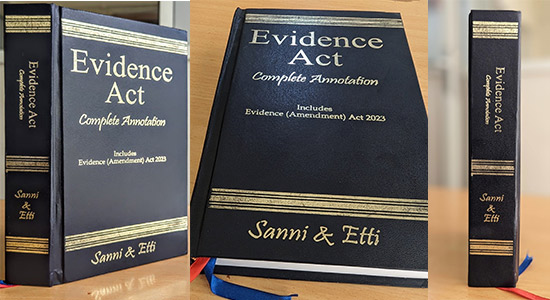
Available now for NGN 40,000 at ASC Publications, 10, Boyle Street, Onikan, Lagos. Beside High Court, TBS. Email publications@ayindesanni.com or WhatsApp +2347056667384. Purchase Link: https://paystack.com/buy/evidence-act-complete-annotation
______________________________________________________________________ “Enhance Legal Practice With Authoritative Reports” — Alexander Payne Offers Comprehensive Law Reports, Spanning Over A Century Of Nigerian Jurisprudence Interested buyers are encouraged to place their orders and enquiries via:
0704 444 4777, 0704 444 4999, 0818 199 9888
Website: www.alexandernigeria.com
“A Comprehensive Guide To Evidence Law” — Releases Second Edition In Three Volumes, Covering 4,051 Cases
For enquiries and orders, contact: 08035526491 Email: jerryamadisilk@gmail.com
 Prof. Jerry Amadi’s Evidence Law, Second Edition (2026), contains 3,314 pages in three volumes, covering the Evidence Act 2011, its 2023 amendment, and 4,051 Nigerian and English cases.