
The National Judicial Institute (NJI) has stated that conflicting judgments and orders, which sometimes arise from courts of coordinate jurisdiction, are not signs of judicial failure.

The NJI Administrator, Justice Babatunde Adejumo, made this known on Thursday in Abuja during a pre-conference media briefing ahead of the 2025 All Nigerian Judges’ Conference.
Responding to recent conflicting orders issued by courts in Abuja and Ibadan ahead of the Peoples Democratic Party (PDP) national convention, Justice Adejumo explained that such occurrences are inherent in the judicial process and contribute to the development and clarification of the law.
He noted that differences in judgments stem from judges’ varying interpretations of facts and evidence presented before them, as well as their individual understanding of the law.
“Judges give judgments based on the facts and evidence presented before them. Even in the United States, which has one of the oldest and most sophisticated judicial systems, state courts often give different opinions on similar issues,” he said.
Justice Adejumo explained that such differences are natural and are resolved through the judicial hierarchy—from the High Courts to the Court of Appeal, and finally the Supreme Court.
“If two or three courts give conflicting decisions on the same subject matter, the appellate courts exist to resolve them. Whatever the Supreme Court decides becomes final and binding,” he added.
He, however, cautioned that while lower courts are not bound by decisions of courts of coordinate jurisdiction, it would amount to “judicial rascality” for any lower court to contradict a higher court’s decision.
“Once the Supreme Court has spoken, no division of the Court of Appeal or lower court should issue a contrary decision, except for clarifying ambiguities in interpretation,” he said.
Justice Adejumo further called for procedural reforms to minimize conflicting rulings, suggesting that litigants should be required to swear an affidavit confirming that the same matter has not been filed in another court. He said any breach of such a rule should amount to perjury.
Reflecting on his 30-year judicial career, Adejumo recounted his experience as former President of the National Industrial Court of Nigeria (NICN), noting the transformation that elevated the court to a superior status in the nation’s judicial hierarchy.
“When I assumed office in 2003, the National Industrial Court had only two divisions in Lagos and Abuja, and 123 staff members. Through sustained advocacy, we secured the enactment of the National Industrial Court Act, 2006, and later a constitutional amendment that established the court as a superior court of record,” he recalled.
The amendment, achieved through extensive consultation with the National Assembly and the endorsement of 33 state assemblies, elevated the NICN to the fourth-highest court in Nigeria and granted its president full membership in the National Judicial Council and the Federal Judicial Service Commission.
Describing the NJI as “the heartbeat of the Nigerian Judiciary,” Adejumo said it serves as a vital platform for judges to engage with the public, legal professionals, and journalists to assess and improve judicial performance.
He reaffirmed his commitment to strengthening judicial education through the institute and correcting misconceptions about the judicial process.
“A judge does not manufacture evidence. In criminal cases, guilt must be proven beyond a reasonable doubt. Any element of doubt must be resolved in favour of the accused,” he stressed.
He added that judgments are based strictly on facts, evidence, witnesses, the law, and precedents, emphasizing, “It is better for one hundred guilty persons to go free than for one innocent person to be wrongly convicted.”
Justice Adejumo expressed optimism that the forthcoming 2025 All Nigerian Judges’ Conference would deepen judicial understanding, enhance professional standards, and strengthen public confidence in the justice system.
 The promotion, which commenced on January 8 and runs until February 8, 2026, offers five core maritime law books authored by Dr. Emeka Akabogu, SAN, ordinarily valued at N405,000, for just N150,000 — a 63% discount.
Interested buyers can place their orders through the following channels:
Phone: 0704 329 3271
Online Store: https://paystack.shop/aa-bookstore
Website: www.akabogulaw.com
_______________________________________________________________________
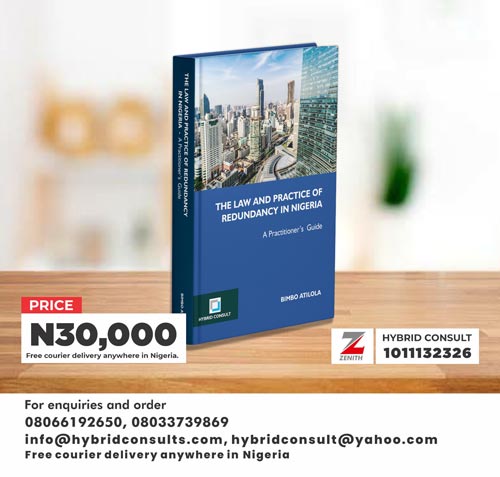
The Law And Practice Of Redundancy In Nigeria: A Practitioner’s Guide, Authored By A Labour & Employment Law Expert Bimbo Atilola
The promotion, which commenced on January 8 and runs until February 8, 2026, offers five core maritime law books authored by Dr. Emeka Akabogu, SAN, ordinarily valued at N405,000, for just N150,000 — a 63% discount.
Interested buyers can place their orders through the following channels:
Phone: 0704 329 3271
Online Store: https://paystack.shop/aa-bookstore
Website: www.akabogulaw.com
_______________________________________________________________________
The Law And Practice Of Redundancy In Nigeria: A Practitioner’s Guide, Authored By A Labour & Employment Law Expert Bimbo Atilola
 _______________________________________________________________________
[A MUST HAVE] Evidence Act Demystified With Recent And Contemporary Cases And Materials

Available now for NGN 40,000 at ASC Publications, 10, Boyle Street, Onikan, Lagos. Beside High Court, TBS. Email publications@ayindesanni.com or WhatsApp +2347056667384. Purchase Link: https://paystack.com/buy/evidence-act-complete-annotation
______________________________________________________________________ ARTIFICIAL INTELLIGENCE FOR LAWYERS: A COMPREHENSIVE GUIDE
Reimagine your practice with the power of AI “...this is the only Nigerian book I know of on the topic.” — Ohio Books Ltd
Authored by Ben Ijeoma Adigwe, Esq., ACIArb (UK), LL.M, Dip. in Artificial Intelligence, Director, Delta State Ministry of Justice, Asaba, Nigeria.
Bonus:
Get a FREE eBook titled “How to Use the AI in Legalpedia and Law Pavilion” with every purchase.
ARTIFICIAL INTELLIGENCE FOR LAWYERS: A COMPREHENSIVE GUIDE
Reimagine your practice with the power of AI “...this is the only Nigerian book I know of on the topic.” — Ohio Books Ltd
Authored by Ben Ijeoma Adigwe, Esq., ACIArb (UK), LL.M, Dip. in Artificial Intelligence, Director, Delta State Ministry of Justice, Asaba, Nigeria.
Bonus:
Get a FREE eBook titled “How to Use the AI in Legalpedia and Law Pavilion” with every purchase.
How to Order: 📞 Call, Text, or WhatsApp: 08034917063 | 07055285878 📧 Email: benadigwe1@gmail.com 🌐 Website: www.benadigwe.com
Ebook Version: Access directly online at: https://selar.com/prv626