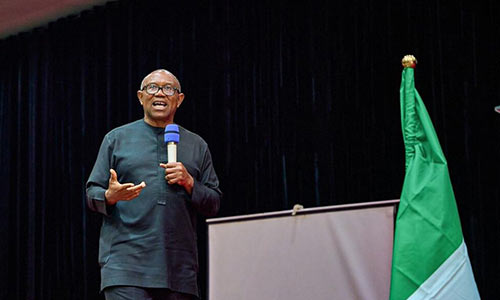
Many top leaders of the African Democratic Congress, including former Labour Party presidential candidate Peter Obi and former Kano State Governor Rabiu Musa Kwankwaso, are planning to defect to the National Democratic Congress ahead of the 2027 general elections, with sources close to Obi confirming that the move could happen “between now and next week,” as growing dissatisfaction with the ADC’s internal structure, rising legal uncertainties despite the Supreme Court’s judgment, and a running battle with the Atiku Abubakar faction over the presidential ticket have forced the opposition’s most prominent figures to seek what they describe as “a safer platform.”

The planned exodus, comes just two days after the Supreme Court set aside the status quo ante bellum order in the ADC leadership case, a ruling that was widely celebrated as a victory for the Mark-led ADC but which, upon closer examination, resolved nothing about the party’s substantive leadership dispute, left multiple lawsuits pending across different courts, and may ultimately prove to be what one ADC chieftain described as “postponing the evil day.”
The development also follows the Attorney-General of the Federation’s intervention in a suit seeking to deregister the ADC and four other parties, INEC’s May 10 deadline for submission of membership registers just eight days away, and what sources describe as an internal power struggle within the ADC coalition that has produced two competing tendencies: an Obi/Kwankwaso ticket versus an Atiku/Makinde or Atiku/Amaechi ticket.
Sources close to Peter Obi provided detailed reasons for the planned move.
“I can confirm to you that His Excellency Peter Obi has been consulting many of us who are stakeholders. And considering what is playing out in the ADC, the party seems to be designed and structured to favour an individual aspirant. They are also not ready to zone their presidential ticket to the South,” a source familiar with the development stated.
“If the party structure is skewed in favour of an aspirant, obviously that aspirant will win, and it will not amount to a credible primary election,” the source added.
The source cited the cascading legal crises as a further motivation: “If you look at the numerous litigations in the party and the crisis rocking it, His Excellency has concluded that the platform is not formidable for him to contest on.”
The source disclosed that Obi’s camp had already engaged with the NDC: “Recall that Obi promised his supporters and Nigerians that his name will be on the ballot. We have met with the NDC and they have promised an unchallenged presidential ticket for him to run in 2027.”
“All things being equal, in a couple of days between now and next week he is expected to dump the ADC for the NDC. It will be a massive move, and all his supporters are also expected to move with him to the NDC. That is what I know,” the source stated.
A second aide confirmed the plan: “From my findings and understanding, he is going to make this intention known to all Nigerians and take action in the coming days.”
Yunusa Tanko, the National Coordinator of the Obidient Movement, declined to confirm or deny the development when contacted but issued a carefully worded statement that neither closed the door on the ADC nor committed to it.
“I would neither confirm nor deny at the same time until such a pronouncement is made officially,” Tanko stated.
“What I want to tell Nigerians is that His Excellency Peter Obi has continuously been saying that he will be on the ballot to run for the office of the President of the Federal Republic of Nigeria. I believe in him, and I want Nigerians to believe that as well,” Tanko added.
“What I said is clear: I said he will run on a platform. I did not say which platform,” Tanko stated, a formulation that conspicuously avoids naming the ADC as that platform.
The NDC Deputy Publicity Secretary, Abdulmumin Abdulsalam, confirmed that discussions involving both Obi and Kwankwaso had been ongoing with the party’s National Leader, Senator Seriake Dickson.
“The most I can tell you is that they have been interfacing with our leader for quite some time. Also, do not forget that there is a possibility of an alliance that has been under discussion for quite some time,” Abdulsalam stated.
“With the legal twist we are witnessing now, the legal uncertainties, I think there might be some credence to that. However, I cannot categorically confirm to you that it is true, but you should know that, to a very large extent, there is a possibility of it happening,” the NDC official added.
He went further: “Obi is most welcome in the party, not just him, even Kwankwaso too. They have discussed with our national leaders, so you should just watch out.”
In the most explicit statement yet, Abdulsalam disclosed: “We received their names about a month ago from the ADC. We are willing to give them the presidential ticket. We are willing to only Providence, except if Providence decides otherwise we are willing, and they will join us.”
The NDC had earlier publicly offered Obi and Kwankwaso a joint ticket with a two-week window to defect. “All we need right now — just all we need. Two weeks to deadline,” the party stated.
A “Unity Summit” themed “One Voice, One Vision, In Unity We Win” has been scheduled for May 2, 2026, at the Barcelona Hotel in Abuja, under the banner of the “Obi/Kwankwaso 2027 Movement.”
Speakers billed to address the summit include Alhaji Buba Galadima, Aisha Yesufu, Dr. Moses Paul, Mr. Isaac Fayose, Hon. John Ughulu, and Dr. Adebayo Adefolaseye, representing a cross-section of political activists and commentators aligned with the Obi-Kwankwaso tendency within the opposition.
The scheduling of a formal summit with its own branding, speaker lineup, and public announcement suggests the Obi/Kwankwaso alliance has advanced beyond informal consultations to organised political action, regardless of which party platform ultimately hosts the ticket.
Also, a key figure in the Kwankwasiyya movement in Dala Local Government Area of Kano State, Hon. Kabiru Adamu Abdullahi, has resigned from the All Democratic Congress (ADC).
In a resignation letter dated May 1, 2026, and addressed to the party chairman in Kofar Ruwa Ward, Abdullahi said he was leaving the party with immediate effect.
“I hereby formally resign my membership of All Democratic Congress (ADC) at Kofar Ruwa Ward with immediate effect.
“I sincerely appreciate the opportunity given to me to be part of the party and wish you and the party the very best in your future endeavors.
“Kindly accept this as my official notice and communicate same to the appropriate authorities,” he said in the statement he shared on Facebook.
Abdullahi, who is a House of Assembly aspirant, is considered one of the prominent Kwankwasiyya leaders in Dala.
In a separate post on his Facebook page, he linked his decision to the directive of the movement’s leader.
“This is the order of Jagora,” he wrote, using the term members commonly used to refer to their leader, Senator Rabiu Musa Kwankwaso.
In a development that signals the direction of travel, former Adamawa State governorship candidate Senator Aishatu Binani formally joined the NDC on Friday, just nine months after leaving the APC for the ADC.
“After carefully studying the party’s constitution, I saw a strong commitment to structured, policy-driven governance,” Binani stated.
She described her move as driven by her supporters: “My foremost priority has always been the interest of my supporters. About nine months ago, we collectively made the decision to join our former party. But over time, for reasons best known to them, my supporters felt it was necessary to move on.”
NDC National Leader Senator Dickson welcomed Binani and used the occasion to issue a broader invitation: “Let me extend an open invitation to all Nigerian political leaders who may have doubts about the viability, sustainability, and strength of their current political platforms. The NDC is open. We are ready to receive and work with you.”
“Every Nigerian has the constitutional right to join any political party at any time — and to leave at any time. If the vehicle you boarded is no longer taking you to your destination, you have every right to step down and board a better one. The NDC is that better vehicle,” Dickson stated.
ADC leaders who spoke to newsmen after the Supreme Court judgment described it in terms far more sober than the celebratory reactions that dominated social media.
“There is not much joy to celebrate in the judgment,” one ADC chieftain stated. “There is nothing much to celebrate in the verdict. It is like postponing the evil day. The substantive matter is at the Federal High Court and we have many bridges to cross on that.”
“If, as expected, the Tinubu administration manipulates the judiciary against us, that will be too late for us, and it may hand Tinubu a cheap victory,” the source warned.
“That’s why, after reviewing the Supreme Court judgment, many of our leaders in the coalition, including the Turaki-led PDP, said we shouldn’t abandon the search for a safer platform. We need to beat Tinubu at his game. We are considering NDC and hope to finalise discussions on that in a few days,” the ADC chieftain stated.
The source also raised the alarm about government sabotage of the NDC: “We are also aware of the President’s move to sponsor crises in the NDC, as they have been doing in every opposition party. The Peoples Redemption Party had indicated interest in working with us and, after a day, the government brought a faction from the party. They are planning to do that in NDC as well, but we shall overcome.”
An NNPP chieftain described the Supreme Court verdict as “a trap ahead,” stating: “There is no way the ADC will escape the trap.” When asked about the possible exit of Obi and Kwankwaso, the official responded: “Something like that. It is like that.”
The ADC’s Legal Minefield
Beyond the Supreme Court’s ruling, the ADC faces a complex web of litigation that threatens to consume its remaining time before INEC’s deadlines.
The Gombe suit (FHC/ABJ/CS/1819/2025): The substantive case that the Supreme Court returned to the Federal High Court. Justice Nwite had adjourned indefinitely to await the Supreme Court verdict. With the apex court having ruled, Nwite is expected to resume hearing next week. Gombe is challenging the legality of the Mark-led caretaker committee and seeking to invalidate all its actions.
The Abejide suit (FHC/ABJ/CS/1637/2025): Filed by Rep. Leke Abejide, who has since left the party, seeking to bar Mark and Aregbesola from parading themselves as party leaders, nullify Nwosu’s handover to them, and restrain INEC from recognising them. Justice Musa Liman has concluded hearings but has not delivered judgment.
The Abdulmalik judgment (FHC/ABJ/CS/581/2026): Delivered on April 29, restraining INEC from recognising congresses organised by the Mark-led committees and upholding state executives’ tenure. The Mark faction has expressed intention to appeal.
The Kachikwu suit (FHC/ABJ/CS/1331/2025): Filed by ADC’s 2023 presidential candidate challenging the Mark-led takeover. Dismissed by Justice Abdulmalik on March 5 as non-justiciable, but the plaintiffs appear unsatisfied.
The deregistration suit (FHC/ABJ/CS/2637/2026): Filed by the National Forum of Former Legislators seeking to compel INEC to deregister the ADC and four other parties for failing to meet constitutional performance thresholds under Section 225A. The AGF has filed processes supporting the suit.
The involvement of the Attorney-General of the Federation, Prince Lateef Fagbemi SAN, in the deregistration suit represents perhaps the most existential threat to the ADC’s participation in 2027.
Fagbemi argued that “the continued existence of the ADC and the other parties violates extant provisions of the 1999 Constitution and ultimately undermines the nation’s electoral integrity.”
He maintained that INEC “has no residual discretion to retain the registration of political parties that have clearly failed to satisfy the minimum threshold prescribed under Section 225A of the Constitution.”
“The continued existence of non-performing political parties will inflate the ballots, burden public funds, complicate election administration, and undermine the constitutional intention behind Section 225A,” the AGF stated.
The AGF sought the deregistration of the ADC alongside the Action Peoples Party, Action Alliance, Accord Party, and Zenith Labour Party.
The opposition views the AGF’s intervention as further evidence of government orchestration of the campaign to eliminate opposition platforms. The fact that the chief law officer of the federation is actively supporting a suit to deregister the main opposition party, while the government simultaneously faces allegations of sponsoring internal crises within the same party, has reinforced the opposition’s narrative of state capture.
Even if the ADC survives its legal challenges, it faces an equally daunting internal challenge: choosing one presidential candidate from a field of heavyweights who each command regional bases, personal loyalists, and individual ambitions.
The names linked to the race include Peter Obi, Atiku Abubakar, Rabiu Kwankwaso, Rotimi Amaechi, and Mohammed Hayatu-Deen.
Sources describe two competing tendencies. One camp favours an Obi/Kwankwaso ticket, described as “making the presidency jittery” and enjoying the backing of “many youths, professionals and retired generals across the country.” The other camp favours an Atiku/Makinde or Atiku/Amaechi ticket, said to have attracted support from ADC leaders in the South-West and the North and potentially prevailing in direct primaries.
Some insiders suggest a compromise candidate may emerge if frontrunners refuse to yield, a “dark horse option” that could resolve the deadlock but would likely disappoint the supporters of each frontrunner.
The danger, as observers note, is simple: “If the primary becomes bitter, losers may walk away — repeating the old Nigerian opposition cycle.” And unlike in the past, those who walk away may not have a platform to contest given INEC’s tight timelines and the provisions of the 2026 Electoral Act.
The most immediate pressure point is INEC’s May 10 deadline for political parties to submit their membership registers, just eight days away.
Under Section 77(4) of the Electoral Act 2026, political parties must submit their membership registers no later than 21 days before conducting primary elections. With primaries required to be completed by May 30, the May 10 deadline is mathematically non-negotiable.
For Obi, Kwankwaso, or any other figure considering a move from the ADC to the NDC, their names must appear on the NDC’s membership register by May 10 to be eligible to participate in NDC primaries. This creates an extremely tight window for the planned defection, which sources say could happen “between now and next week.”
ADC National Publicity Secretary Bolaji Abdullahi dismissed the reports of an impending exodus.
“You are just telling me that; I am not aware of any move by any of the coalition leaders to adopt another platform,” Abdullahi stated.
He added: “Not minding the Tinubu-sponsored crises in opposition parties, his aim to be the only candidate on the ballot will fail.”
However, the denials sit uneasily against the weight of evidence: the NDC confirming discussions, sources close to Obi confirming plans, the Unity Summit scheduled for May 2, and the growing acknowledgment among ADC leaders that the Supreme Court judgment was, at best, a temporary reprieve.
Multiple sources across the political landscape reported that Obi and Kwankwaso’s silence following the Supreme Court judgment was itself significant.
“There are credible rumours that Obi and Kwankwaso didn’t react to the Supreme Court judgment because they had already moved on. They are said to be heading to the NDC and no longer care about what happens to the ADC,” sources stated.
The absence of public statements from two of the ADC’s most prominent figures on what was billed as a landmark judgment in their party’s survival is conspicuous and consistent with the reports of imminent departure.
Meanwhile, the Supreme Court’s nullification of the PDP’s Ibadan convention has produced its own factional manoeuvring.
FCT Minister Nyesom Wike declared there are “no more factions in the PDP,” insisting his camp is now in charge. The Turaki-led group countered that the party is now without leadership. The Senator Adolphus Wabara-led factional Board of Trustees moved to assume leadership and issued directives to PDP organs on Thursday night.
The PDP’s continued fragmentation further narrows the opposition’s options and strengthens the case for those within the ADC who argue that a move to the NDC represents the best chance of presenting a united opposition front before the electoral deadlines expire.
The opposition’s situation, viewed in its totality, is one of cascading crises.
The ADC has won a Supreme Court battle but faces a war on multiple fronts: the substantive Gombe suit returning to trial, the Abdulmalik judgment restricting its congress committee, the Abejide suit awaiting judgment, the AGF-backed deregistration suit, internal power struggles between competing presidential tendencies, the planned defection of key figures to the NDC, the May 10 membership register deadline, and the May 30 primaries deadline.
The PDP has been gutted by the Supreme Court’s nullification of its convention, with competing factions fighting over the remains.
The Labour Party remains entangled in its own leadership crisis.
And the government, through the AGF, INEC, and what the opposition describes as sponsored litigation and internal sabotage, continues to apply pressure across all opposition platforms simultaneously.
For Obi, Kwankwaso, and the other opposition leaders who promised Nigerians they would be on the ballot in 2027, the choice is becoming starkly simple: stay in a party that may not survive its legal battles, or move to one that may face the same treatment but at least offers a fresh start.
As one ADC chieftain stated: “We need to beat Tinubu at his game.”
Whether that game can be won from the NDC, or whether the government’s alleged pattern of sponsoring crises in opposition parties will simply follow them to their new platform, is the question that the coming days will answer.
The May 10 deadline waits for no one. The clock is ticking. And the opposition’s next move could determine whether the 2027 elections feature a credible multi-party contest or the one-party outcome that Governor Uba Sani has already celebrated in Kaduna.
[A MUST HAVE] Evidence Act Demystified With Recent And Contemporary Cases And Materials

Available now for NGN 40,000 at ASC Publications, 10, Boyle Street, Onikan, Lagos. Beside High Court, TBS. Email publications@ayindesanni.com or WhatsApp +2347056667384. Purchase Link: https://paystack.com/buy/evidence-act-complete-annotation
______________________________________________________________________ “Enhance Legal Practice With Authoritative Reports” — Alexander Payne Offers Comprehensive Law Reports, Spanning Over A Century Of Nigerian Jurisprudence Interested buyers are encouraged to place their orders and enquiries via:
0704 444 4777, 0704 444 4999, 0818 199 9888
Website: www.alexandernigeria.com
Interested buyers are encouraged to place their orders and enquiries via:
0704 444 4777, 0704 444 4999, 0818 199 9888
Website: www.alexandernigeria.com