In words of Justice Hillary Oshomah “#the the reliefs sort by the plaintiff are totally misconceived, unmeriterous and not granted. On this decision, this honourable court dismiss this suit”. Now, for us to know whether or not the decision is erroneous, it would be suitable to briefly and critically examine the relevant statutory provisions alongside the court’s decision. Section 1(2) Legal Education (Consolidation) Act, 1976 provides that “#the Council of Legal Education shall have responsibility for the legal education of persons seeking to become members of the legal profession in Nigeria”. Furthermore, Section 5(b) of same Act is to the effect that the Council of Legal Education is empowered to prescribe condition precedent for admission into the Nigerian Law School; for instance fit and proper principle or good conduct. See #Okonjo v. Council of Legal Education, FCA/L16/78 1979 Digest of Appeal Cases (DAC) 28). In other words, the Council of Legal Education is indeed a regulatory body saddled with the responsibility of setting down rules and regulations that must be met for anyone aspiring to be a legal practitioner in Nigeria. In the light of the following the court was right when it held that “#the power to admit students into law school is intrinsic and since the first defendant (CLE) does not share its power with any other person, that on issue of who to admit students and criteria of admitting that student is a matter of the domestic confines of council of Legal Education.” The court further held “this court cannot decide to order University Commission or Council of Legal Education to admit students from National Open University of Nigeria into law school for reasons being that they obtained their law degree by part-time or distance education.” Conclusively, it is also important to note that having an LL.B certificate does not make one eligible for admission into law school, hence, if an aspirant does not possess other necessary requirements and/or the institution he/she graduated therefrom is not accredited by Council of Legal Education, then such person is not qualified. From all I have said above, it is apparent that the position of the court is correct. James Obiadazie [LL.B in-view] University of Nigeria, Nsukka ]]>

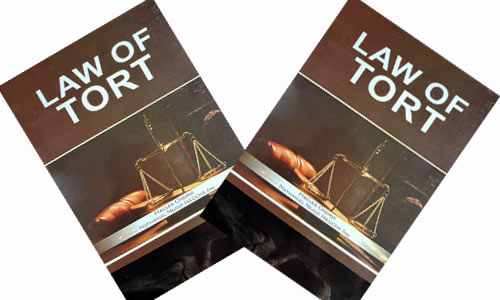 The book, titled The Law of Torts in Nigeria: A Functional Approach, authored by Professor Hagler Sunny Okorie Ph.D and Ikeocha, Nathaniel Ngozi Esq, offers law students, practitioners, and academics a comprehensive guide to understanding and applying tort law in Nigerian courts. Interested buyers can place orders via the following contact numbers: 08028636615, 08037667945, 08032253813, or +234 902 196 2209.
______________________________________________________________________
[A MUST HAVE] Evidence Act Demystified With Recent And Contemporary Cases And Materials
The book, titled The Law of Torts in Nigeria: A Functional Approach, authored by Professor Hagler Sunny Okorie Ph.D and Ikeocha, Nathaniel Ngozi Esq, offers law students, practitioners, and academics a comprehensive guide to understanding and applying tort law in Nigerian courts. Interested buyers can place orders via the following contact numbers: 08028636615, 08037667945, 08032253813, or +234 902 196 2209.
______________________________________________________________________
[A MUST HAVE] Evidence Act Demystified With Recent And Contemporary Cases And Materials

 ARTIFICIAL INTELLIGENCE FOR LAWYERS: A COMPREHENSIVE GUIDE
Reimagine your practice with the power of AI “...this is the only Nigerian book I know of on the topic.” — Ohio Books Ltd
Authored by Ben Ijeoma Adigwe, Esq., ACIArb (UK), LL.M, Dip. in Artificial Intelligence, Director, Delta State Ministry of Justice, Asaba, Nigeria.
Bonus:
Get a FREE eBook titled “How to Use the AI in Legalpedia and Law Pavilion” with every purchase.
ARTIFICIAL INTELLIGENCE FOR LAWYERS: A COMPREHENSIVE GUIDE
Reimagine your practice with the power of AI “...this is the only Nigerian book I know of on the topic.” — Ohio Books Ltd
Authored by Ben Ijeoma Adigwe, Esq., ACIArb (UK), LL.M, Dip. in Artificial Intelligence, Director, Delta State Ministry of Justice, Asaba, Nigeria.
Bonus:
Get a FREE eBook titled “How to Use the AI in Legalpedia and Law Pavilion” with every purchase.
How to Order: 📞 Call, Text, or WhatsApp: 08034917063 | 07055285878 📧 Email: benadigwe1@gmail.com 🌐 Website: www.benadigwe.com
Ebook Version: Access directly online at: https://selar.com/prv626
 _______________________________________________________________________
“Enhance Legal Practice With Authoritative Reports” — Alexander Payne Offers Comprehensive Law Reports, Spanning Over A Century Of Nigerian Jurisprudence
_______________________________________________________________________
“Enhance Legal Practice With Authoritative Reports” — Alexander Payne Offers Comprehensive Law Reports, Spanning Over A Century Of Nigerian Jurisprudence
 Interested buyers are encouraged to place their orders and enquiries via:
0704 444 4777, 0704 444 4999, 0818 199 9888
Website: www.alexandernigeria.com
Interested buyers are encouraged to place their orders and enquiries via:
0704 444 4777, 0704 444 4999, 0818 199 9888
Website: www.alexandernigeria.com