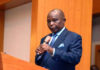
Nigeria’s minister of finance and coordinating minister of the economy, Wale Edun, has ruled out any return to fuel and foreign exchange subsidies, warning that reversing recent reforms could undermine the country’s fragile economic gains despite a potentially favourable oil price environment.

Speaking at a press conference after the Intergovernmental Group of 24 meetings in Washington DC, Edun who chairs the G24, stressed that while higher crude prices may boost revenues for oil-producing countries like Nigeria, the broader impact of the ongoing global energy shock presents a more complex and less benign reality.
According to him, “it is important that we don’t have a return to generalized subsidies, a sort of relapse into policies that have not proven successful in the past,” noting that recent reforms under President Bola Ahmed Tinubu were already delivering progress before being disrupted by external shocks.
President Bola Ahmed Tinubu had at the inception of his tenure in 2023 scrapped petrol subsidies and liberalised its foreign exchange regime in, moves widely seen as critical to restoring macroeconomic stability but which have also triggered a sharp rise in the cost of living.
Edun argued that the current global crisis which is driven by geopolitical tensions and energy market disruption, should not derail those reforms, even as households come under increasing pressure.
Rather than a wholesale rollback, he advocated targeted and temporary interventions aimed at cushioning the poorest and most vulnerable economies against rising prices. “We have to use targeted and temporary relief as opposed to rolling back the transformations which economies have taken,” he said.
His comments come amid renewed debate over whether oil-exporting nations like Nigeria stand to benefit from rising crude prices. While acknowledging that higher prices could strengthen fiscal and external balances, Edun cautioned that the gains are offset by inflationary spillovers.
“It’s not a one-way street,” he explained, noting that increased energy costs feed into higher prices for fertiliser, food and transportation, thereby eroding real incomes even in oil-producing economies.
On the monetary side, Edun warned that central banks must tread carefully to avoid worsening the situation through overly aggressive tightening. “There’s a critical balancing role here,” he said, cautioning that raising interest rates too early or too sharply could damage ongoing economic transformations, while delayed action could allow inflation to spiral.
This was corroborated by the Director G24 Secretariat, Iyabo Masha, who argued that supply-driven inflation, particularly from oil production constraints does not respond effectively to higher interest rates.
She urged policymakers to adopt a more cautious, data-dependent approach, noting that central banks should only tighten decisively if inflation begins to feed into wages and broader demand pressures.
“Unless these inflationary pressures are going into wages central banks should at least balance and wait and see how things evolve,” she said.
The G24 raised concerns about the deteriorating external financing environment for developing economies. G24 Chair and Nigeria’s Minister of Finance, Edun revealed that many countries are now experiencing net financial outflows, with debt servicing costs far exceeding inflows from aid and investment.
According to him, developing countries paid about $163 billion in debt servicing in 2024, compared to just $47 billion in overseas development assistance, even when foreign direct investment is included.
This imbalance, he noted, is constraining the ability of countries like Nigeria to invest in growth and poverty reduction.
“We are in a period where developing countries… are facing a net outflow,” Edun said, calling for stronger support from multilateral institutions such as the International Monetary Fund and the World Bank.
He, however, emphasised that the long-term solution lies in strengthening domestic resource mobilisation, including tax reforms and improved revenue collection, to reduce reliance on external financing.
As global uncertainties persist, the message from Nigeria’s economic managers is clear: reforms must hold, even in the face of rising pressures, while policymakers carefully navigate the delicate balance between stabilisation and growth.
[A MUST HAVE] Evidence Act Demystified With Recent And Contemporary Cases And Materials

Available now for NGN 40,000 at ASC Publications, 10, Boyle Street, Onikan, Lagos. Beside High Court, TBS. Email publications@ayindesanni.com or WhatsApp +2347056667384. Purchase Link: https://paystack.com/buy/evidence-act-complete-annotation
______________________________________________________________________ “Enhance Legal Practice With Authoritative Reports” — Alexander Payne Offers Comprehensive Law Reports, Spanning Over A Century Of Nigerian Jurisprudence Interested buyers are encouraged to place their orders and enquiries via:
0704 444 4777, 0704 444 4999, 0818 199 9888
Website: www.alexandernigeria.com
Interested buyers are encouraged to place their orders and enquiries via:
0704 444 4777, 0704 444 4999, 0818 199 9888
Website: www.alexandernigeria.com