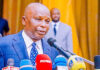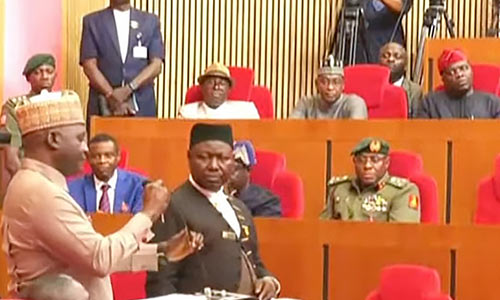
The Nigerian Senate has unanimously confirmed retired General Christopher Gwabin Musa as the country’s new Minister of Defence, capping a rigorous screening session marked by pointed questions on recent military lapses and a firm rejection of procedural shortcuts. Senate President Godswill Akpabio announced the approval during Wednesday’s plenary, emphasizing the nominee’s potential to address escalating insecurity, including kidnappings, insurgencies, and cross-border banditry.

Musa, a 39-year veteran of the Nigerian Army who served as Chief of Defence Staff from 2023 until his retirement, steps in for Mohammed Badaru, who resigned on Monday citing health concerns. Badaru, appointed in August 2023, had drawn public ire for remarks in a BBC Hausa interview about the challenges of bombing terrorists in dense forest hideouts.
The screening kicked off immediately after Akpabio read President Bola Tinubu’s nomination letter, with lawmakers demanding accountability for high-profile failures. Key concerns included the abduction of 24 students from Government Girls’ Comprehensive Secondary School in Maga, Kebbi State where troops allegedly withdrew just before the attack and the capture of Brigadier General Uba by terrorists.
When Senator Sani Musa moved for the nominee to “take a bow and go” without full interrogation, Akpabio swiftly overruled him, suspending chamber rules to allow Musa direct entry for questioning. “This is not the time for politics of ‘bow and go’. Even Donald Trump is on our neck. We’ve not asked him what his response will be to Donald Trump. A nominee for Minister of Defence, and you stand up and say he should take a bow and go, with so many questions on the mouth of Nigerians and over 200 children still in the bush and being tortured. Let’s give the man the opportunity to give Nigerians hope,” Akpabio declared, underscoring the gravity of the moment.
Musa, undeterred, vowed exhaustive probes into these incidents. On the Kebbi abductions: “It’s unfortunate that troops were there and then left shortly before something happened. We are going to investigate, and all those found culpable will face the law accordingly.” Regarding General Uba’s capture and reported death, he expressed profound shock: “It’s very unfortunate for a brigadier general to be captured that way. I was wondering how General Uba could have been alone when he was supposed to have his own troops with him. There are questions that need answers, and we will get to the bottom of this, including why those troops withdrew at Baga, Kebbi.” He pledged a full inquiry into the military’s withdrawal before the schoolgirls’ abduction and the circumstances surrounding Uba’s death.
Enforcing discipline, Musa promised a zero-tolerance stance: “No indolence, no act of cowardice will be entertained. We are going to make sure that we follow them—from the commanders down to the troops. They must be professional.”
Delving into systemic issues, Musa addressed perceptions of regional disparities, crediting the South-West’s relative success to governors’ collective resolve. “The South-West seems to be doing very well because all the governors agreed together. And that’s why, regionally, governors must come together, because two or three are better than one,” he said, urging leaders from other zones to emulate this unity. He highlighted bandits’ border-hopping tactics: “The bandits do not respect borders. They do not at all. How they get their strength is their ability to run when you attack them, especially around the Sokoto area. They enter Niger Republic, and once they get to Niger Republic you can’t touch them until they come back in. We need to also build up the capacity to hold up towards the border with Mali and Burkina Faso, because we are beginning to have those incursions into Kwara, coming down South-West. And we must stop them not to get further than that.”
On pervasive violence, including genocide allegations, Musa framed it as a national affliction: “On the issue of genocide, we are all victims. Everybody is being killed.” To restore civilian life, he prioritized agriculture: “Farmers must be able to go back to their farms. Protecting the farm work is very important.” He revealed plans to reduce military checkpoints nationwide, redirecting troops to targeted operations in forests and ungoverned spaces, while emphasizing food security as a stability pillar: “A hungry man is an angry man. Protecting farmers means protecting the nation.”
Musa raised alarms over emerging threats, including renewed maritime crimes along Akwa Ibom Cameroon corridors such as sea robbery, piracy, and coastal kidnappings confirming the expansion of Operation Delta Safe to counter infiltrations. He also decried cultism and illegal mining as key financing streams for armed groups in forest belts, calling for an outright ban on illicit extraction activities.
In a sweeping critique of Nigeria’s fragmented systems, Musa identified the lack of a unified national database as a critical barrier to effective counter-terrorism. “Nigeria’s fight against insecurity will remain ineffective until the country establishes a unified national database that captures every citizen and links all security, banking, and identity systems together,” he asserted. He lambasted “multiple data silos” managed by agencies like immigration and quarantine services, which create exploitable gaps for terrorists, kidnappers, bandits, cybercriminals, and mining syndicates. “Something as simple as a unified database for all citizens is urgently needed… Once you commit a crime, it should be easy to track and trace you. Other countries can instantly deactivate bank accounts or digital access; we must get to that point.”
He advocated integrating ICT to revolutionize investigations, enabling real-time tracing of ransom payments, suspicious transactions, and criminal networks. This tech backbone would also aid military recruitment, where over 70,000 Nigerians apply annually but many resist conflict-zone deployments; a national database could verify identities and curb fraud.
Musa took a hardline on ransoms: “There is no negotiation with any criminal. When people pay ransoms, it buys terrorists time to regroup, re-arm and plan new attacks. Communities that negotiated still got attacked later.” He insisted Nigeria’s banking system could trace such flows if fully leveraged, urging a total ban on payments at all levels of government.
Stressing that “kinetic efforts alone cannot win the war,” Musa pegged military operations at just 25–30 percent of the counter-insurgency equation, with poverty, illiteracy, poor governance, and weak local structures fueling crime. He challenged state and local administrators: “Take responsibility for community-level intelligence and early intervention security agencies cannot shoulder the entire national burden alone.”
He criticized the sluggish justice system, where terrorism and kidnapping trials drag on for years, eroding troop morale: “In some countries, terrorism cases are handled decisively. Here, cases drag for years. It discourages security forces who risk their lives to make arrests.” Musa recommended swift reforms, including special terrorism courts, harsher penalties, and expedited hearings.
Leveraging his career from commissioning as a Second Lieutenant in 1991, commanding Operation Hadin Kai in 2021, to leading the Nigerian Army Infantry Corps Musa assured lawmakers of his grasp of these challenges. “We can win this war, but we must work together; we must get the support,” he stated, committing to “daily operational reviews from ‘Day 1′” and close collaboration with service chiefs to plug gaps in delegated powers.
In a bold reform pitch, Musa called for government-to-government deals on defence acquisitions: “Defence equipment is very expensive; Nigeria needs government-to-government agreements for the procurement of military hardware and weapons.” He also pledged to brief the Senate on precise funding and resource needs to overcome the armed forces’ “gaps.”
Akpabio, in confirming the nomination, spotlighted concurrent Senate initiatives to designate kidnapping as terrorism and mandate the death penalty for perpetrators without fine options measures aimed at deterring abductions. Tinubu’s letter had lauded Musa’s expertise to “strengthen Nigeria’s security architecture” and revitalize the ministry.
Musa wrapped up with an impassioned plea, acknowledging public expectations: “I cannot afford to fail my nation or my family. Nigerians want peace, and we must deliver it.” He reiterated: “We are going to spend everything that is required to ensure that there is peace in Nigeria… our children are going to be secured and safe, but it’s going to be that all of us are working together.”

 ARTIFICIAL INTELLIGENCE FOR LAWYERS: A COMPREHENSIVE GUIDE
Reimagine your practice with the power of AI “...this is the only Nigerian book I know of on the topic.” — Ohio Books Ltd
Authored by Ben Ijeoma Adigwe, Esq., ACIArb (UK), LL.M, Dip. in Artificial Intelligence, Director, Delta State Ministry of Justice, Asaba, Nigeria.
Bonus:
Get a FREE eBook titled “How to Use the AI in Legalpedia and Law Pavilion” with every purchase.
ARTIFICIAL INTELLIGENCE FOR LAWYERS: A COMPREHENSIVE GUIDE
Reimagine your practice with the power of AI “...this is the only Nigerian book I know of on the topic.” — Ohio Books Ltd
Authored by Ben Ijeoma Adigwe, Esq., ACIArb (UK), LL.M, Dip. in Artificial Intelligence, Director, Delta State Ministry of Justice, Asaba, Nigeria.
Bonus:
Get a FREE eBook titled “How to Use the AI in Legalpedia and Law Pavilion” with every purchase.
How to Order: 📞 Call, Text, or WhatsApp: 08034917063 | 07055285878 📧 Email: benadigwe1@gmail.com 🌐 Website: www.benadigwe.com
Ebook Version: Access directly online at: https://selar.com/prv626
________________________________________________________________________ The Law And Practice Of Redundancy In Nigeria: A Practitioner’s Guide, Authored By A Labour & Employment Law Expert Bimbo Atilola _______________________________________________________________________
New Year Promo: Get Five Maritime Law Books For N150,000 — 63% Discount
_______________________________________________________________________
New Year Promo: Get Five Maritime Law Books For N150,000 — 63% Discount
 The promotion, which commenced on January 8 and runs until February 8, 2026, offers five core maritime law books authored by Dr. Emeka Akabogu, SAN, ordinarily valued at N405,000, for just N150,000 — a 63% discount.
Interested buyers can place their orders through the following channels:
Phone: 0704 329 3271
Online Store: https://paystack.shop/aa-bookstore
Website: www.akabogulaw.com
______________________________________________________________________
The promotion, which commenced on January 8 and runs until February 8, 2026, offers five core maritime law books authored by Dr. Emeka Akabogu, SAN, ordinarily valued at N405,000, for just N150,000 — a 63% discount.
Interested buyers can place their orders through the following channels:
Phone: 0704 329 3271
Online Store: https://paystack.shop/aa-bookstore
Website: www.akabogulaw.com
______________________________________________________________________