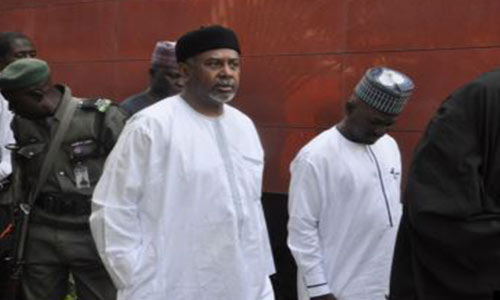
An Economic and Financial Crimes Commission (EFCC) witness insisted on Wednesday that one of former National Security Adviser (NSA) Sambo Dasuki’s co-defendant in their N33.2 billion arms funds diversion trial voluntarily wrote his extrajudicial statements without any form of coercion.

The Federal Capital Territory (FCT) High Court in Abuja had paused the main trial in January to conduct a trial-within-trial to ascertain Aminu Baba-Kusa, the second defendant’s claim of writing the statement under duress while in EFCC custody in 2015.
Salihu Kadir, an EFCC detective, testified as the third prosecution witness in the trial-within-trial on Wednesday.
His testimony echoed earlier testimonies of two other EFCC officials, who maintained that the defendant freely wrote the statements, which the prosecution sought to tender to prove its case in the trial.
“I supervised the recording of the Exhibit (extra-judicial statement), which was dated Nov 26, 2015. I administered the cautionary words,” Mr Kadir said, led by the prosecution lawyer, Oluwaleke Atolagbe. “The witness made his statement voluntarily after words of caution were read to him.”
Mr Dasuki and Mr Baba-Kusa are facing a joint trial for alleged diversion of N33.2 billion in arms and security funds entrusted to the NSA office.
The EFCC is prosecuted them alongside Mr Baba-Kusa’s companies – Acacia Holdings Limited and Reliance Referral Hospital Limited – which allegedly received part of the suspicious funds from the Office of the National Security Adviser (ONSA) under Mr Dasuki’s supervision.
The trial has lasted for over a decade, suffering spells of setbacks that stalled its progress.
EFCC had to re-arraign the defendants in March last year after the case was reassigned to the current trial judge, Charles Agbaza, kicking off a fresh start after about 10 years of complicated run.
The defendants all denied the charges again as they previously did before the former judge.
On 14 January, the EFCC tried to tender Mr Baba-Kusa’s statements as evidence, but Mr Baba-Kusa’s lawyer objected to their admissibility on the grounds that they were obtained under duress.
The defence argued that a statement made by someone while being held in the underground cell of the EFCC could not be said to have been freely made.
He also said there was no compliance with Section 15(4) and 17 (2) of the Administration of Justice Act 2015.
This prompted the judge to order trial-within-trial to ascertain the voluntariness of the statements.
“Statement was taken after a search of Mr Baba-Kusa’s office and house”
Mr Kadir’s EFCC’s third witness in the trial-within-trial said on Wednesday that the disputed statement was written at the EFCC’s office in the presence of the commission’s staff members, following words of caution.
The witness gave a brief description of the environment where Mr Baba-Kusa wrote the statement.
“The room is a general open room, and other persons were present in the room, and about three people on the part of the second defendant were witnesses to the statement taken.
“There was the company secretary, a lady, a finance controller, and a lawyer,” he said.
According to the EFCC investigator, Mr Baba-Kusa’s statement was taken after a search of his office and house. He said the statement captured items recovered from Mr Baba-Kusa’s house.
During cross-examination, defence lawyer to the fourth defendant, A.O. Ayodele, demanded to know why the witness did not append his signature on the dotted lines for the witness.
Responding, the witness said the law does not make it mandatory for the defendant to sign the statement but added that he wrote the statement in his handwriting.
While taking his turn to cross-examine the witness, Mr Baba-Kusa’s lawyer, Solomon Umoh, a Senior Advocate of Nigeria (SAN), said to him, “You were brought in to own up to be the one to present this statement because it was not signed by anybody, that was why they brought you to claim you took the statement.”
Denying the lawyer’s assertion, the witness said, “That is not correct, my Lord, this is my handwriting.”
Mr Umoh also questioned him about the video recording of Mr Baba-Kusa while writing the statement.
He confirmed that there was video recording of when Mr Baba-Kusa was writing his statement, saying such recording was not mandatory under the law.
He, however, said that there was a CCTV camera recording, but he urged the court to note that it was done about 10 years ago.
Responding to further question, he confirmed EFCC had the records of visitation of members of staff of Acacia Holdings Limited (a defendant in the case) to Mr Baba-Kusa during his detention by the commission.
After the EFCC investigator was discharged from the witness box, the prosecution informed the court that it had closed its case.
The trial judge, Mr Agbaza, adjourned proceedings until 15 May.
On 24 February, Halima Kazeem, an assistant commandant 1 at the EFCC, said Mr Baba-Kusa was treated well in custody in 2015
Similarly, Michael Adariku, an assistant commander 2 at the EFCC, refuted the suggestion of detaining him in an underground cell during investigations in 2015.
In the substantive trial, the EFCC has called one prosecution witness, Mr Adarikun, as the first prosecution witness.
Mr Adarikun narrated how N2.2 billion intended for election security was allegedly diverted from the NSA office under the leadership of Mr Dasuki.
So far, he has testified about transfers from Office of the National Security Adviser’s account, with the approval of Mr Dasuki, to Mr Babba-Kusa, who allegedly used the proceeds to buy properties and foreign currencies in euros and dollars.
The decade-old trial suffered multiple adjournments in its early years, largely due to the State Security Services (SSS) refusing to release Mr Dasuki on bail in defiance to multiple court orders.
Mr Dasuki served as NSA between 2012 and 2015, in the heat of Boko Haram attacks in Nigeria’s North-east, under the administration of then-President Goodluck Jonathan.
The N33.2 billion fraud trial is one of the several cases he EFCC filed in the aftermath of the scandal of alleged diversion of funds meant for procurement of arms to firm up the Nigerian military’s offensive against Boko Haram terrorists between 2014 and 2015.
An audit panel, established by President Muhammadu Buhari following his 2015 election victory, found that approximately $2 billion for arms procurement was unaccounted for. These funds were managed by the NSA, led by Mr Dasuki.
Mr Dasuki is also standing trial alongside former Sokoto State Governor Attahiru Bafarawa, his son Sagir Bafarawa, former Minister of State for Finance Bashir Yuguda, and Dalhatu Investment Limited for N4.6 billion arms procurement fraud.
The charges accused them of diverting N4.6 billion from the NSA office’s account. The money was said to be meant for the procurement of arms to firm up the offensive against Boko Haram terrorists between 2014 and 2015.
[A MUST HAVE] Evidence Act Demystified With Recent And Contemporary Cases And Materials

Available now for NGN 40,000 at ASC Publications, 10, Boyle Street, Onikan, Lagos. Beside High Court, TBS. Email publications@ayindesanni.com or WhatsApp +2347056667384. Purchase Link: https://paystack.com/buy/evidence-act-complete-annotation
______________________________________________________________________ “Enhance Legal Practice With Authoritative Reports” — Alexander Payne Offers Comprehensive Law Reports, Spanning Over A Century Of Nigerian Jurisprudence Interested buyers are encouraged to place their orders and enquiries via:
0704 444 4777, 0704 444 4999, 0818 199 9888
Website: www.alexandernigeria.com
Interested buyers are encouraged to place their orders and enquiries via:
0704 444 4777, 0704 444 4999, 0818 199 9888
Website: www.alexandernigeria.com