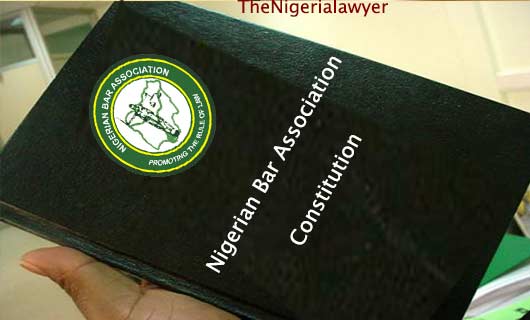
The Nigerian Bar Association unveiled its amended constitution, formally titled “Nigerian Bar Association Constitution 2015 (as amended in 2025),” which came into effect on August 28, 2025, upon its adoption at the Annual General Meeting held in Enugu.

This is the latest in a series of amendments, succeeding the 2021 amendment. NBA President Afam Osigwe SAN has already referenced the amended constitution in official communications, including his report to the NBA National Executive Council meeting held in Maiduguri.
Key Structural Features of the Amended Constitution
Governance Architecture
The constitution maintains a layered governance structure. The General Meeting remains the supreme authority of the Association. Below it sit the National Executive Council (a broad body comprising national officers, past presidents, branch chairmen and secretaries, and other categories of members with a quorum of 50), the National Executive Committee (the 10 elected national officers who meet monthly), and various standing committees.
The constitution provides for three categories of membership: full membership (lawyers enrolled at the Supreme Court and registered with a branch), honorary membership, and international membership. Only full members who have paid their practising fees have the right to vote or be voted for.
The ECNBA — Composition Controversy
One of the most immediately significant provisions is the composition of the Electoral Committee of the Nigerian Bar Association (ECNBA). Section 14(2)(m) of the constitution now provides that the ECNBA shall be made up of “a Chairman, a Secretary, and five (5) other members” — making a total of seven members.
This is directly relevant to the reference in President Osigwe’s NEC report where he noted that the initial ECNBA inaugurated had only five members (chaired by Aham Eke-Ejelam SAN), and that two additional members — Hadiza Nura Alfa and Umimke Helen Akpana — were being proposed to bring the committee to its full complement of seven as required by the amended constitution.
This is a noteworthy amendment. The previous constitution apparently provided for a smaller ECNBA. By expanding it to seven members, the amended constitution seeks to broaden representation on the body responsible for conducting what are often contentious national elections. The fact that the initial inauguration fell short of the constitutional requirement raises a procedural question: were the ECNBA’s actions before its full composition valid? Strictly speaking, the constitution mandates seven members, and a committee of five is not the committee the constitution established. However, this is likely to be treated as a curable irregularity rather than a fatal defect, particularly since the proposal to complete the membership was made promptly.
Election of National Officers — Zoning and Rotation
The constitution retains and reinforces the zoning arrangement for national offices. Nigeria is divided into three geographical zones for election purposes: Northern, Eastern, and Western. The offices of President, First Vice President, Second Vice President, Third Vice President, and General Secretary rotate among these zones. Notably, the zone that produces the President also produces the First Vice President.
The qualification requirements are detailed and tiered. For the top offices (President, First Vice President, General Secretary), candidates must be at least 15 years post-call and must have been members of the National Executive Council for at least two years. For mid-tier offices (Treasurer, Publicity Secretary, Welfare Secretary), the requirement is 10 years post-call. For the assistant positions, it is five years post-call. All candidates must have paid their practising fees and branch dues for three consecutive years.
Schedule Two, Part III — Disqualification Provisions
President Osigwe specifically drew attention to Schedule Two, Part III in his Maiduguri report, warning that breach of its provisions would lead to disqualification. This Part governs the election of National Officers and contains the disqualification grounds in Part VII, which include: not being a Nigerian citizen, membership of a political party, bankruptcy, mental unfitness, conviction for fraud or dishonesty, and professional misconduct findings by the Legal Practitioners Disciplinary Committee.
Critically, the constitution now expressly limits the ECNBA’s power to disqualify: “The power of ECNBA to disqualify a person who wishes to contest for an office shall only be for the grounds specifically contained in this Constitution.” This is a significant safeguard against arbitrary disqualification and appears to be a direct response to past controversies where candidates felt the ECNBA exceeded its mandate in screening exercises.
Amendment Procedure
Section 26 sets out a rigorous amendment procedure. The constitution can only be amended or repealed by a two-thirds majority of members present and entitled to vote at an Annual General Meeting, provided that two-thirds of the branches are represented, and provided further that at least 60 days’ notice of the proposed amendment has been given through the National Executive Committee, which must circulate it at least 30 days before the AGM. This is a deliberately high threshold designed to prevent hasty or poorly considered changes.
What Is Notably Absent — The MCPD Question
In light of the recent Federal High Court judgment in Victor Ozioma Nwadike v. NBA (FHC/ABJ/CS/1238/2025), where Justice M.G. Umar struck down the NBA’s Mandatory Continuing Professional Development rules as a condition for the right of audience, a striking observation about this amended constitution is what it does not contain.
The constitution makes no mention of MCPD, Continuing Professional Development, or any CPD-related requirement as a condition for membership, voting rights, or practice eligibility. The only financial conditions for membership benefits are the payment of Annual Practising Fees and Branch Dues. There is no constitutional basis for tying MCPD compliance to a lawyer’s ability to practice or appear in court.
This is significant because it reinforces the court’s finding in the Nwadike case. If the NBA’s own constitution — its highest internal document — does not establish MCPD as a condition for practice, then the MCPD Rules, 2025, and the relevant provisions of the Rules of Professional Conduct, 2023, were indeed subsidiary instruments that went beyond what even the NBA’s own constitution authorized, let alone the Legal Practitioners Act.
The constitution does list among the NBA’s aims and objectives the “Promotion and advancement of Legal Education, Continuing Legal Education, Advocacy and Jurisprudence” (Section 3(2)). However, this is aspirational — it identifies continuing legal education as an objective to be promoted, not as a mandatory condition for practice. There is a world of difference between promoting continuing education and making it a gatekeeping requirement for court appearance.
Analysis of the Amendment Process
President Osigwe’s report confirms that the amendments were adopted at the AGM in Enugu on August 28, 2025. Section 29 of the constitution itself states that it “comes into effect this 28th day of August, 2025 upon its adoption by the Annual General Meeting.”
The question of whether the amendment procedure under Section 26 was strictly followed — including the 60-day notice requirement, the 30-day circulation requirement, and the two-thirds branch representation threshold — is not something that can be verified from the document alone. However, President Osigwe’s report described the process positively, stating that “after a robust debate, members adopted significant amendments to the NBA Constitution.” If the procedural requirements were met, the amendments are valid. If not, they could be challenged.
It is also worth noting the reference to “registration” of the constitution. President Osigwe’s NEC report stated: “Consequent upon the registration of the NBA Constitution as amended and adopted at our last AGM in Enugu on August 28, 2025…” This likely refers to registration with the Corporate Affairs Commission under CAMA, which is a prudent step to give the amended constitution formal legal recognition beyond the internal affairs of the Association.
Implications Going Forward
For the 2026 Elections
The amended constitution will govern the 2026 NBA national elections. The ECNBA, once fully constituted with its seven members, will conduct the elections in accordance with Schedule Two. The zoning provisions, qualification requirements, and disqualification grounds are now settled — at least until the next amendment. Aspirants should pay careful attention to the specific grounds for disqualification, as the constitution now expressly limits ECNBA’s discretion to those grounds alone.
For Professional Regulation
The absence of any MCPD provision in the constitution, combined with the Nwadike judgment, creates a clear legal position: MCPD cannot be enforced as a condition for practice under the current legal and constitutional framework of the NBA. If the NBA wishes to make MCPD mandatory, it would need to either amend its own constitution to provide for it (which would still not override the Legal Practitioners Act) or, more fundamentally, seek an amendment to the Legal Practitioners Act itself through the National Assembly.
For Internal Governance
The amendments appear designed to strengthen institutional processes — expanding the ECNBA, clarifying disqualification grounds, and tightening electoral procedures. These are positive developments for an association that has historically faced internal governance challenges and disputed elections.
NBA CONSTITUTION 2015 (AS AMENDED IN 2025) LATEST CTCConclusion
The NBA Constitution 2015 (as amended in 2025) represents a meaningful effort to modernize and strengthen the Association’s governance framework. Its most significant features include the expanded ECNBA, the express limitation on disqualification powers, and the detailed electoral procedures. However, its silence on MCPD — read alongside the Nwadike judgment — confirms that the NBA’s attempt to regulate practice through CPD requirements lacked both statutory and constitutional foundation. The constitution provides a solid framework for the 2026 elections and internal governance, but the broader question of professional regulation and continuing education remains unresolved and will require legislative action beyond the NBA’s own rule-making powers.
 _______________________________________________________________________
[A MUST HAVE] Evidence Act Demystified With Recent And Contemporary Cases And Materials

Available now for NGN 40,000 at ASC Publications, 10, Boyle Street, Onikan, Lagos. Beside High Court, TBS. Email publications@ayindesanni.com or WhatsApp +2347056667384. Purchase Link: https://paystack.com/buy/evidence-act-complete-annotation
______________________________________________________________________ ARTIFICIAL INTELLIGENCE FOR LAWYERS: A COMPREHENSIVE GUIDE
Reimagine your practice with the power of AI “...this is the only Nigerian book I know of on the topic.” — Ohio Books Ltd
Authored by Ben Ijeoma Adigwe, Esq., ACIArb (UK), LL.M, Dip. in Artificial Intelligence, Director, Delta State Ministry of Justice, Asaba, Nigeria.
Bonus:
Get a FREE eBook titled “How to Use the AI in Legalpedia and Law Pavilion” with every purchase.
ARTIFICIAL INTELLIGENCE FOR LAWYERS: A COMPREHENSIVE GUIDE
Reimagine your practice with the power of AI “...this is the only Nigerian book I know of on the topic.” — Ohio Books Ltd
Authored by Ben Ijeoma Adigwe, Esq., ACIArb (UK), LL.M, Dip. in Artificial Intelligence, Director, Delta State Ministry of Justice, Asaba, Nigeria.
Bonus:
Get a FREE eBook titled “How to Use the AI in Legalpedia and Law Pavilion” with every purchase.
How to Order: 📞 Call, Text, or WhatsApp: 08034917063 | 07055285878 📧 Email: benadigwe1@gmail.com 🌐 Website: www.benadigwe.com
Ebook Version: Access directly online at: https://selar.com/prv626
______________________________________________________________________ “Bridging Theory And Courtroom Practice” — Hagler Sunny Okorie, Nathaniel Ngozi Ikeocha Unveil ‘Functional’ Tort Law Book For Nigerian Legal System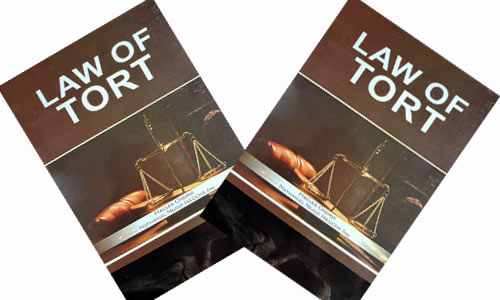 The book, titled The Law of Torts in Nigeria: A Functional Approach, authored by Professor Hagler Sunny Okorie Ph.D and Ikeocha, Nathaniel Ngozi Esq, offers law students, practitioners, and academics a comprehensive guide to understanding and applying tort law in Nigerian courts. Interested buyers can place orders via the following contact numbers: 08028636615, 08037667945, 08032253813, or +234 902 196 2209.
______________________________________________________________________
“Enhance Legal Practice With Authoritative Reports” — Alexander Payne Offers Comprehensive Law Reports, Spanning Over A Century Of Nigerian Jurisprudence
The book, titled The Law of Torts in Nigeria: A Functional Approach, authored by Professor Hagler Sunny Okorie Ph.D and Ikeocha, Nathaniel Ngozi Esq, offers law students, practitioners, and academics a comprehensive guide to understanding and applying tort law in Nigerian courts. Interested buyers can place orders via the following contact numbers: 08028636615, 08037667945, 08032253813, or +234 902 196 2209.
______________________________________________________________________
“Enhance Legal Practice With Authoritative Reports” — Alexander Payne Offers Comprehensive Law Reports, Spanning Over A Century Of Nigerian Jurisprudence
 Interested buyers are encouraged to place their orders and enquiries via:
0704 444 4777, 0704 444 4999, 0818 199 9888
Website: www.alexandernigeria.com
Interested buyers are encouraged to place their orders and enquiries via:
0704 444 4777, 0704 444 4999, 0818 199 9888
Website: www.alexandernigeria.com