The National Assembly’s recently released Certified True Copies (CTCs) of the country’s new tax laws have confirmed widespread alterations to the versions originally passed by lawmakers. Despite this validation of claims made by a federal lawmaker and independent investigations, no individuals have been held responsible, leaving the public to grapple with concerns over potential foul play in the gazetting process.

The controversy erupted in December 2025 as the Federal Government sought public support for its sweeping tax reforms. Abdulsamad Dasuki, a House of Representatives member representing Kebbe/Tambuwal Federal Constituency in Sokoto State, publicly accused the government of gazetting versions of the tax bills that diverged significantly from those debated, harmonised, and approved by the National Assembly. Dasuki highlighted that key provisions in the officially published laws were never part of the legislative deliberations, sparking fears of post-parliamentary tampering.
Initial government responses ranged from outright denial to deflection. Mohammed Idris, the Minister of Information and National Orientation, rejected any presidential involvement and insisted no changes had occurred, redirecting blame to the legislature to investigate. Taiwo Oyedele, chairman of the Presidential Tax Reform Committee, dismissed circulating documents as “fake or unverified,” emphasising that only the harmonised bills certified by the Clerk of the National Assembly were authentic. However, these certified copies were not publicly available at the time, fuelling further suspicion.
Investigations by the Foundation for Investigative Journalism (FIJ) corroborated Dasuki’s claims. By examining primary legislative documents, FIJ revealed material discrepancies between the gazetted laws and the passed bills. Despite calls for transparency, neither the government nor the National Assembly initially released the harmonised versions. Instead, the National Assembly quietly mandated a re-gazetting of the laws. Under Nigeria’s Authentication Act, the legislature’s role concludes with passing a bill and forwarding an authenticated copy for presidential assent, while gazetting falls under executive purview.
On January 4, 2026, the CTCs were finally published, publicly affirming the alterations. No official explanation has been provided for how these changes occurred or who is accountable. Prior reporting noted that Nigeria’s gazetting process relies heavily on trust, with significant power concentrated in a few officials, particularly in the Clerk’s office.
The CTCs exposed several unauthorised changes in the Nigeria Tax Administration Act:
- Reporting Thresholds and Disclosure Requirements: The previously gazetted version lowered reporting thresholds for individuals from ₦50 million to ₦25 million and for companies from ₦250 million to ₦100 million. Disclosure obligations were narrowed from including names, customer locations, and transaction details to just names and addresses. The CTCs restored the original thresholds and full disclosure requirements.
- Information Demands: Provisions allowing tax authorities to request information via written notices were absent in the gazetted version but have been reinstated in the CTCs.
- Currency for Tax Computations (Section 39(3)): The gazetted law mandated all petroleum operations computations in United States dollars, overriding the original provision allowing assessments in the currency of the transaction. The CTCs reverted to the lawmakers’ version, requiring taxes to be assessed and paid in the transaction currency.
- Federal Taxes Scope (Section 3(1)(b)): The gazetted Act omitted petroleum income tax and value-added tax (VAT) from federal administration categories, reducing the list from five to three. The CTCs restored the full list: income tax, petroleum income tax, stamp duties, VAT, and tax incentives.
- Power of Arrest (Section 64(1)): The gazetted version granted tax authorities the power to arrest suspects through law enforcement agencies, in addition to conducting investigations. This was removed in the CTCs, limiting powers to investigations only, as originally approved.
- Tax Tribunal Repayment and Appeals (Section 41): The original law outlined seven parts for objecting to assessments, including a 30-day objection deadline, required details, and appeal processes. The gazetted version added an unauthorised eighth part allowing appeals to the Court of Appeal and Supreme Court. The CTCs eliminated this addition.
Changes in the Joint Revenue Board of Nigeria (Establishment) Act
- Authority of Board Officers (Section 9): The gazetted version used vague language permitting “any officer specifically in that behalf” to exercise powers, potentially broadening unauthorised access. The CTCs clarified that only the Board or its specifically authorised officers can act, in line with the original legislation.
Alterations in the Nigeria Revenue Service (Establishment) Act
- Asset Sales and Court Orders (Section 61): The gazetted Act allowed the sale of seized movable assets without a High Court order. The CTCs reinstated the requirement for a court order after a 14-day holding period if debts remain unpaid.
- National Assembly Oversight (Sections 25, 26, 30): The gazetted version omitted mandates for quarterly and annual reports to the National Assembly, summons for accountability, and submission of strategic plans and budgets. These were fully restored in the CTCs.
- Funding Sources (Section 14): The gazetted Act added an unapproved source, “additional contributions from members,” to the original four funding streams. The CTCs removed this, retaining only the approved sources.
- Consolidated Revenue Funding for Tribunal and Ombudsman: The gazetted versions made the Tax Appeal Tribunal and the Office of the Tax Ombudsman dependent on general appropriations, removing direct funding from the Consolidated Revenue Fund. The CTCs restored this independent funding mechanism.
Despite the ongoing dispute, the Nigeria Revenue Service (NRS) announced on January 5, 2026, that enforcement of the new tax regime commenced as scheduled on January 1, 2026. NRS Chairman, Zacch Adedeji, stated that the agency is obligated to enforce the gazetted laws, not the parliamentary versions, and dismissed criticisms and planned protests as politically driven. He urged reliance on formal legislative channels for any amendments, noting that the laws were signed in June 2025 with a built-in preparation period.
The controversy highlights vulnerabilities in Nigeria’s legislative and gazetting processes, where trust-based systems may enable undetected alterations. Calls for accountability persist, with experts warning that without identifying and sanctioning those responsible, public confidence in governance could erode further. The Federal Government and the National Assembly have yet to announce any investigations or reforms to prevent a recurrence.

Get your copy today and take the first step toward financial growth:👉 https://selar.co/4f16676016
_______________________________________________________________________ ARTIFICIAL INTELLIGENCE FOR LAWYERS: A COMPREHENSIVE GUIDE
Reimagine your practice with the power of AI “...this is the only Nigerian book I know of on the topic.” — Ohio Books Ltd
Authored by Ben Ijeoma Adigwe, Esq., ACIArb (UK), LL.M, Dip. in Artificial Intelligence, Director, Delta State Ministry of Justice, Asaba, Nigeria.
Bonus:
Get a FREE eBook titled “How to Use the AI in Legalpedia and Law Pavilion” with every purchase.
ARTIFICIAL INTELLIGENCE FOR LAWYERS: A COMPREHENSIVE GUIDE
Reimagine your practice with the power of AI “...this is the only Nigerian book I know of on the topic.” — Ohio Books Ltd
Authored by Ben Ijeoma Adigwe, Esq., ACIArb (UK), LL.M, Dip. in Artificial Intelligence, Director, Delta State Ministry of Justice, Asaba, Nigeria.
Bonus:
Get a FREE eBook titled “How to Use the AI in Legalpedia and Law Pavilion” with every purchase.
How to Order: 📞 Call, Text, or WhatsApp: 08034917063 | 07055285878 📧 Email: benadigwe1@gmail.com 🌐 Website: www.benadigwe.com
Ebook Version: Access directly online at: https://selar.com/prv626
________________________________________________________________________ The Law And Practice Of Redundancy In Nigeria: A Practitioner’s Guide, Authored By A Labour & Employment Law Expert Bimbo Atilola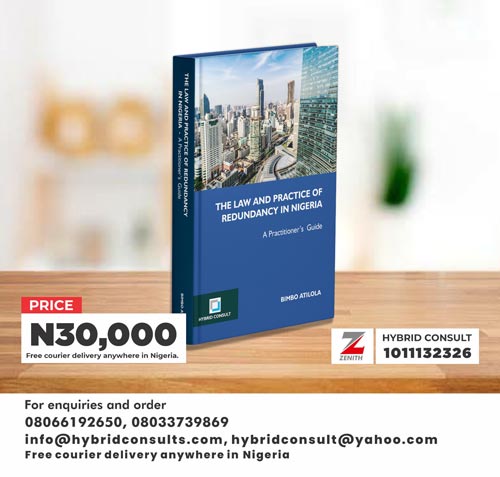 _______________________________________________________________________
[A MUST HAVE] Evidence Act Demystified With Recent And Contemporary Cases And Materials
_______________________________________________________________________
[A MUST HAVE] Evidence Act Demystified With Recent And Contemporary Cases And Materials