
Prof. Ernest Ojukwu, has publicly disagreed with Senior Advocate of Nigeria Femi Falana over the conflicting Federal High Court judgments on INEC’s 2027 election timetable, defending both judges, opposing calls for an NJC investigation, and arguing that the divergent rulings represent a healthy interpretive process that will ultimately enrich the Court of Appeal’s jurisprudence and strengthen Nigeria’s constitutional law.

In a series of posts on X (formerly Twitter), Ojukwu dismantled Falana’s position point by point, challenging the suggestion that Justice Omotosho should have deferred to the Court of Appeal, questioning the rationale for a probe, defending the principle of judicial independence, and proposing a practical solution the consolidation of all related appeals before the same appellate panel.
“I Do Not Agree with Femi on This”
Ojukwu opened his response by flatly rejecting Falana’s core argument that Justice Omotosho should have awaited the Court of Appeal’s determination of Justice Umar’s earlier judgment before delivering his own ruling on substantially the same issues.
“No, I do not agree with Femi on this. I do not think that Justice Omotosho should have awaited the Court of Appeal decision before delivering his own judgment. And by the way, did any party bring the fact that a sister case was in the Court of Appeal to the knowledge of Justice Omotosho and urged him to wait?” Ojukwu wrote.
The rhetorical question raises a significant procedural point about whether Justice Omotosho had formal notice of the pending appeal. However, lawyers have since pointed out that SDP’s counsel, Realwon Okpanachi, Esq., did file a Motion on Notice with Justice Umar’s earlier judgment attached as an exhibit asking Justice Omotosho to strike out the SDP suit on the grounds that a sister case had already substantially addressed the same issues. The court nonetheless proceeded to deliver judgment.
“What Do We Mean by Judicial Independence?”
Ojukwu then challenged the fundamental premise of Falana’s criticism that one Federal High Court judge should follow or defer to the decision of another judge of coordinate jurisdiction.
“What do we mean by judicial independence if one judge must follow the decision of his colleague at the same level? I think it will be ill for us to be making negative calls on judges each time they make decisions,” Ojukwu stated.
The argument goes to the heart of the common law tradition: judges of coordinate jurisdiction are not bound by each other’s decisions. A judgment of the Federal High Court is persuasive not binding on another judge of the same court. Justice Omotosho was therefore legally entitled to reach a different conclusion from Justice Umar on the same questions of law, just as judges routinely do in other jurisdictions where novel or contested legal questions produce competing interpretations.
“What Has a Probe Got to Do With It?”
Ojukwu’s sharpest criticism was directed at Falana’s call for the NJC and NBA to investigate the circumstances surrounding the conflicting judgments. He described the call as potentially amounting to harassment of a judge for exercising independent judgment.
“What has a probe got to do with Justice Omotosho’s decision this time? Why call for a probe? Just to harass him? Whenever we have a new legislation, we expect these interpretative developments. That is why we have the appellate system,” Ojukwu stated.
His point is that conflicting judicial interpretations of new legislation are not evidence of judicial misconduct — they are a normal and expected feature of the legal system, particularly when courts are interpreting a recently enacted statute like the Electoral Act 2026 for the first time. The appellate system exists precisely to resolve such conflicts and produce authoritative interpretations that bind all lower courts.
“Both Judges Should Be Commended”
Far from condemning either judge, Ojukwu took the unusual step of commending both Justice Umar and Justice Omotosho for their decisions, describing them as bold exercises of judicial independence.
“Both judges at the Federal High Court should be commended for their bold decisions. The right thing to do is to ensure that all the appeals relating to the same thing given within the same period are heard by the same panel on appeal even consolidated,” Ojukwu stated.
His proposed solution consolidation of all related appeals before the same Court of Appeal panel is practical and directly addresses the risk of further conflicting decisions at the appellate level. If separate panels of the Court of Appeal hear the appeals arising from the two judgments independently, there is a risk that the appellate court could itself produce conflicting outcomes, compounding rather than resolving the problem.
“My Friend Femi Got It Wrong”
Ojukwu concluded with a direct personal rebuke of Falana’s position, while maintaining the collegial tone of their professional relationship.
“Their divergent interpretations will actually enrich the judges at the appeal level and help reach a decision that will actually support our democracy and constitutional law. My friend Femi got it wrong this time,” Ojukwu stated.
The argument is that the existence of two well-reasoned but contradictory judgments gives the Court of Appeal a richer body of legal reasoning to draw upon two different analytical frameworks, two different sets of authorities, and two different conclusions on the same questions which should ultimately produce a more robust and comprehensive appellate decision than would have been possible if only one judgment existed.
What Falana Had Said
Ojukwu’s intervention was a direct response to a statement by Falana titled “Nigerian Judges and Lawyers Should Be Prevented From Sabotaging the 2027 Election,” in which the senior advocate warned that the conflicting rulings had created avoidable uncertainty at a sensitive period in the country’s electoral calendar.
Falana had argued that Justice Omotosho should have allowed the Court of Appeal to determine the validity of Justice Umar’s earlier decision instead of delivering a contradictory judgment. He called on the NJC and NBA to urgently investigate the circumstances surrounding both judgments and warned that failure to resolve the situation could revive memories of 1993, when conflicting court orders contributed to the crisis surrounding the annulment of the June 12 presidential election.
“Unless the judges and lawyers involved are called to order, the 2027 election may be sabotaged by judges and lawyers,” Falana had warned.
The Legal Analysis: Where the Judges Agreed and Diverged
Meanwhile, a detailed legal analysis by Dr Misbau Alamu Lateef, PhD, SFHEA, which has been widely shared among lawyers, has brought analytical clarity to the debate by identifying the specific areas where the two judgments converge and where they diverge irreconcilably.
On convergence, both Justice Umar and Justice Omotosho agreed that the 120-day period under Section 29(1) for submission of candidates’ particulars and the 90-day period under Section 31 for candidate substitution are mandatory statutory rights that INEC cannot abridge. “On these two points, the two decisions speak with one voice and constitute settled persuasive authority at first instance,” Lateef noted.
On divergence, the irreconcilable conflict lies on the foundational question of whether INEC possesses the constitutional power to fix a window for party primaries. Justice Umar held it does not, grounding his decision in the silence of the Electoral Act on primary timelines. Justice Omotosho held it does, citing Paragraph 15, Item F of the Third Schedule to the 1999 Constitution, Section 151 of the Electoral Act, and Section 285(14)(c) of the Constitution which expressly includes “timetable for an election” among pre-election matters.
Further divergences exist on Section 32 (publication of candidate lists), membership register requirements, the campaign period under Section 98, and the overall scope of relief with Lateef characterising Justice Umar’s approach as “omnibus and substantially invalidating” and Justice Omotosho’s as “measured and surgical.”
“The conflict on the foundational question is direct and unqualified. Both decisions cannot simultaneously represent the law. This conflict cannot be resolved at first instance. It requires authoritative determination by the Court of Appeal,” Lateef concluded.
The Motion That Was Filed
A critical procedural detail that has emerged is that SDP’s counsel, Realwon Okpanachi, Esq., filed a Motion on Notice before Justice Omotosho asking the court to strike out the SDP suit in view of Justice Umar’s earlier judgment, which had substantially addressed the same issues. Justice Umar’s judgment was attached to the motion as an exhibit.
This means Justice Omotosho was formally made aware that a coordinate court had already delivered judgment on substantially the same issues yet proceeded to deliver his own ruling. The court’s reasons for declining to strike out the suit will likely become a focal point of any appellate review. Many lawyers have criticised Justice Omotosho, describing him as a “notice-me judge” and alleging that he often acts as though he knows it all.
This disclosure complicates Ojukwu’s defence of Justice Omotosho somewhat, as his initial rhetorical question “did any party bring the fact that a sister case was in the Court of Appeal to the knowledge of Justice Omotosho?” appears to have been answered in the affirmative. However, Ojukwu’s broader point about judicial independence that a judge of coordinate jurisdiction is not bound to follow another judge’s decision remains legally valid regardless of whether the judge was aware of the earlier ruling.
INEC has already filed an appeal against Justice Umar’s judgment at the Court of Appeal through Chief Alex Izinyon, SAN, with a request for a stay of execution. Justice Omotosho’s judgment may also be appealed by aggrieved parties.
Ojukwu’s proposed solution consolidation of all related appeals before the same appellate panel offers the most efficient path to a definitive resolution. If adopted, it would prevent the Court of Appeal from producing its own set of conflicting decisions and ensure that a single panel considers both sets of legal reasoning before reaching a unified determination.
Until the Court of Appeal speaks, INEC, political parties, and aspirants remain caught between two contradictory legal frameworks governing the same electoral process a situation that, regardless of whether one agrees with Falana’s alarm or Ojukwu’s reassurance, underscores the urgent need for appellate clarity on the foundational question of INEC’s constitutional authority over election timetables.
As Ojukwu put it: “Their divergent interpretations will actually enrich the judges at the appeal level and help reach a decision that will actually support our democracy and constitutional law.”
Whether that optimism proves justified will depend on how quickly and how decisively the Court of Appeal acts.
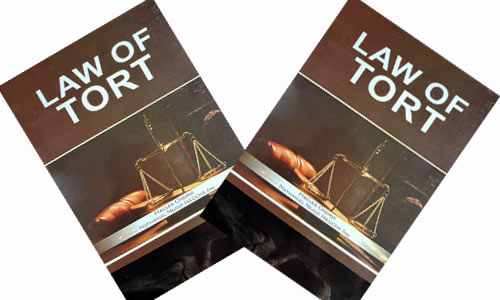 The book, titled The Law of Torts in Nigeria: A Functional Approach, authored by Professor Hagler Sunny Okorie Ph.D and Ikeocha, Nathaniel Ngozi Esq, offers law students, practitioners, and academics a comprehensive guide to understanding and applying tort law in Nigerian courts. Interested buyers can place orders via the following contact numbers: 08028636615, 08037667945, 08032253813, or +234 902 196 2209.
_______________________________________________________________________
The book, titled The Law of Torts in Nigeria: A Functional Approach, authored by Professor Hagler Sunny Okorie Ph.D and Ikeocha, Nathaniel Ngozi Esq, offers law students, practitioners, and academics a comprehensive guide to understanding and applying tort law in Nigerian courts. Interested buyers can place orders via the following contact numbers: 08028636615, 08037667945, 08032253813, or +234 902 196 2209.
_______________________________________________________________________
“Order Your Copy Now” — Basil Momodu, Esq. Unveils Second Edition Of His Book, "Civil Procedure In Nigeria"
 According to the learned author, Basil Momodu Esq. "Law review is a continuum. We will continue to track changes in the law to enrich future editions." Recommended Booksellers: Lagos: 08033855230, Abuja: 08035991379, and others.
______________________________________________________________________
[A MUST HAVE] Evidence Act Demystified With Recent And Contemporary Cases And Materials
According to the learned author, Basil Momodu Esq. "Law review is a continuum. We will continue to track changes in the law to enrich future editions." Recommended Booksellers: Lagos: 08033855230, Abuja: 08035991379, and others.
______________________________________________________________________
[A MUST HAVE] Evidence Act Demystified With Recent And Contemporary Cases And Materials

 Interested buyers are encouraged to place their orders and enquiries via:
0704 444 4777, 0704 444 4999, 0818 199 9888
Website: www.alexandernigeria.com
Interested buyers are encouraged to place their orders and enquiries via:
0704 444 4777, 0704 444 4999, 0818 199 9888
Website: www.alexandernigeria.com
 As an added bonus, every purchase comes with a FREE ebook titled: “AI in Legalpedia and Law Pavilion: A Research Guide.”
Ohio Books Ltd praises the publication, stating:
"....this is the only Nigerian book I know of on the topic."
How to Order:
📞 Call, Text, or WhatsApp: 08034917063 | 07055285878
📧 Email: benadigwe1@gmail.com
🌎 Website: www.benadigwe.com
Ebook Version: Access it directly online at https://selar.com/prv626
As an added bonus, every purchase comes with a FREE ebook titled: “AI in Legalpedia and Law Pavilion: A Research Guide.”
Ohio Books Ltd praises the publication, stating:
"....this is the only Nigerian book I know of on the topic."
How to Order:
📞 Call, Text, or WhatsApp: 08034917063 | 07055285878
📧 Email: benadigwe1@gmail.com
🌎 Website: www.benadigwe.com
Ebook Version: Access it directly online at https://selar.com/prv626