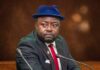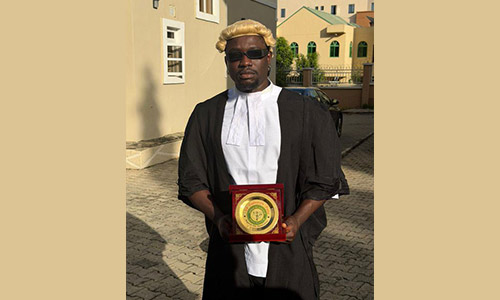
An Abuja-based legal practitioner, Roland C. Uwakwe of Max & Roll Partners, has petitioned the President of the Nigerian Bar Association, asking the Association to formally investigate the recent appearance of Mr Martins Otse, popularly known as VeryDarkMan, in the wig and gown of a Nigerian barrister, and to refer the matter to law enforcement if the facts disclose an offence under the Legal Practitioners Act.

The letter, dated 29th August, 2026, and routed through the Chairman of the NBA Garki Branch, Abuja, is titled “Request for Institutional Action and Referral for Investigation Regarding the Alleged Holding Out as a Legal Practitioner by Mr. Martins Otse (a.k.a. VeryDarkMan).”
Uwakwe frames the complaint as one that goes beyond the individual involved.
“I write respectfully… to draw the attention of the President of the Nigerian Bar Association to a matter which, in my considered view, transcends the personality of the individual involved and raises a fundamental question concerning the protection, integrity and dignity of the legal profession in Nigeria,” he wrote.
The petition states that Otse, though not called to the Nigerian Bar or enrolled as a legal practitioner, publicly appeared in the traditional professional regalia of a Nigerian barrister, consisting of the wig and gown, and in the accompanying presentation portrayed himself in the manner of a lawyer.
The lawyer notes that the controversy arose against the background of Otse’s invitation to and participation at the Nigerian Bar Association Conference in Port Harcourt.
He is careful to disclaim any finding of guilt. The NBA, he writes, “as an organisation committed to the rule of law, must itself be guided by due process and should not condemn any person without investigation.”
“My concern, therefore, is not to prejudge Mr. Otse, but to request that the Association take appropriate steps to investigate the circumstances and, where the facts establish the requisite elements, refer the matter to the appropriate law-enforcement authority for action under the Legal Practitioners Act and any other applicable law,” he stated.
The petition anchors itself on section 2(1) of the Legal Practitioners Act, Cap. L11, Laws of the Federation of Nigeria 2004, which provides that a person is entitled to practise as a barrister and solicitor in Nigeria if and only if his name is on the Roll of Legal Practitioners, and on section 24, which defines a legal practitioner as a person entitled under the Act to practise as a barrister, or as a barrister and solicitor, whether generally or for the purpose of a particular office or proceeding.
“The significance of these provisions is that membership of the legal profession is not a matter of self-identification. It is a status conferred and recognised by law following the prescribed process of admission and enrolment,” the letter states.
Uwakwe places the weight of his argument on section 22(1) of the Act, which creates offences for persons who are not legal practitioners. He reproduces the operative words: a person other than a legal practitioner commits an offence where he “practises, or holds himself out to practise, as a legal practitioner”, or “takes or uses the title of legal practitioner”, or “wilfully takes or uses any name, title, addition or description falsely implying, or otherwise pretends, that he is a legal practitioner or is qualified or recognised by law to act as a legal practitioner.”
He argues that the reach of the section is deliberate. “The statutory language is deliberately wider than merely appearing before a court. The Legislature did not criminalise only the actual performance of legal work. It also addressed the holding out or representation of oneself as a legal practitioner.”
According to the petition, the question is not simply whether Otse physically wore a wig and gown.
“The proper legal question is whether, having regard to the totality of the circumstances, the use of the professional regalia, the manner of presentation, the words used, the context and the accompanying publication or representation, he deliberately represented himself as a legal practitioner when he knew that he had not been called to the Nigerian Bar.”
He urges that the material said to show Otse in full barristerial attire, and referring to himself as a lawyer, “should be preserved and independently examined rather than dismissed as mere entertainment or satire.”
The letter draws support from a regulatory step taken earlier this year, stating that the Council of Legal Education and the Nigerian Law School issued a warning in July 2026 against persons not yet called to the Bar wearing legal wigs and gowns and portraying themselves as qualified lawyers, with specific reference to photographs and videos in legal regalia.
“If the law considers such conduct sufficiently serious to warrant an express warning even in respect of persons who have successfully completed their legal education but are yet to be called to the Bar, it would be difficult to justify treating a similar representation by a person who has never been called to the Bar as entirely inconsequential,” he wrote.
The petition relies on three decisions.
In Emmanuel Okafor & Ors v. Augustine Nweke & Ors (2007) 10 NWLR (Pt. 1043) 521, the Supreme Court considered sections 2 and 24 of the Legal Practitioners Act and affirmed that a person must satisfy the statutory requirements for recognition as a legal practitioner, and that persons outside the statutory class cannot practise law in Nigeria.
In Alhaji Ibrahim Adamu v. Alhaji Abdullatif Hassan & Ors (2014) NGCA 14, the Court of Appeal reaffirmed the effect of section 2(1), that a person is entitled to practise as a barrister and solicitor if and only if his name is on the Roll.
The letter further cites Jafar Abubakar v. Alhaji Ibrahim Hassan Dankwambo & Ors (2015), stating that the court emphasised that the Act is designed to prevent persons outside the profession from usurping the status of legal practitioners, and described the framework as one preventing an uncontrolled floodgate of persons outside the profession.
“The importance of these authorities is that the legal profession is a closed and regulated profession. The statutory language does not create an open field in which any person may assume the identity, status or professional description of a lawyer,” Uwakwe submitted.
The petition rejects the argument that legal robes are ordinary clothing.
“The wig and gown cannot reasonably be regarded as ordinary clothing within the Nigerian legal system. They are recognised symbols of the advocate appearing in his or her professional capacity.”
Citing Chief Gani Fawehinmi v. Nigerian Bar Association & Ors (No. 1) (1989) 2 NWLR (Pt. 105) 494, the letter states that the Supreme Court considered the professional significance of the wig and gown and the rules governing the attire of legal practitioners, demonstrating that legal robes carry recognised professional significance within the Nigerian justice system.
“I therefore respectfully submit that the issue cannot be reduced to the proposition that ‘anyone can wear a wig and gown because it is merely clothing,’” he wrote, adding that the legal question is whether an unqualified person deliberately appropriated an important professional symbol in circumstances whose reasonable effect is to represent that he holds the status of a legal practitioner.
The section headed “The Danger of Creating a Precedent” is the core of the appeal.
“The issue is bigger than VDM,” the letter states. “Today, it may be one individual wearing a wig and gown and presenting himself as a lawyer. Tomorrow, another person may do the same.”
Uwakwe sets out a progression: an appearance at a court-related event, another person signing documents as “Barrister”, another giving legal advice for consideration, another advertising himself as a lawyer on social media, and another attempting to appear before a court.
“If the profession responds to the first instance with indifference merely because the person is popular, influential or regarded as an entertainer, the profession risks creating an unfortunate precedent by acquiescence,” he wrote.
“The law cannot be selectively enforced according to the popularity of the person involved. What is unlawful when done by an unknown person does not become lawful merely because it is done by a celebrity. Indeed, the more prominent the individual, the greater the potential for the conduct to be copied and normalised.”
The letter expressly disclaims any intention to restrain criticism.
“This request should not be understood as an attempt to silence Mr. Otse, punish criticism of lawyers or interfere with his constitutional freedom of expression,” Uwakwe wrote, adding that a non-lawyer remains entitled to criticise lawyers, criticise the NBA, attend public events, make political or social commentary and express opinions about the administration of justice.
“What he cannot do, if the statutory elements are established, is cross the legal boundary between criticising or satirising the profession and falsely assuming the status of a member of that profession.”
He added: “Freedom of expression cannot, without more, confer a professional status which the law reserves for persons duly called to and enrolled in the legal profession. The distinction between satire and false professional representation is therefore a matter of fact requiring proper investigation.”
Uwakwe asks the NBA President to take six steps:
To cause the conduct complained of to be formally investigated, including obtaining and preserving the relevant videos, photographs, social-media publications and other evidence.
To ascertain the precise representations made by Otse in connection with his appearance in wig and gown, and determine whether, objectively and subjectively, the circumstances disclose an intention to hold himself out as a legal practitioner.
To cause a formal petition to be made to the appropriate law-enforcement agency, where the facts establish the necessary elements, for investigation of possible offences under section 22 of the Legal Practitioners Act and any other applicable law.
To request appropriate legal advice from the relevant authorities where necessary on the proper interpretation and application of section 22 to the facts.
To issue, where considered appropriate, a public clarification that the professional status of a legal practitioner in Nigeria derives from lawful Call to the Bar and enrolment, and cannot be assumed by self-description, costume, social-media representation or participation in a professional event.
To consider whether a general advisory should be issued to the public and to members of the profession discouraging the unauthorised use of professional legal regalia in circumstances capable of creating the impression that the wearer is a qualified legal practitioner.
“The Nigerian Bar Association is not merely an association of lawyers. It is also an important institution in the preservation of the rule of law, professional standards and public confidence in the administration of justice,” the petition concludes.
“The profession has invested generations of sacrifice, training and institutional regulation in ensuring that the public can distinguish a duly qualified legal practitioner from an impostor. That distinction must be protected.”
Uwakwe urges that the matter be treated not as a personality contest or an attempt to manufacture controversy, but as an opportunity to reaffirm that a person not called to the Nigerian Bar and not enrolled as a legal practitioner cannot assume, appropriate or represent himself to the public as a member of the Nigerian legal profession.
“The purpose of any action taken should not be vindictive. It should be protective, corrective and precedent-setting,” he wrote.
He allows expressly for the opposite outcome: “Conversely, if investigation establishes that the conduct was genuinely and unmistakably theatrical or satirical and did not amount to the statutory offence, the matter can equally be resolved on that basis. What is important is that the issue should be authoritatively determined rather than casually ignored.”
The letter closes with a request that it be given urgent attention.
[A MUST HAVE] Evidence Act Demystified With Recent And Contemporary Cases And Materials

Available now for NGN 40,000 at ASC Publications, 10, Boyle Street, Onikan, Lagos. Beside High Court, TBS. Email publications@ayindesanni.com or WhatsApp +2347056667384. Purchase Link: https://paystack.com/buy/evidence-act-complete-annotation
______________________________________________________________________ “Enhance Legal Practice With Authoritative Reports” — Alexander Payne Offers Comprehensive Law Reports, Spanning Over A Century Of Nigerian Jurisprudence Interested buyers are encouraged to place their orders and enquiries via:
0704 444 4777, 0704 444 4999, 0818 199 9888
Website: www.alexandernigeria.com
Interested buyers are encouraged to place their orders and enquiries via:
0704 444 4777, 0704 444 4999, 0818 199 9888
Website: www.alexandernigeria.com