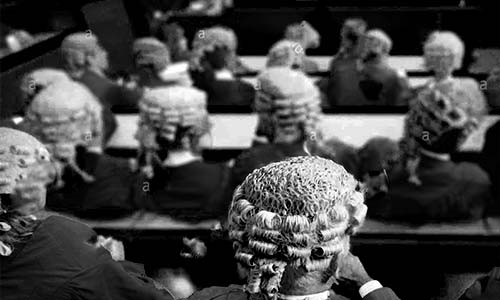
In this article, Platinum Post chronicles the major reasons why Lawyers wear wigs in Court.


Have you ever wondered why lawyers wear wigs? If yes, you are in the right place. In this short article, we will clearly explain and point out some of the reasons why lawyers still wear wigs today.
The culture of lawyers wearing wigs as part of courtroom dress code arose as a result of the common practice of the era.
Until the 17th century, lawyers were expected to appear in court with clean, short hair and beards. Judge portraits from the early 1680s still show him with natural hair and no wig. Charles XI, King of England from 1660 to his 1685, returned from France and brought with him the trend of wearing periwigs from the court of his XIV to Louis. Since then, British society has embraced this trend, as has the barrister.
However, wigs in those days were also worn for other reasons.
Why Lawyers Wear Wigs
- Some wore wigs to hide their baldness. Wigs were expensive in those days, so these people were usually wealthy, like Louis XIV.
- At that time, diseases such as lice were prevalent, so some people wore wigs to hide their shaving.
Furthermore, wigs gradually fell out of fashion during the reign of George XI (1760-1820). By the end of the century they were mainly worn by bishops, coachmen, and legal professionals. She had an ongoing interest in wearing wigs because she felt that she was sufficiently differentiated or stood out from the rest of society.
- These days, many judges and lawyers who wear wigs claim that wigs bring a sense of formality and solemnity to legal proceedings.According to Washington DC attorney Kevin Newton, The above reasons are actually the overwhelming point of having a wig. Some argue that the wig is a symbol of anonymity, an attempt to keep the wearer away from being personally involved in the case, and also a way to visually emphasize the primacy of the law.
In the UK, however, the tradition of wearing wigs in court was challenged in a case presided over by Baron Phillips, Chief Justice of the Matlabor of Worthy, in 2007. Wigs worn in civil or family cases A Supreme Court justice was held when it was no longer held. However, wigs and robes are still used in criminal trials.
Most common wealthy countries still enjoy wearing wigs and gowns in court.Nigeria is a case study. In Nigeria, all lawyers and judges still wear wigs during proceedings. However, this depends on which court you appear in. For example, in magistrates courts, lawyers are not required to wear wigs or gowns when proceeding with cases. However, other courts, starting with the High Court, require full robes of wigs and gowns.
Criticism of wearing wigs by lawyers
There has been a great deal of criticism of wigs, with many scholars advocating the discontinuation of wigs.
- Be of colonial origin
In Africa, almost half a century has passed since the colonialists left. However, they seem to have misplaced their wigs. Even at a time when Africa seeks liberation from colonial influence in many parts of the world, it is terrifying to see one of the wisest institutions still following in the footsteps of the colonialists. increase.
- Discomfort
Wigs have also been criticized for being uncomfortable for those who wear them.Africa as a continent has a case of high temperatures. It is unreasonable and inappropriate for lawyers and judges to wear wigs in such temperatures under the guise of being suitable for their profession.
- Messy
Some lawyers have such a messy approach to the profession that they see robes in their eyes. The scariest part of it is that so-called wigs are white in color and appear when they are not properly groomed.
So far, I have listed and explained some reasons why lawyers wear wigs. Therefore, I have pointed out the main criticisms directed at the wearing of wigs among lawyers. However, if you feel you should contribute, please try to do so using the comments section. Don’t forget to share this post.
[A MUST HAVE] Evidence Act Demystified With Recent And Contemporary Cases And Materials

Available now for NGN 40,000 at ASC Publications, 10, Boyle Street, Onikan, Lagos. Beside High Court, TBS. Email publications@ayindesanni.com or WhatsApp +2347056667384. Purchase Link: https://paystack.com/buy/evidence-act-complete-annotation
______________________________________________________________________ “Enhance Legal Practice With Authoritative Reports” — Alexander Payne Offers Comprehensive Law Reports, Spanning Over A Century Of Nigerian Jurisprudence Interested buyers are encouraged to place their orders and enquiries via:
0704 444 4777, 0704 444 4999, 0818 199 9888
Website: www.alexandernigeria.com
Interested buyers are encouraged to place their orders and enquiries via:
0704 444 4777, 0704 444 4999, 0818 199 9888
Website: www.alexandernigeria.com