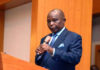
Lagos State Deputy Governor, Dr. Obafemi Hamzat, has advised young workers struggling with the high cost of accommodation in the state to consider living with their parents or relatives, or sharing apartments with others, rather than committing a large portion of their earnings to expensive rent.

Hamzat gave the advice during a question-and-answer session on Nigeria Info FM on Thursday while responding to concerns about the worsening housing affordability challenge confronting young residents of Lagos.
The Deputy Governor was asked how a 22-year-old earning about ₦100,000 monthly could afford a self-contained apartment or mini-flat reportedly costing around ₦1 million annually.
Responding, Hamzat said young people should make housing decisions based on their incomes and financial circumstances rather than feeling pressured to immediately live independently in accommodation they cannot comfortably afford.
“Don’t let us misunderstand ourselves as a people. We are cultural people,” he said, noting that traditionally, many young Nigerians continue to live with their parents or relatives until they become financially stable.
According to him, young workers can also reduce housing expenses by sharing accommodation with friends or colleagues.
Hamzat argued that there was no need for young people to “start from the top” by immediately renting self-contained apartments when their earnings could not sustain such a lifestyle.
“So, if you don’t start from the top self-contained, you don’t start from the top. You start from the average depending on,” he said.
He also warned against committing an excessive percentage of income to rent, advising that housing expenses should ideally not exceed 40 per cent of a worker’s earnings.
“In fact, if you spend more than 40 per cent of your income on rent, it is too high because you must eat, you must buy clothes, you must do transportation,” Hamzat said.
The Deputy Governor said the Lagos State Government was also promoting mortgage financing and other housing schemes to make home ownership more accessible to residents.
He explained that instead of paying the entire cost of a property at once, prospective homeowners could make an initial deposit and spread the outstanding balance over several years, depending on their income and repayment capacity.
Using a ₦7 million property as an example, Hamzat said a buyer could make an initial payment of ₦700,000, representing 10 per cent of the cost, and spread the balance over a period of about 10 years.
“Some people pay 25,000 monthly or 35,000, whatever it is, depending on your income,” he said.
Hamzat also highlighted the role of the Lagos State Residents Registration Agency (LASRRA) in identifying residents, their addresses and places of employment, information which he said could assist in determining eligibility for housing finance.
He stressed that prospective homeowners must cultivate a saving culture, noting that financial institutions would ordinarily require evidence that applicants have the capacity and discipline to meet their repayment obligations.
According to him, young residents could begin with smaller and more affordable housing options and gradually work towards owning larger properties as their incomes and savings improve.
The Deputy Governor, however, acknowledged that addressing Lagos’ housing challenge would require more than encouraging residents to adjust their accommodation choices.
He said the broader economy must improve so that workers can earn better incomes and cope with the rising cost of housing and other essential needs.
“What is important is we must also build our economy in such a way that people earn better,” Hamzat said.
He added that reducing the rising cost of goods and services would improve household purchasing power and enable residents to plan their finances more effectively.
Lagos State has over the years introduced mortgage and rent-to-own housing programmes, including LagosHOMS, aimed at allowing eligible residents to acquire homes while spreading payments over an extended period.
[A MUST HAVE] Evidence Act Demystified With Recent And Contemporary Cases And Materials

Available now for NGN 40,000 at ASC Publications, 10, Boyle Street, Onikan, Lagos. Beside High Court, TBS. Email publications@ayindesanni.com or WhatsApp +2347056667384. Purchase Link: https://paystack.com/buy/evidence-act-complete-annotation
______________________________________________________________________ “Enhance Legal Practice With Authoritative Reports” — Alexander Payne Offers Comprehensive Law Reports, Spanning Over A Century Of Nigerian Jurisprudence Interested buyers are encouraged to place their orders and enquiries via:
0704 444 4777, 0704 444 4999, 0818 199 9888
Website: www.alexandernigeria.com
Interested buyers are encouraged to place their orders and enquiries via:
0704 444 4777, 0704 444 4999, 0818 199 9888
Website: www.alexandernigeria.com