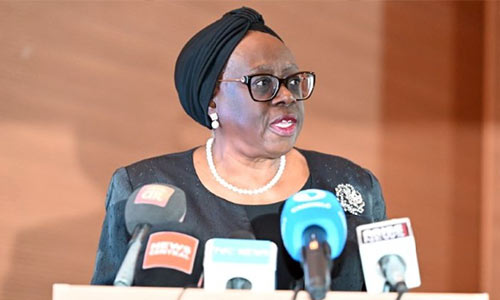
The Chief Justice of Nigeria, Justice Kudirat Kekere-Ekun, on Monday cautioned judicial officers across the country against misconduct and indiscreet use of social media, warning that ethical lapses could erode public confidence in the judiciary.

Speaking at the opening ceremony of the 2026 National Workshop on Judicial Ethics for Judges of the Superior Courts of Record, held at the National Judicial Institute in Abuja, the CJN stressed that the legitimacy of the judiciary rests not only on the correctness of its decisions but also on the perception of integrity by the public.
She noted that in an era of rapid technological advancement and digital communication, judicial officers must exercise heightened caution in their conduct, as their actions and expressions are now subject to immediate and widespread scrutiny.
“The legitimacy of judicial authority depends not only on the correctness of decisions, but also on the confidence reposed in the courts by the public,” she said.
Kekere-Ekun warned that the increasing visibility of judges, particularly on social media platforms, introduced new ethical challenges that require discipline and a clear understanding of professional boundaries.
According to her, “Judicial actions and expressions are now subject to immediate and widespread public scrutiny. These realities require Judicial Officers to exercise heightened caution, sound judgment, and a clear understanding of the ethical boundaries of judicial engagement.”
The CJN emphasised that ethical standards in judicial service extend beyond compliance with formal rules, noting that judges must consistently uphold principles such as independence, impartiality, integrity, propriety, equality, competence, and diligence—both within and outside the courtroom.
She added that even unintended lapses in conduct could have far-reaching consequences for the credibility of the judiciary.
“A judge must consistently act in a manner that preserves the dignity of the office and reinforces confidence in the justice system,” she said, warning that “lapses in conduct, however unintended, may undermine that confidence.”
Kekere-Ekun also highlighted recurring ethical dilemmas faced by judges, including issues of conflict of interest, recusal, extra-judicial engagements, and interactions with counsel and litigants, noting that such situations often require the careful exercise of discretion guided by both the letter and spirit of the Code of Conduct for Judicial Officers.
She stressed that the conduct of judges of superior courts carries broader institutional implications, as their actions often set standards for judicial practice nationwide.
“Clear, consistent, and principled conduct contributes to coherence and predictability within the justice system, while inconsistency may weaken public trust,” she said.
The CJN further underscored the importance of judicial education in strengthening ethical awareness and professional competence, commending the National Judicial Institute for its ongoing reforms aimed at aligning judicial training with contemporary demands and international best practices.
Kekere-Ekun noted that the workshop’s programme was carefully structured to address contemporary issues in judicial conduct, including social media use, financial disclosure, standards of recusal, and the limits of acceptable extra-judicial activities.
She urged participants to take full advantage of the platform to exchange ideas and share experiences, describing peer engagement as critical to strengthening institutional coherence within the judiciary.
The CJN also acknowledged the contributions of key stakeholders in judicial education, including the Chairman of the Education Committee of the Board of Governors of the National Judicial Institute, Justice John Inyang Okoro, and the Administrator of the Institute, Justice Babatunde Adejumo, for their roles in advancing capacity-building initiatives.
Reaffirming the importance of continuous learning, she stated that judicial education remained a core responsibility of judges, enabling them to respond effectively to evolving legal and societal expectations.
“By participating in this workshop, your Lordships reaffirm your dedication to delivering justice that is fair, impartial, and worthy of public trust,” she said.
[A MUST HAVE] Evidence Act Demystified With Recent And Contemporary Cases And Materials

Available now for NGN 40,000 at ASC Publications, 10, Boyle Street, Onikan, Lagos. Beside High Court, TBS. Email publications@ayindesanni.com or WhatsApp +2347056667384. Purchase Link: https://paystack.com/buy/evidence-act-complete-annotation
______________________________________________________________________ “Enhance Legal Practice With Authoritative Reports” — Alexander Payne Offers Comprehensive Law Reports, Spanning Over A Century Of Nigerian Jurisprudence Interested buyers are encouraged to place their orders and enquiries via:
0704 444 4777, 0704 444 4999, 0818 199 9888
Website: www.alexandernigeria.com
Interested buyers are encouraged to place their orders and enquiries via:
0704 444 4777, 0704 444 4999, 0818 199 9888
Website: www.alexandernigeria.com