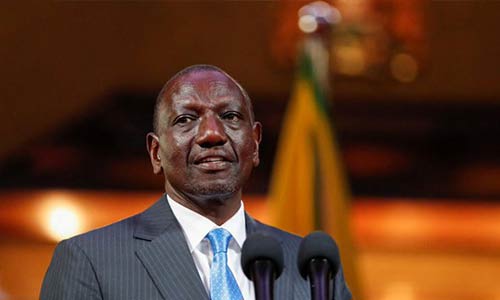
Kenya has given foreign workers 90 days to regularise their immigration and business status, stepping back from an earlier order by President William Ruto that had triggered panic among migrants over the operation of small businesses in the country.

The clarification followed widespread concern after Ruto said last week that foreigners would no longer be allowed to operate as hawkers or run small retail shops, giving them until Monday to stop such activities.
“We have made efforts to improve the economy, we have not improved investor confidence for hawkers to come to Kenya,” Ruto had said.
The directive sparked anxiety among foreign nationals, particularly citizens of neighbouring East African Community countries who live and work in Kenya.
Kenya is a member of the EAC, whose citizens enjoy freedom of movement within the regional bloc. Work permits for citizens of EAC member states are also free, although many migrants have reportedly failed to complete the required registration process.
The situation became particularly tense among Burundian nationals, many of whom earn a living through street vending and small-scale trading in Nairobi.
On Monday, hundreds of Burundians reportedly went to their embassy seeking assistance to return home amid fears that the crackdown could expose them to harassment or xenophobic attacks.
The concern intensified following reports that some Burundians had already been attacked after the President’s remarks.
Kenya’s junior foreign minister, Korir Sing’Oei, subsequently apologised to affected Burundians, saying some had been attacked because of what he described as a misunderstanding of the government’s position.
“Many have been attacked by their neighbours and their friends” because of a “lack of understanding,” Sing’Oei said.
He explained that the government’s intention was not to target foreigners simply because of their nationality but to ensure that migrants were properly documented and that their businesses complied with Kenyan law.
“Our main aim is to know how you are living, where you are, that you have identification, and that your jobs are registered,” he said.
The Kenyan Presidency has now clarified that the government will conduct what it described as an “orderly regularisation exercise” over the next 90 days.
Under the arrangement, foreign nationals will be allowed to use the period to obtain the appropriate work permits, licences and other documentation required to operate legally in the country.
The Presidency warned, however, that once the 90-day window expires, immigration and business regulations would be enforced strictly.
It said immigration rules “will be enforced firmly and strictly in accordance with the law” at the end of the regularisation period.
The latest position represents a significant softening of the earlier directive, which had been interpreted as an immediate prohibition on foreigners operating small businesses.
Government officials now insist that the objective is primarily to identify foreign workers, regularise their status and ensure that businesses are properly registered rather than to carry out an indiscriminate expulsion of migrant traders.
The controversy is particularly sensitive because Kenya attracts workers and traders from across East Africa, including Burundi, Uganda, Tanzania and other countries in the regional bloc.
Burundi, with a population of about 15 million, is one of the poorest countries in the world and is also a member of the EAC.
The 90-day regularisation window is therefore expected to provide temporary relief to migrants who feared immediate closure of their businesses or removal from the country, while leaving open the possibility of enforcement action against those who fail to comply with immigration and licensing requirements before the deadline.
 The book also examines Nigeria's legal ecosystem, focusing on the LPELR and NBA AI Guidelines. As a bonus, every purchase comes with a FREE eBook titled: How to Use the AI Features in LegalPedia and LawPavilion.
Ohio Books Ltd praises the publication, stating:
"....this is the only Nigerian book I know of on the topic."
How to Order:
📞 Call, Text, or WhatsApp: 08034917063 | 07055285878
📧 Email: benadigwe1@gmail.com
🌎 Website: www.benadigwe.com
Ebook Version: Access it directly online at https://selar.com/prv626
Authored by Ben Ijeoma Adigwe Esq., ACIarb (UK), LL.M, Dip. in Artificial Intelligence, Director at the Delta State Ministry of Justice, Asaba, Nigeria.
______________________________________________________________________
[A MUST HAVE] Evidence Act Demystified With Recent And Contemporary Cases And Materials
The book also examines Nigeria's legal ecosystem, focusing on the LPELR and NBA AI Guidelines. As a bonus, every purchase comes with a FREE eBook titled: How to Use the AI Features in LegalPedia and LawPavilion.
Ohio Books Ltd praises the publication, stating:
"....this is the only Nigerian book I know of on the topic."
How to Order:
📞 Call, Text, or WhatsApp: 08034917063 | 07055285878
📧 Email: benadigwe1@gmail.com
🌎 Website: www.benadigwe.com
Ebook Version: Access it directly online at https://selar.com/prv626
Authored by Ben Ijeoma Adigwe Esq., ACIarb (UK), LL.M, Dip. in Artificial Intelligence, Director at the Delta State Ministry of Justice, Asaba, Nigeria.
______________________________________________________________________
[A MUST HAVE] Evidence Act Demystified With Recent And Contemporary Cases And Materials

 Interested buyers are encouraged to place their orders and enquiries via:
0704 444 4777, 0704 444 4999, 0818 199 9888
Website: www.alexandernigeria.com
Interested buyers are encouraged to place their orders and enquiries via:
0704 444 4777, 0704 444 4999, 0818 199 9888
Website: www.alexandernigeria.com