*Says Section 305 Silent on Displacing State Bodies to Uphold Federalism

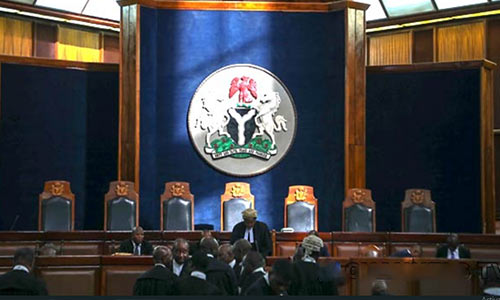
In a judgment delivered today, the Supreme Court of Nigeria struck out a suit filed by the Attorneys-General of 11 states challenging the federal government’s declaration of a state of emergency in Rivers State. The court held that it lacked jurisdiction to entertain the case due to the absence of a direct, justiciable dispute between the plaintiffs and the federation. However, in a detailed obiter dictum, Justice Mohammed Baba Idris, delivering the majority judgment, provided extensive clarification on the scope of emergency powers under Section 305 of the 1999 Constitution (as amended), emphasizing their temporary and proportionate nature.
BACKGROUND TO THE CASE
The case, Attorney General of Adamawa State & 10 Ors v. Attorney General of the Federation & Anor (SC/CV/329/2025), was brought by the Attorneys-General of Adamawa, Akwa Ibom, Bauchi, Bayelsa, Enugu, Osun, Oyo, Plateau, Taraba, and Zamfara States. The plaintiffs invoked the court’s original jurisdiction under Section 232 of the Constitution to contest the constitutional validity of the emergency declaration in Rivers State, which included the suspension of the state’s Governor, Deputy Governor, and House of Assembly, as well as the appointment of a Sole Administrator. They also sought declaratory and injunctive reliefs to prevent similar actions against their own states, citing an alleged threat from a media statement by the Attorney-General of the Federation.
The defendants—the Attorney-General of the Federation and the National Assembly—opposed the suit on its merits while raising preliminary objections on jurisdiction, the plaintiffs’ locus standi, and the overall competence of the action.
COURT’S RESOLUTION ON JURISDICTION
In resolving the preliminary objections, Justice Idris underscored that jurisdiction is the “life-blood of adjudication” and must be determined based solely on the plaintiffs’ originating processes. For the Supreme Court’s original jurisdiction under Section 232(1) to apply, three conditions must coexist: a dispute between the federation and a state (or states), involvement of a question of law or fact, and concern over the existence or extent of a legal right.
The court found that the plaintiffs’ grievances centered on events in Rivers State, which they neither represented nor had authority to litigate for. No state of emergency had been declared in any of the plaintiffs’ states, and the alleged media statement by the federal Attorney-General did not constitute actionable conduct by the federation itself. “Complaints directed against individual officials… do not amount to disputes between the Federation and a State within the contemplation of the Constitution,” the judgment stated.
Consequently, the court ruled that the plaintiffs failed to disclose a reasonable cause of action, rendering the suit incompetent. “The absence of a competent cause of action is fatal and deprives this Court of jurisdiction,” Justice Idris noted, leading to the suit being struck out with no order as to costs.
CLARIFICATION ON EMERGENCY POWERS UNDER SECTION 305
Despite striking out the suit, the court deemed it “imperative” to discuss Section 305 given its significance in Nigeria’s constitutional framework. Justice Idris highlighted Nigeria’s federal system, rooted in constitutional supremacy, separation of powers, and checks and balances. Governmental authority is divided among executive, legislative, and judicial arms, and across federal, state, and local tiers, with no entity permitted to usurp another’s powers unlawfully.
Section 305 allows the President to declare a state of emergency in extraordinary situations threatening public order, safety, or the federation’s existence, such as war, invasion, or breakdowns in governance. However, unlike constitutions in India (Articles 352–360) or Pakistan (Article 234), which explicitly permit federal assumption of state powers, Nigeria’s provision is silent on displacing state institutions. This omission, the court said, is deliberate, reflecting commitment to federalism and state autonomy.
PRESIDENTIAL DISCRETION CONSTRAINED
The President’s discretion in implementing “extraordinary measures” is flexible but constrained: measures must be temporary, corrective, proportionate, and aimed at restoring constitutional order, not extinguishing it. Historical precedents were cited, including suspensions of state institutions during the 2004 Plateau and 2006 Ekiti emergencies, contrasted with the 2013 Borno, Adamawa, and Yobe declarations where state bodies continued functioning. “The constitutionally permissible response depends on the magnitude of the threat, proportionality… and the necessity of intervention,” the judgment explained.
Critically, any permanent displacement of elected institutions would be a “constitutional aberration.” Outside a valid emergency, the President has no power to interfere with state executives or legislatures.
LEGISLATIVE OVERSIGHT
The court also emphasized legislative oversight: A proclamation lapses unless approved by a two-thirds majority of each House of the National Assembly within stipulated timelines, per Sections 305(2) and (6)(b). The Constitution does not specify voting procedures, deferring to each House’s Standing Orders under Section 60. In the Senate, Orders 133–136 and Chapter X (including voice votes, divisions, or electronic voting) apply, with numerical divisions required if challenged. In the House of Representatives, Order 16 governs emergencies, and Order 11 Rule 6 empowers the Speaker to order named, recorded votes for matters of national concern like emergencies, ensuring transparency.
Overall, a state of emergency is valid if issued under Section 305, approved by a supermajority in line with Standing Orders, and implemented through restorative measures. Such exercises remain subject to judicial review to prevent abuse.
JUDGMENT - ATTORNEY GENERAL OF ADAMAWA STATE & 10 ORS vs. ATTORNEY GENERAL OF OF THE FEDERATION & ANOR TheNigeriaLawyerIMPORTANT CLARIFICATION
The Supreme Court did not explicitly rule that the President has an unrestricted or blanket power to suspend elected officials (e.g., Governors, Deputy Governors, or State House of Assembly members) under Section 305 of the 1999 Constitution (as amended).
Core Holding on Jurisdiction: The suit (SC/CV/329/2025) was struck out entirely for lack of jurisdiction. The plaintiffs (Attorneys-General of 11 PDP-led states) failed to establish a justiciable dispute under Section 232(1), as their challenge focused on the Rivers State emergency (where no plaintiff state was directly affected), and the alleged “threat” from the AGF’s media statement was insufficient. The Court emphasized this absence of locus standi and cause of action, rendering the suit incompetent.
Obiter Dictum on Emergency Powers (Non-Binding Guidance): In an extensive discussion (obiter, as the case was dismissed on preliminary grounds), Justice Mohammed Baba Idris (delivering the majority judgment) clarified Section 305:
- The President can proclaim a state of emergency for threats like war, invasion, or breakdown of public order.
- The provision is silent on displacing state institutions (unlike India’s Articles 352–360 or Pakistan’s Article 234, which explicitly allow federal takeover). This silence is “deliberate” to uphold federalism and state autonomy.
- The President has discretion for “extraordinary measures” to restore order, but these must be:
- Temporary and proportionate.
- Directed at restoring constitutional governance, not extinguishing it.
- Subject to legislative approval (two-thirds majority in both Houses of the National Assembly) and judicial review.
- Permanent suspension or abrogation of elected bodies is a “constitutional aberration.”
- Historical examples show variability: Suspensions occurred in Plateau (2004) and Ekiti (2006), but not in Borno/Adamawa/Yobe (2013), depending on threat magnitude.
- Outside a valid emergency, the President has no power to interfere with state executives or legislatures.
No Definitive Ruling on Suspension Power: Since the suit was struck out without delving into the merits of the Rivers-specific actions, the Court did not adjudicate whether the Rivers suspensions were constitutional. The discussion affirms flexibility in crises but stresses limits—no absolute or automatic right to suspend elected officials exists.
Recent media coverage describes the ruling as a 6-1 split affirming presidential discretion for emergencies, with some headlines claiming “affirmation” of suspension powers during emergencies (if temporary). However:
- Justice Obande Festus Ogbuinya dissented, arguing emergency powers do not extend to suspending elected officials, as it undermines democracy.
- The majority did not validate the Rivers case specifically; reports note the emergency (declared March 2025, lifted September 2025) involved suspending Gov. Siminalayi Fubara et al. for 6 months, appointing a Sole Administrator (Vice Admiral Ibok Ete Ibas).
- Critics (e.g., SERAP, legal analysts) view this as potential overreach, weakening federalism.

 ARTIFICIAL INTELLIGENCE FOR LAWYERS: A COMPREHENSIVE GUIDE
Reimagine your practice with the power of AI “...this is the only Nigerian book I know of on the topic.” — Ohio Books Ltd
Authored by Ben Ijeoma Adigwe, Esq., ACIArb (UK), LL.M, Dip. in Artificial Intelligence, Director, Delta State Ministry of Justice, Asaba, Nigeria.
Bonus:
Get a FREE eBook titled “How to Use the AI in Legalpedia and Law Pavilion” with every purchase.
ARTIFICIAL INTELLIGENCE FOR LAWYERS: A COMPREHENSIVE GUIDE
Reimagine your practice with the power of AI “...this is the only Nigerian book I know of on the topic.” — Ohio Books Ltd
Authored by Ben Ijeoma Adigwe, Esq., ACIArb (UK), LL.M, Dip. in Artificial Intelligence, Director, Delta State Ministry of Justice, Asaba, Nigeria.
Bonus:
Get a FREE eBook titled “How to Use the AI in Legalpedia and Law Pavilion” with every purchase.
How to Order: 📞 Call, Text, or WhatsApp: 08034917063 | 07055285878 📧 Email: benadigwe1@gmail.com 🌐 Website: www.benadigwe.com
Ebook Version: Access directly online at: https://selar.com/prv626
________________________________________________________________________ The Law And Practice Of Redundancy In Nigeria: A Practitioner’s Guide, Authored By A Labour & Employment Law Expert Bimbo Atilola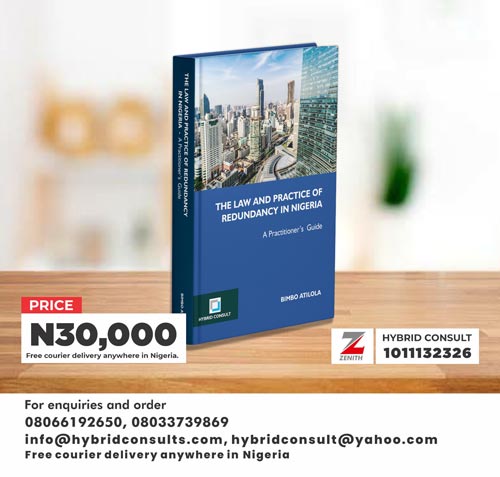 _______________________________________________________________________
"You Don't Need To Be Rich, You Just Need To Start" — Victoria Ezeigwe, Esq Launches Investment Handbook For Nigerians Starting With ₦5,000
_______________________________________________________________________
"You Don't Need To Be Rich, You Just Need To Start" — Victoria Ezeigwe, Esq Launches Investment Handbook For Nigerians Starting With ₦5,000

Get your copy today and take the first step toward financial growth:👉 https://selar.co/4f16676016
_______________________________________________________________________