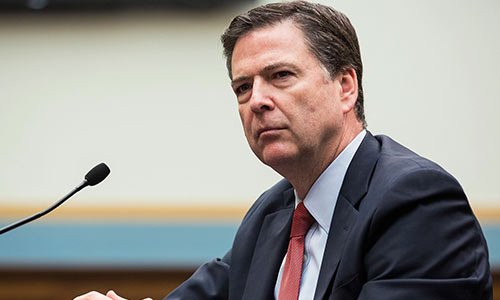
A federal judge dealt a setback Saturday to the Justice Department’s effort to re-indict former FBI Director James Comey, blocking prosecutors’ access to key evidence from email accounts and a computer belonging to close Comey friend and attorney Daniel Richman.

U.S. District Judge Colleen Kollar-Kotelly granted a temporary restraining order sought by Richman’s lawyers, requiring that the evidence be sequestered pending a ruling on Richman’s claim that the government illegally retained his emails and other data.
“The Court concludes that Petitioner Richman is likely to succeed on the merits of his claim that the Government has violated his Fourth Amendment right against unreasonable searches and seizures by retaining a complete copy of all files on his personal computer (an ‘image’ of the computer) and searching that image without a warrant,” Kollar-Kotelly wrote in a four-page order filed Saturday, one day after Richman’s attorneys requested the emergency order.
Kollar-Kotelly, a Clinton appointee based in Washington, issued the restraining order before getting a formal response from prosecutors to a petition Richman filed last week seeking return of his data. However, she said a lack of clear indication about who currently has the data and where it is stored supported her conclusion that a temporary order limiting access to the trove of records was warranted.
“Uncertainty about its whereabouts weighs in favor of acting promptly to preserve the status quo,” Kollar-Kotelly wrote.
Spokespeople for the Justice Department did not immediately respond to requests for comment.
Richman’s communications are a central aspect of the case prosecutors are attempting to bring against Comey.
A copy of the law professor’s personal computer, iCloud account and Columbia University email accounts were obtained by the Justice Department in 2017, following Trump’s firing of Comey as FBI director. Richman allowed investigators to make an image of his computer during an investigation into an alleged disclosure of classified information. The FBI later obtained other records through search warrants.
After the Justice Department charged Comey in September for allegedly lying to Congress about his contacts with the media, Comey’s attorneys contended that prosecutors had improperly relied on Richman’s records, some of which may have included information protected by attorney-client privilege.
Richman’s attorneys have argued that prosecutors and investigators were obliged to return or destroy the data once the initial investigations concluded and that the FBI appears to have examined data not within the scope of the warrants.
It’s unclear just how significant a lack of access to Richman’s records would be for the Justice Department’s efforts to re-indict Comey. Investigators would likely have access to some of the emails from other sources. However, Comey’s lawyers have already argued that access to Richman’s data tainted the investigation that led to Comey’s indictment in September on charges of lying to and obstructing a Senate committee.
And U.S. Magistrate Judge William Fitzpatrick, who helped manage the Comey case, said the lone grand jury witness — an FBI case agent — may have viewed material that should have been protected, threatening the entire case.
The issue was never fully resolved because U.S. District Judge Cameron Currie dismissed the charges against Comey after concluding the lead prosecutor, Lindsey Halligan, was illegally appointed to her position. Still, prosecutors are weighing whether to seek a new grand jury indictment against Comey, and the Richman material could come back into play.
Richman was not charged in the case filed against Comey. No one was charged in the earlier investigations.
Kollar-Kotelly put the dispute over Richman’s data on a fast track, ordering the Justice Department to confirm by Monday that it has complied with her order and to respond to Richman’s legal arguments by Tuesday. She did not immediately schedule a hearing on the issue, but said her order limiting access to Richman’s emails and computer files will be in effect through Friday unless she cancels it before then.
 ARTIFICIAL INTELLIGENCE FOR LAWYERS: A COMPREHENSIVE GUIDE
Reimagine your practice with the power of AI “...this is the only Nigerian book I know of on the topic.” — Ohio Books Ltd
Authored by Ben Ijeoma Adigwe, Esq., ACIArb (UK), LL.M, Dip. in Artificial Intelligence, Director, Delta State Ministry of Justice, Asaba, Nigeria.
Bonus:
Get a FREE eBook titled “How to Use the AI in Legalpedia and Law Pavilion” with every purchase.
ARTIFICIAL INTELLIGENCE FOR LAWYERS: A COMPREHENSIVE GUIDE
Reimagine your practice with the power of AI “...this is the only Nigerian book I know of on the topic.” — Ohio Books Ltd
Authored by Ben Ijeoma Adigwe, Esq., ACIArb (UK), LL.M, Dip. in Artificial Intelligence, Director, Delta State Ministry of Justice, Asaba, Nigeria.
Bonus:
Get a FREE eBook titled “How to Use the AI in Legalpedia and Law Pavilion” with every purchase.
How to Order: 📞 Call, Text, or WhatsApp: 08034917063 | 07055285878 📧 Email: benadigwe1@gmail.com 🌐 Website: www.benadigwe.com
Ebook Version: Access directly online at: https://selar.com/prv626
________________________________________________________________________ The Law And Practice Of Redundancy In Nigeria: A Practitioner’s Guide, Authored By A Labour & Employment Law Expert Bimbo Atilola _______________________________________________________________________
[A MUST HAVE] Evidence Act Demystified With Recent And Contemporary Cases And Materials
_______________________________________________________________________
[A MUST HAVE] Evidence Act Demystified With Recent And Contemporary Cases And Materials