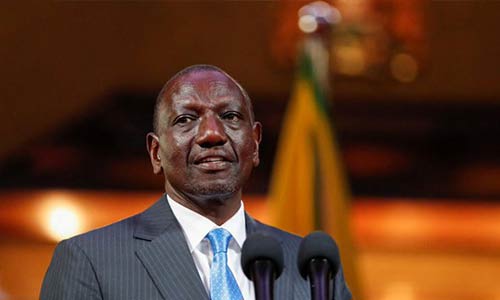
Kenyan President William Ruto has reversed his earlier stance on Nigerian English, declaring that Nigerians speak “excellent English” and claiming that his widely circulated comments mocking Nigerian-accented English were taken out of context from what was meant to be a private conversation, in a diplomatic about-face that has generated as much amusement as his original remarks generated offence.

Speaking at a forum on responsible mining and sustainable investment in Nairobi, and addressing Nigeria’s Minister of Solid Minerals Dele Alake, who was present at the event, Ruto asked the minister to convey his regards to President Bola Tinubu and to “the great people of Nigeria, who are my in-laws,” while attempting to reframe his original comments as a compliment that was misrepresented rather than an insult that was accurately reported.
“Please pass my regards to President Tinubu, my friend, and to the great people of Nigeria, who are my in-laws, and do so in good English,” Ruto stated, opening his clarification with the diplomatic warmth that had been conspicuously absent from his original remarks.
Ruto’s reversal follows widespread criticism of comments he made while addressing Kenyans in Italy, where he praised Kenya’s education system and English proficiency but suggested that Nigerian English was incomprehensible and might require translation.
“Our education is good. Our English is good. We speak some of the best English in the world. If you listen to a Nigerian speaking, you don’t know what they are saying. You need a translator even when they are speaking English,” Ruto had stated, drawing laughter from his Italian audience.
“We have some of the best human capital anywhere in the world. We just need to sharpen it with more training,” the Kenyan president added.
The remarks, captured on video, went viral across social media platforms, triggering strong reactions from Nigerians and a broader debate about public communication between African heads of state.
At the Nairobi mining conference, Ruto offered a markedly different characterisation of his original intent.
“I was captured, I was speaking to my fellow citizens somewhere, and somebody, it was supposed to be a private conversation, but somebody decided that it should be public. But they also misrepresented the facts,” Ruto stated.
He then attempted to repackage his original remarks as a compliment rather than an insult.
“The facts are that I was talking about how we in Africa speak very good English, all of us. In fact, in some countries like Nigeria, if you don’t speak excellent English, like the one we speak in Kenya, you may need a translator, you know, for you to understand the excellent English of Nigeria. So that was the comparison, but somebody decided to take it out of context,” Ruto stated.
The new framing inverts the meaning of his original comments entirely. Where the original statement suggested Nigerians speak English so poorly that a translator is needed, the revised version suggests Nigerians speak English so excellently that a translator might be needed to keep up with their sophistication.
Whether this creative reinterpretation is convincing is another matter. The original video, which remains publicly available, shows Ruto clearly contrasting Kenya’s “best English in the world” with Nigerian English that “you don’t know what they are saying,” a formulation that is difficult to reframe as a compliment to Nigerian English proficiency.
Ruto repeatedly referred to Nigerians as his “in-laws” throughout his clarification, a term of endearment in African diplomatic parlance that signals familial closeness and mutual respect.
“Please pass my regards to President Tinubu, my friend, and to the great people of Nigeria, who are my in-laws,” Ruto stated.
He concluded his remarks with a note that blended diplomatic charm with what sounded like genuine apprehension about the diplomatic consequences of his original comments.
“But I think it is as well that we can have this conversation. And my in-laws, I hope there will be no consequences for whatever was done,” Ruto stated.
The phrase “I hope there will be no consequences” suggests the Kenyan president is aware that his original remarks may have caused genuine diplomatic friction and that some form of response from Nigeria, whether official or through the court of public opinion, remains a possibility.
The controversy did not emerge in a vacuum. Ruto’s original comments were widely interpreted as a response to remarks made by President Tinubu during a visit to Bayelsa State on April 10, 2026, where the Nigerian president compared living conditions in Nigeria with those in other African countries, including Kenya.
While the specific content of Tinubu’s comparison was not detailed in Ruto’s clarification, the sequence suggests a diplomatic tit-for-tat in which one president’s unflattering comparison of another’s country prompted a retaliatory comparison, which then required damage control when it went viral.
The exchange highlights the sensitivity of public comparisons between African nations, where leaders’ comments about each other’s countries can quickly escalate from diplomatic banter to national insult, amplified by social media’s ability to extract and circulate specific clips without the context of the broader conversation.
Ruto’s characterisation of his original remarks as a “private conversation” that was made public is a defence that has become increasingly common in the age of ubiquitous recording devices and social media.
However, the defence has limitations. The original comments were made at what appears to have been a public event, addressing a gathering of Kenyans in Italy. In the era of smartphones, any public statement by a head of state, regardless of the intended audience, is effectively a global statement.
The suggestion that the remarks were “misrepresented” is also difficult to sustain when the original video shows Ruto making the comments in his own words, in context, and to audience laughter that indicates the remarks were understood as humorous mockery rather than sophisticated linguistic commentary.
The original comments triggered widespread reactions on Nigerian social media, with users responding with a mixture of amusement, offence, and counter-mockery.
Many Nigerians pointed out that Nigeria has produced some of the world’s most acclaimed English-language writers, including Nobel laureate Wole Soyinka, Chinua Achebe, and Chimamanda Ngozi Adichie, and that Nigerian universities and law schools maintain rigorous English-language standards.
Others noted that Nigerian Pidgin English, which may have been the accent Ruto was referencing, is a distinct linguistic form that is widely understood across West Africa and has its own grammatical rules and cultural significance, rather than being a defective form of standard English.
The exchange has also sparked broader conversations about communication between African leaders, with some commentators arguing that public mockery of other African nations’ cultures, languages, or educational systems undermines the Pan-African solidarity that the continent needs.
Ruto’s reversal offers a lesson in the risks of using neighbouring countries as unflattering comparisons for domestic political purposes.
His original comments in Italy were designed to praise Kenya’s education system and boost the self-image of Kenyans abroad. Using Nigeria as a negative comparison point served that domestic purpose effectively but created an international problem that required the kind of public reversal that Ruto was forced to deliver in Nairobi.
The reversal itself, while diplomatically necessary, risks drawing further attention to the original remarks and creating the impression that the clarification is motivated by fear of consequences rather than genuine regret.
For Nigeria and Kenya, two of Africa’s largest economies and most influential nations, the episode underscores the importance of diplomatic restraint in public communications and the reality that in the digital age, there are no private conversations for heads of state.
As Ruto stated with a mix of diplomacy and apprehension: “My in-laws, I hope there will be no consequences for whatever was done.”
Whether there will be consequences, diplomatic or otherwise, remains to be seen. But the viral spread of his original remarks and the necessity of his public reversal suggest that the consequences have already begun.
[A MUST HAVE] Evidence Act Demystified With Recent And Contemporary Cases And Materials

Available now for NGN 40,000 at ASC Publications, 10, Boyle Street, Onikan, Lagos. Beside High Court, TBS. Email publications@ayindesanni.com or WhatsApp +2347056667384. Purchase Link: https://paystack.com/buy/evidence-act-complete-annotation
______________________________________________________________________ “Enhance Legal Practice With Authoritative Reports” — Alexander Payne Offers Comprehensive Law Reports, Spanning Over A Century Of Nigerian Jurisprudence Interested buyers are encouraged to place their orders and enquiries via:
0704 444 4777, 0704 444 4999, 0818 199 9888
Website: www.alexandernigeria.com
Interested buyers are encouraged to place their orders and enquiries via:
0704 444 4777, 0704 444 4999, 0818 199 9888
Website: www.alexandernigeria.com