*Says “A Bag Of Rice Does Not Solve Hunger For The Rest Of The Year”

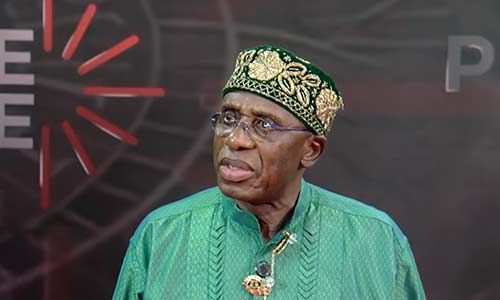
Former Minister of Transport and two-term Governor of Rivers State, Chibuike Rotimi Amaechi, has declared that the first thing he would do as President of Nigeria is to enforce the rule of law, accusing the government of President Bola Tinubu of locking up critics and opposition figures, denying them bail, and shuttling them from one anti-graft agency to another “all to shut up opposition,” while alleging that the President is “creating hunger as a way of manipulating voters.”
Amaechi, who is seeking the presidential ticket of the African Democratic Congress (ADC) ahead of the 2027 general elections, made the wide-ranging declarations during an appearance on Arise Television’s Prime Time programme in Abuja, where he discussed his record as Governor of Rivers State, his role in the 2015 coalition that brought the APC to power, insecurity, poverty, and his ambition to confront President Tinubu in 2027.
Setting out what he described as his foremost priority, Amaechi said: “The first thing I would do as president of Nigeria is the rule of law. There has to be law and order.”
Pressed on how he would move the needle on accountability, Amaechi argued that the central problem with Nigerian politics is that those in power are not held accountable, and that the only people held to account are those perceived to be opposed to the government.
“The day Nigerians decide to take power in their hands, Nigerian politicians will become responsible. The problem with Nigerian politics is that they are not held accountable. Anybody who is held accountable is because he’s opposed to the government,” he said.
He stressed that under his envisaged rule-of-law regime, prosecution would be based on conduct, not political alignment.
“It’s not because you don’t like the president and then you go to prison… it’s not because you don’t like my face that takes you to prison. What will take you to prison is what you have done. Now, not also will it be that because you like the president then you are forgiven from the crime you have committed,” he said.
Amaechi accused the Tinubu government of weaponising the security and anti-corruption agencies against critics and the opposition, describing a pattern in which dissenters are detained, denied bail, and moved from one agency to another.
“If you say anything you’re locked up, is in detention, bail not granted, tomorrow he’s taken to EFCC, the next day to ICPC, the next day to SSS. All to shut up opposition. It will not happen,” he said.
He argued that repression would ultimately fail in the face of widespread hunger, declaring: “You know why? Hunger has no respite except food. So you can lock up everybody you want to lock up. You can flog everybody you want to flog. But if you’re hungry, you’re hungry.”
He further questioned why the ruling party, if confident of its strength, would not allow the opposition to operate freely.
“APC, if they say they are strong, why are they not allowing the opposition to have their political parties? Why are they influencing the political and government institutions against the opposition? Why would they leave the rule of law?” he asked.
In one of his sharpest allegations, Amaechi accused the government of deliberately deploying hunger as a tool to manipulate the electorate.
“So the president is creating hunger as a way of manipulating voters… so on that day, city boys will bring bag of rice and some people will eat that rice and vote against them, because a bag of rice does not solve hunger for the rest of the year,” he said.
He linked the hunger in the land to the management of the proceeds of the removal of fuel subsidy, arguing that the savings had ended up in private pockets while ordinary Nigerians grew poorer.
“As good as the policy to remove oil subsidy is, the funds are in people’s pocket. So governors are growing richer. The president and his team are growing richer and then Nigerians are impoverished the more,” he said.
When the interviewer observed that a hungry population creates opportunities for manipulation, Amaechi agreed, accepting the framing that hunger is being used to manipulate voters.
Turning to insecurity, Amaechi argued that terrorism and banditry are driven mostly by economic desperation, insisting that “nobody was born to be a terrorist” and that “circumstances and environment force you to be a terrorist.”
He recalled that whereas suicide was once culturally unthinkable, people were now being paid as little as N25,000 to carry out suicide attacks, attributing this to the absence of economic alternatives.
He proposed mass social housing, mechanised farming through a dedicated hedge fund, and large-scale job creation as antidotes to crime, citing the multiplier effect of construction and agriculture on employment.
“Just imagine that we build 200,000 houses in Kano… 300,000 masons… 300,000 carpenters… 300,000 contractors. The payment cascades down and everybody’s involved in one thing or the other,” he said, adding that “the more jobs you create, the more you take people away from crime.”
He referenced reports that a large sum was missing from the federation account as a potential source of funding, saying: “I hear that 34.6 trillion naira was missing from federation account… the World Bank said we collected 84-something trillion naira and 34.6 trillion naira is missing. That alone can build houses.”
Responding to critics who questioned where his current passion for the poor was during his nearly eight years as a minister, Amaechi insisted he had always spoken against the impoverishment of Nigerians, recalling that as Governor of Rivers State he told Nigerians that unless they “stone the politicians,” the politicians would not stop stealing.
He gave a detailed account of his record in Rivers State, including building model primary schools in every village, reducing class sizes from 150 children per class to 25, employing 13,200 teachers, building secondary schools managed with the aid of hired Indian technologists for digitalised education, constructing primary healthcare centres in every village, employing 400 additional doctors, providing official cars and accommodation for doctors and nurses, and building roads, water and power infrastructure.
On power, he said Rivers State had developed the capacity to generate 715 megawatts against a requirement of 450 megawatts, and had installed 28 substations, but was denied federal approval to exit the national grid and distribute power a refusal he said led to disagreement between him and the Federal Government.
Amaechi called for the 2027 election to be treated as a referendum on the records of all the leading contenders, rather than a contest decided along ethnic or religious lines.
“President Tinubu has governed the country, has governed Lagos, has been a senator. So you have to judge him. Atiku has been vice president… P2B (Peter Obi) has also been a governor… I have been a governor, a minister, a speaker. You have basis to assess me. So let it be a referendum,” he said.
He warned Nigerians against voting on the basis of ethnicity: “Let Nigerians not vote for ‘I’m from Yoruba’… because at the end of the day, the market is currency. Naira and kobo. So if tomorrow you get a bad government, don’t cry because you voted.”
On why the ADC should choose him ahead of rivals including former Vice President Atiku Abubakar and Muhammad Hayatu-Deen, Amaechi presented himself as the most experienced and the most electable.
“I’m the most experienced of them all. I’m the youngest but most experienced. I have been chairman of governor’s forum — none of them, including the president, has been chairman of governor’s forum. I’ve been chairman of speakers’ forum… I established the speaker’s conference office in Abuja and ran it for two terms,” he said.
He recalled being the first chairman to secure a second term as Chairman of the Nigeria Governors’ Forum, and how the then-President objected, telling him: “You have turned the governor’s forum into a labour union,” to which he said he replied that he was merely a “public relations officer” announcing the collective decisions of the governors.
Amaechi pledged that should he lose the ADC presidential ticket in a free and transparent process, he would remain in the party and support its eventual candidate. “Of course I will. That’s an agreement we had… I will not leave the ADC. I will support the ADC. But the process must be fair and transparent,” he said.
Asked whether his exit from the APC and his current presidential bid under the ADC amounted to an admission that the political project he helped build had failed, Amaechi declined to accept personal blame, pointing instead to the choices of voters.
“If anybody should bear the blame, it’s Nigerians who actually voted for him if they actually voted for him not me,” he said, recalling that he served as Director-General of the campaign and crisscrossed the country as Chairman of the Governors’ Forum to push the message of change.
He conceded that the coalition did not achieve all its objectives. “In some areas we did, in some areas we did not… but did we do our best? We did do our best,” he said, recalling that he once walked into the President’s office to ask whether the administration was achieving the objectives that set them on the path — though he declined to disclose the answer, saying it would feature in a book he is writing.
He also reflected on what he described as a political error of the era: the abandonment of collegiate leadership. “A lot of us believed that collegiate leadership was the best, and I don’t think we got it… the president did not elect himself and he’s not a repository of all ideas. If he brings everybody together in the party who helped to put him in power, they will share the ideas,” he said.
Amaechi dismissed as false a viral video which suggested he had stormed out of a meeting at the residence of David Mark after being asked to step down for another aspirant.
“That video was not correct. I didn’t storm out anywhere. The chairman of the party did not speak to me to step down for anybody. Nothing. Just a normal visit, normal conversation. Then I left because I was walking briskly,” he said, explaining that he walks 23 kilometres a day, five times a week, as brisk-walk exercise.
He also addressed his earlier meeting with Peter Obi (PTO), saying Obi had at the time spoken about a “southern front” on the basis that it was the turn of the South, but that his own position was that merit “south or north” should be the basis of leadership selection.
Reflecting on his unsuccessful 2023 bid for the APC presidential ticket, Amaechi, a Christian, said the loss briefly affected his faith, leading him to ask God whether Nigerians were meant to continue to suffer until his spiritual director rebuked him, asking, “Who are you to question God?” He said he then returned to his knees and asked God for forgiveness.
He expressed greater confidence in his current bid, attributing it partly to the volume of work invested in the campaign and to his self-description as a non-ethnic politician with national appeal.
In his closing message to Nigerians and members of the ADC, Amaechi made a direct appeal for votes and a pledge of accountable, participatory governance.
“Please vote for me, and I’m serious about it. I’m serious that Nigeria will change — not just about ADC. Nigeria will change in all ramifications, on all fronts. Not only will Nigeria change, I want to be held accountable for every action I take, and I want to govern in a manner that people themselves will be involved in the governance, just like we did in Rivers,” he said.
He recalled going “from local government to local government, village to village” to ask citizens what they wanted, and publishing the contract sums for roads so that “the contractor will begin to get scared and make sure he discharges his responsibility.”
“ADC should vote for me because this will be a new party, a new ADC, a new government. Why would Nigerians vote for me? Because I will reduce poverty… So also will I reduce crime. I’ve done it before in Rivers State. When I came to Rivers State, it was bad. Nobody could walk the streets. Children, two months old, were being kidnapped. I stopped all that before I left office. I can do that in Nigeria,” he declared.
Chibuike Rotimi Amaechi a two-term Governor of Rivers State, former Speaker of the Rivers State House of Assembly, former Chairman of the Nigeria Governors’ Forum, former Minister of Transport, and one of the principal architects of the opposition alliance that broke the PDP’s grip on power in 2015 and ushered in the APC era is now back in opposition politics as a presidential aspirant under the ADC, where he faces competition from heavyweight figures including former Vice President Atiku Abubakar and Muhammad Hayatu-Deen.
He turns 61 on 27 May 2026, and is making his pitch at a moment of deep national anxiety marked by rising insecurity, widespread economic pain, and growing concern among many Nigerians about whether democratic politics is delivering measurable improvements in daily life.
[A MUST HAVE] Evidence Act Demystified With Recent And Contemporary Cases And Materials

Available now for NGN 40,000 at ASC Publications, 10, Boyle Street, Onikan, Lagos. Beside High Court, TBS. Email publications@ayindesanni.com or WhatsApp +2347056667384. Purchase Link: https://paystack.com/buy/evidence-act-complete-annotation
______________________________________________________________________ “Enhance Legal Practice With Authoritative Reports” — Alexander Payne Offers Comprehensive Law Reports, Spanning Over A Century Of Nigerian Jurisprudence Interested buyers are encouraged to place their orders and enquiries via:
0704 444 4777, 0704 444 4999, 0818 199 9888
Website: www.alexandernigeria.com
Interested buyers are encouraged to place their orders and enquiries via:
0704 444 4777, 0704 444 4999, 0818 199 9888
Website: www.alexandernigeria.com