A bilateral investment treaty (BIT) is an agreement establishing the terms and conditions for private investment by nationals and companies of one state in another state. This type of investment is called foreign direct investment (FDI). BITs are established through trade pacts.

Nigeria has currently signed 29 BIT’s with 15 in force. Nigeria’s BIT provisions are broadly divided into the substantive protections and procedural rights provisions. The substantive provisions include clauses such as Fair and Equitable Treatment (FET), Expropriation, Protection and Security, Most Favoured Nation (MFN) and the Umbrella Clause. The procedural rights include the cooling off period, access to local courts and arbitration. The BITs currently in force have similar standard provisions with a few minor differences. 3 days ago President Muhammadu Buhari has appointed an economics lecturer at the Lagos Business School (LBS), Prof. Doyin Salami, to head the newly formed Economic Advisory Council (EAC) to replace the Economic Management Team (EMT) headed by Vice President Yemi Osinbajo. The investment sector seems to be a key area to look into.
The Nigeria-Morocco BIT was signed on 3 December 2016. Although the BIT is yet to come into force, it has received commendation as a potential step towards a more balanced form of intra-African investor protection treaty. However, a breakdown of the various clauses is necessary to see whether it is indeed ground-breaking especially in comparison to the other BITs that have emerged over the last few years
- investors are required to carry out social impact assessments for their proposed investments (article 14(2));
- investors are required to apply the precautionary principle in assessing the impact of their investments on the environment (article 14(3));
- investors are required to ensure that measures and efforts are undertaken to combat corruption (article 17);
- investors are required to uphold human rights, act in accordance with core labour standards as required by the International Labour Organisation (ILO) Declaration on Fundamental Principles and Rights of Work, and comply with environmental management standards (article 18);
- a new dispute prevention mechanism was introduced, which will be overseen by a joint committee of representatives of each country who, before the initiation of arbitration, will assess the parties through consultations and negotiations by the committee (article 26(1));
- investments are required to meet or exceed nationally and internationally accepted standards of corporate governance in the sector involved, particularly transparency and accounting practices (article 19);
- the BIT requires that arbitral proceedings must be transparent, such that the notice of arbitration, pleadings, memorials, briefs submitted to the tribunal, written submissions, minutes of transcripts of hearings, orders, awards and decisions of the tribunal are readable by and available to the public (article 10(5));
- investors shall be subject to civil actions for liability in the judicial process of their home state for the acts or decisions made in relation to the investment where such acts or decisions lead to significant damage, personal injuries or loss of life in the host state (article 20); and
- investors are required to comply with all applicable laws and operate through ‘high levels of socially responsible practices’ (article 24).
Preparatory materials
Does the state have a central repository of treaty preparatory materials? Are such materials publicly available?
Yes. The International and Comparative Department of the Federal Ministry of Justice is the central depository of treaty preparatory materials. The treaty preparatory materials are not known to be publicly available in Nigeria.
Scope and coverage
What is the typical scope of coverage of investment treaties?
Nigerian BITs do not specify the qualifications of investors and the types of investments. The BITs allow investors to invest in varied investments including movable and immovable property, shares, debt instruments, intellectual property rights and business concessions, and offer their protection to any foreign national or company operating in the territory of the other country.
Nigerian BITs, however, require that investments must be made in accordance with the host state’s laws, and failure to abide by this requirement may result in the loss of the investor’s ability to claim under the applicable BIT.
Protections
What substantive protections are typically available?
Generally speaking, Nigerian BITs:
- provide investors with compensation in the event of nationalisation, expropriation and equivalent measures;
- guarantee certain minimum standards such as entitlement to fair and equitable treatment and full protection and security;
- offer some protection against losses in the event of conflict or war;
- affirm the right to repatriate profits and other returns; and
- guarantee treatment in line with that accorded by the host state to investors under its most-favoured-nation treatment provisions or to the host state’s own nationals.
The BITs also make provisions for settlement of disputes by arbitration under the ICSID Convention and under ad-hoc arbitral tribunals established under the United Nations Commission on International Trade Law. They also provide for the right of subrogation, allowing foreign investors to obtain suitable investment insurance and for these investment insurance providers to seek remedy on their behalf from Nigeria.
Confidentiality
Does the state have an established practice of requiring confidentiality in investment arbitration?
There is no known or established practice requiring confidentiality in investment arbitration. However, investment arbitration involving Nigeria is usually treated with confidentiality.
However, in the new Morocco-Nigeria BIT, article 10 provides for a transparent dispute resolution process, wherein both states agreed that administrative rulings regarding foreign investment will be accessible to the general public. The parties agreed that wherein the dispute results in arbitration, the notice of arbitration, pleadings, briefs submitted to the tribunal, other written submissions and all requisite documents shall be available to the public.
Insurance
Does the state have an investment insurance agency or programme?
Nigeria does not have an investment insurance agency or programme specially designed for the insurance of foreign investments.
Ikechukwu Onuoma Esq, Managing Solicitor Obra Legal

Get your copy today and take the first step toward financial growth:👉 https://selar.co/4f16676016
_______________________________________________________________________ ARTIFICIAL INTELLIGENCE FOR LAWYERS: A COMPREHENSIVE GUIDE
Reimagine your practice with the power of AI “...this is the only Nigerian book I know of on the topic.” — Ohio Books Ltd
Authored by Ben Ijeoma Adigwe, Esq., ACIArb (UK), LL.M, Dip. in Artificial Intelligence, Director, Delta State Ministry of Justice, Asaba, Nigeria.
Bonus:
Get a FREE eBook titled “How to Use the AI in Legalpedia and Law Pavilion” with every purchase.
ARTIFICIAL INTELLIGENCE FOR LAWYERS: A COMPREHENSIVE GUIDE
Reimagine your practice with the power of AI “...this is the only Nigerian book I know of on the topic.” — Ohio Books Ltd
Authored by Ben Ijeoma Adigwe, Esq., ACIArb (UK), LL.M, Dip. in Artificial Intelligence, Director, Delta State Ministry of Justice, Asaba, Nigeria.
Bonus:
Get a FREE eBook titled “How to Use the AI in Legalpedia and Law Pavilion” with every purchase.
How to Order: 📞 Call, Text, or WhatsApp: 08034917063 | 07055285878 📧 Email: benadigwe1@gmail.com 🌐 Website: www.benadigwe.com
Ebook Version: Access directly online at: https://selar.com/prv626
________________________________________________________________________ The Law And Practice Of Redundancy In Nigeria: A Practitioner’s Guide, Authored By A Labour & Employment Law Expert Bimbo Atilola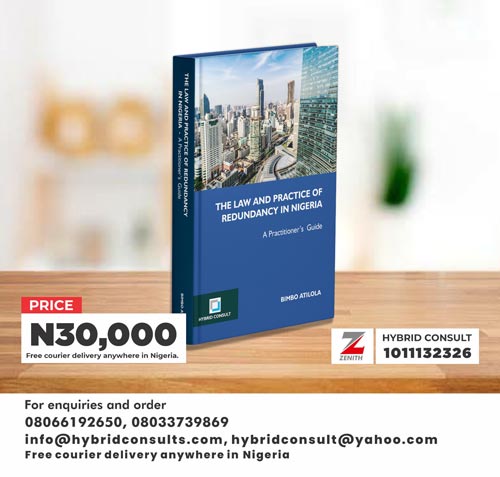 _______________________________________________________________________
[A MUST HAVE] Evidence Act Demystified With Recent And Contemporary Cases And Materials
_______________________________________________________________________
[A MUST HAVE] Evidence Act Demystified With Recent And Contemporary Cases And Materials