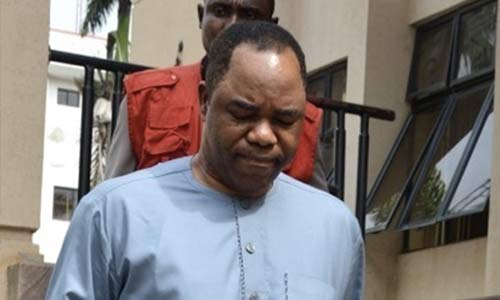
If the story of Tunde Ayeni; businessman, former Skye Bank chairman, Ntel investor, political financier, and now, once again, a guest of Nigeria’s foremost anti-corruption agency EFCC, teaches us anything, it is this: the Economic and Financial Crimes Commission has a very, very long memory.

On April 24, 2026, operatives of the EFCC arrested Tunde Ayeni in Abuja. The charges being investigated are staggering; alleged misappropriation and diversion of funds to the tune of N36.54 billion and $30 million, obtained from Polaris Bank through a web of at least 12 companies linked to him. The loans, according to EFCC sources, were obtained ostensibly for marine security operations, electricity distribution contracts, and estate development. Instead, investigators allege, the funds were funnelled into the acquisition of NITEL/MTEL telecom assets through a NATCOM account. EFCC spokesperson Dele Oyewale confirmed the arrest, with Ayeni expected to be arraigned upon conclusion of investigations.
It is a story that feels familiar. Because it has happened before. Multiple times. And therein lies the real story.
A Chronology of Encounters: Tunde Ayeni and the EFCC
To understand what is happening now, you must understand the full arc of this man’s relationship with Nigerian law enforcement. This is not a first-time arrest. This is the latest and arguably most consequential chapter in a story that began over two decades ago.
2004 — The Alamieyeseigha Connection
The story starts in the era of Nuhu Ribadu’s EFCC; arguably the most feared iteration of the commission Nigeria has ever seen. Ribadu, appointed by President Olusegun Obasanjo in 2003, turned the EFCC into a genuine instrument of terror for the corrupt elite. In 2004, his commission came for Diepreye Alamieyeseigha, the flamboyant Governor of Bayelsa State, on money laundering and corruption charges that would eventually land him in prison before a controversial presidential pardon years later.
In the course of that investigation, the EFCC’s net snagged a younger, ambitious businessman: Tunde Ayeni. He was arrested and detained for questioning over transactions connected to the Alamieyeseigha case, with Ayeni later acknowledged in court documents as having helped execute some of the disgraced governor’s deals. The EFCC eventually cleared Ayeni of direct complicity, with two letters from the agency confirming his release. But the fact that a young Nigerian businessman was already in a Ribadu-era detention room answering questions about a sitting governor’s corruption was not nothing.
November 2016 — The Bala Mohammed Land Scandal
More than a decade later, the EFCC knocked again. In November 2016, Ayeni was arrested in connection with allegations involving former FCT Minister Bala Mohammed and the controversial acquisition of 54 Abuja land plots. The case centred on allegations of large-scale land racketeering during Mohammed’s tenure as minister, with over N1.6 trillion allegedly unaccounted for. Ayeni’s name was pulled into the investigation.
He was released without charge. But once again, Tunde Ayeni had sat across from EFCC investigators in a room where questions were asked and answers were demanded.
December 2018 — The Skye Bank Collapse: First Arraignment
This was when the gloves truly came off. In September 2018, the Central Bank of Nigeria had finally done what market watchers had seen coming for years: it revoked Skye Bank’s licence entirely. The bank, once a tier-2 institution of genuine significance, had been hollowed out by insider lending, capital adequacy failures, and what the CBN politely called “inability to provide further liquidity support.” Polaris Bank was created as the successor institution, with AMCON injecting emergency capital to prevent total system failure.
The CBN had dissolved Skye Bank’s board back in July 2016 and imposed an interim management team, an almost unprecedented move that signalled the depth of the crisis. Tunde Ayeni, the bank’s chairman since December 2011, had overseen a tenure that investigators would later characterise as catastrophic for depositors.
In December 2018, the EFCC struck. Ayeni was arrested and arraigned before Justice Nnamdi Dimgba at the Federal High Court in Maitama, Abuja. He faced an 8-count charge of money laundering involving N4.75 billion and $5 million. Former Skye Bank Managing Director Timothy Oguntayo was co-accused. Both pleaded not guilty and were granted bail.
The charges painted a specific and alarming picture: funds alleged to have been moved out of Skye Bank during Ayeni’s chairmanship, through a system of suspense accounts and connected companies, into the pockets and projects of those at the very top of the institution entrusted with protecting depositors’ money.
March 2019 — Second Arraignment: N25.4 Billion Money Laundering
The EFCC was not done. Less than three months after the first arraignment, on March 6th and 7th, 2019, the commission brought two separate actions against Ayeni. Before Justice Valentine Ashi of the FCT High Court in Apo, Ayeni was charged with criminal breach of trust involving N4.597 billion. At the Federal High Court, he faced a 10-count charge of money laundering to the staggering tune of N25.4 billion, alongside Oguntayo and two companies Control Dredging Company Ltd and Royaltex Paramount Ventures Ltd.
One of the counts was unambiguous in its allegation: that between January 2014 and December 2014, while serving as chairman of Skye Bank, Ayeni converted the sum of N17.415 billion taken in cash from the bank’s Suspense Account, money that investigators said he “reasonably ought to have known forms part of the proceeds of an unlawful act.” Other counts alleged that billions of naira were transferred from the bank’s Suspense Account to companies, some of which were believed to be connected to him.
The EFCC also alleged that Ayeni had authorised a N1 billion donation from Skye Bank funds to the campaign chest of then-President Goodluck Jonathan using depositors’ money to play politics at the highest level.
Ayeni pleaded not guilty.
2022 — The Controversial Withdrawal
Here is where the story took a turn that drew sharp criticism from civil society. In 2022, the EFCC withdrew the N25.4 billion money laundering charges against Ayeni, following what was described as a settlement that included asset forfeiture. The two companies, Control Dredging Company Ltd and Royaltex Paramount Ventures Ltd were subsequently re-arraigned separately.
The withdrawal drew instant and fierce criticism. Lawyer Inibehe Effiong publicly questioned the use of plea bargains in a case of this magnitude. Anti-corruption advocate Auwal Rafsanjani raised concerns about what such settlements communicated to the public about the true meaning of accountability. The sense in certain quarters was that a very wealthy, very connected man had once again found a way to sidestep a final reckoning.
But the EFCC, as it has demonstrated before and after, does not close files permanently.
April 24, 2026 — The Latest Arrest
Which brings us to today. The new charges are the largest yet. N36.54 billion and $30 million, a figure that dwarfs even the 2019 allegations. Allegedly diverted through 12 companies linked to Ayeni, using loans obtained from Polaris Bank for stated purposes that investigators say were never the actual destination of the funds. The NITEL/MTEL/NATCOM connection adds a dimension that ties the alleged fraud to one of the most controversial telecom privatisation deals in Nigerian history.
Ayeni is currently in EFCC custody. He is expected to be arraigned upon conclusion of investigations.
What This Means
Tunde Ayeni has maintained his innocence across all his encounters with the law. He has, by his own account, suggested political motivations behind at least some of the prosecutions. He has hired top-flight legal representation, including, in 2019, the formidable Wole Olanipekun, SAN, one of Nigeria’s most accomplished courtroom lawyers. He has not been convicted of any crime. He is, in the eyes of the law, an accused man, not a guilty one, and that distinction matters.
But the paper trail is what it is. Six encounters with the EFCC over twenty-two years, spanning three different chairmen of the commission, multiple presidencies, and a range of financial allegations that have only grown in scope with each new investigation. A bank that was once among Nigeria’s significant financial institutions collapsed during his chairmanship and was absorbed by AMCON at the taxpayer’s expense. A telecom privatisation he anchored is now at the centre of a fresh fraud investigation.
This is not the biography of a man being persecuted by a rogue anti-corruption agency with a personal vendetta. This is the documented biography of a man who has spent over twenty years in and out of EFCC investigations, arraignments, and detentions each episode connected to his role at the epicentre of some of Nigeria’s most consequential financial institutions.
And the EFCC, whatever settlement was reached in 2022, has come back. With bigger numbers. With a fresh investigation. With 12 companies under scrutiny and arraignment proceedings pending.
The Nuhu Ribadu led EFCC once detained a young businessman connected to a corrupt governor. Twenty-two years later, Ola Olukoyede’s EFCC is now investigating that same man on charges involving N36 billion and $30 million. The institution has changed hands many times over two decades but the name at the top of the file has not.
The EFCC, for all its imperfections, appears to have decided something: that in Nigeria, the long arm of the law is exactly that; long. And when it finally closes around your wrist, no amount of money, connections, or time elapsed can explain away a two-decade paper trail.
Nigerians are watching. And they deserve answers.
[A MUST HAVE] Evidence Act Demystified With Recent And Contemporary Cases And Materials

Available now for NGN 40,000 at ASC Publications, 10, Boyle Street, Onikan, Lagos. Beside High Court, TBS. Email publications@ayindesanni.com or WhatsApp +2347056667384. Purchase Link: https://paystack.com/buy/evidence-act-complete-annotation
______________________________________________________________________ “Enhance Legal Practice With Authoritative Reports” — Alexander Payne Offers Comprehensive Law Reports, Spanning Over A Century Of Nigerian Jurisprudence Interested buyers are encouraged to place their orders and enquiries via:
0704 444 4777, 0704 444 4999, 0818 199 9888
Website: www.alexandernigeria.com
Interested buyers are encouraged to place their orders and enquiries via:
0704 444 4777, 0704 444 4999, 0818 199 9888
Website: www.alexandernigeria.com