The Senate on Wednesday moved to change provisions in the Electoral Act process to place the burden of proof in electoral litigation on the Independent National Electoral Commission (INEC). This means that the practice of candidates proving their election petitions will no longer apply.

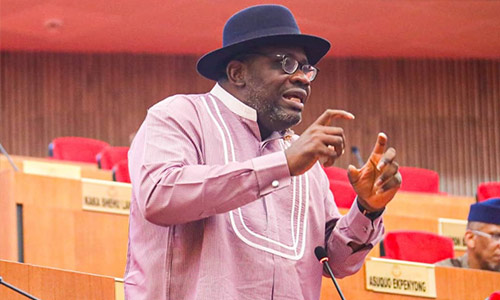
Speaking during the debate on the general principles of the Bill in plenary, former Bayelsa Governor, Henry Seriake Dickson, argued that shifting the evidential burden to INEC would inspire greater trust in the system.
He said the conventional rule—that whoever alleges must prove—should be discarded because “it is INEC that conducts elections and keeps the materials. It must therefore show that its conduct was lawful.”
His position was supported by Senate President Godswill Akpabio, who said it was illogical to assume that INEC’s actions were flawless when it controls both the conduct and materials of elections.
“It is wrong to assume that whatever INEC does is perfect. INEC should be held accountable because it controls electoral materials and logistics,” Akpabio said. “Therefore, it should bear the responsibility in court to prove that its actions were lawful and in line with the will of the people.”
Speaking further, Akpabio said Nigeria’s democracy had recorded progress under the Electoral Act 2022 but stressed that the legal framework must evolve to ensure credibility and public confidence ahead of the 2027 general elections.
“We are improving, but we are not yet perfect. We must continue to discuss until we get a near-perfect Electoral Act for the 2027 elections. INEC must be held responsible this time because it has the materials and logistics. The Commission should prove that its actions were legal and reflected the people’s will.”
The Senate President also said transparency was achieved in the last general elections, adding that Nigeria set an example for other African countries by uploading presidential results before final declaration, but maintained that the goal of perfection remained ahead.
Other senators who spoke on the bill called for reforms to strengthen electoral credibility, citing the need for improved use of technological tools, accountability mechanisms, and stricter penalties for malpractice.
In his contribution, Ekong Sampson called for stricter enforcement of sanctions, cautioning that strong laws alone would not guarantee credible elections.
“Elections are not conducted by ghosts. Our laws are strong, but enforcement is weak. We must strengthen sanctions and ensure that those who operate the system act as trustees of the people’s mandate,” he said.
In the same vein, Mohammed Adamu Aliero called for a thorough amendment, recalling that in 2022, they hurriedly passed the legislation and made errors that should now be corrected.
“We shot ourselves in the foot by excluding senators, House members, governors, and other elected officials from being delegates. That was a mistake we must fix,” he said.
On his part, Adams Oshiomhole condemned the culture of violence during elections, describing it as a major threat to democracy.
“We cannot continue treating elections like war. Politicians arm poor youths, and after elections, the weapons remain in circulation, fueling crime,” he warned.
Oshiomhole also urged that national and state elections be held on separate days to ease security management and reduce tension.
Similarly, Garba Musa Maidoki decried the high cost of accessing election materials from INEC, saying candidates sometimes pay as much as N1.5 billion to obtain certified true copies of results. He also renewed calls for diaspora voting.
“Nigerians abroad contribute more to the economy through remittances than crude oil revenue. They should have a voice in choosing the country’s leaders,” he said.
In his closing remarks, Akpabio agreed that diaspora Nigerians remain part of the democratic constituency and should be factored into future reforms.
Earlier in the session, the Senate read three correspondences from President Bola Ahmed Tinubu requesting confirmation of nominees for the boards of the Nigerian Communications Commission (NCC) and the Universal Service Provision Fund (USPF), as well as the appointment of Dr. Bernard Mohammed Doro as Minister of the Federal Republic.
The nominations were referred to the Committee on Communications and the Committee of the Whole for further legislative action.
Meanwhile, the Senate has suspended Thursday’s plenary to enable members of the Constitution Review Committee to join their counterparts in the House of Representatives for a joint retreat in Lagos.
[A MUST HAVE] Evidence Act Demystified With Recent And Contemporary Cases And Materials

Available now for NGN 40,000 at ASC Publications, 10, Boyle Street, Onikan, Lagos. Beside High Court, TBS. Email publications@ayindesanni.com or WhatsApp +2347056667384. Purchase Link: https://paystack.com/buy/evidence-act-complete-annotation
______________________________________________________________________ “Enhance Legal Practice With Authoritative Reports” — Alexander Payne Offers Comprehensive Law Reports, Spanning Over A Century Of Nigerian Jurisprudence Interested buyers are encouraged to place their orders and enquiries via:
0704 444 4777, 0704 444 4999, 0818 199 9888
Website: www.alexandernigeria.com
Interested buyers are encouraged to place their orders and enquiries via:
0704 444 4777, 0704 444 4999, 0818 199 9888
Website: www.alexandernigeria.com