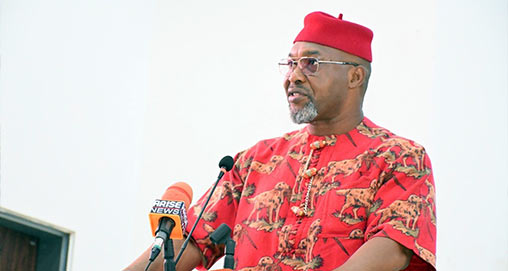
A former Minister of Aviation, Osita Chidoka, has criticised what he described as excessive and unrealistic bail conditions imposed by some Nigerian courts, warning that such conditions undermine the constitutional right to bail and weaken the dignity of the justice system.

Chidoka made the remarks in a statement titled, “Bail and the Dignity of the Law: A Call For Judicial Restraint,” where he questioned a recent ruling of a High Court in Abuja which granted bail to a defendant but attached conditions he said were virtually impossible for ordinary Nigerians to meet.
According to him, the court required the defendant’s sureties to be serving federal civil servants on Grade Level 16 or above, with each surety expected to own properties in Abuja worth at least ₦500 million. He added that one of the sureties was also required to provide a bank guarantee of ₦15 billion.
Chidoka said the conditions had no relationship with the realities of public service in Nigeria, arguing that a civil servant who starts at Grade Level 08 and rises to Grade Level 16 after nearly three decades would likely earn between ₦80 million and ₦100 million throughout an entire career.
“By the court’s ruling, we are asking that officer to show assets worth five times his lifetime earnings, and to stand behind a liability of ₦15 billion, roughly 150 times everything an honest career could ever yield,” he said.
He said such requirements send a troubling message that lawful public service is insufficient to produce the level of wealth now expected from persons considered fit to stand as sureties.
“What message does this send?” Chidoka asked. “It says, in the plainest terms, that lawful public service cannot produce the wealth the court now expects of a respectable citizen and that the civil servant worth trusting is the one who has, somehow, acquired what his salary could never explain.
“In an anti-corruption case, of all places, that is a strange proxy for integrity.”
The former minister also faulted the requirement that sureties surrender their international passports, saying it could obstruct senior public officers from performing official duties outside the country.
“The passport condition compounds the error. Senior officers travel on the nation’s business to negotiations, conferences, and training,” he said.
“Stripping them of their passports merely to vouch for an accused person interferes with the very duties the state employs them to perform.”
Chidoka compared the bail terms to what would be considered outrageous in other jurisdictions, saying a similar condition abroad would immediately raise concerns about proportionality.
“To grasp the scale of it, imagine requiring a British official to own property in Belgravia, Chelsea or Mayfair before he could stand surety, and to produce a bank guarantee of £8.2 million,” he said.
“Such a proposition would immediately raise questions about proportionality and public outrage.”
He argued that Nigerian law already prohibits excessive bail conditions, citing Section 165 of the Administration of Criminal Justice Act, which provides that bail conditions “shall not be excessive.”
Chidoka also referenced the Court of Appeal decision in Dasuki v. Director-General, State Security Service, which he said rejected the use of serving public servants as sureties and struck down a ₦100 million bail requirement.
“And the law has spoken. Section 165 of the Administration of Criminal Justice Act commands that bail conditions ‘shall not be excessive.’ In Dasuki v. D.G., SSS, the Court of Appeal held the use of serving public servants as sureties unknown to our law, contrary to the Public Service Rules, and corrosive of the fight against corruption, and struck down a ₦100 million requirement.
“We have answered that ruling with ₦500 million and a guarantee of ₦15 billion,” he said.
Chidoka maintained that a court cannot find that an accused person is not a flight risk and still impose bail conditions that only persons of extraordinary wealth can satisfy.
According to him, bail conditions that cannot realistically be met amount to a denial of bail in practical terms.
“A court that finds no real risk of flight cannot, in the same breath, impose conditions fit for a fugitive of vast and unexplained means. Conditions that cannot be met are not conditions; they are a denial of bail by arithmetic,” he said.
He stressed that the issue was not about whether an accused person is guilty or innocent, but about protecting the integrity of the legal process and ensuring that courts do not turn bail into punishment before conviction.
“The focus remains bail application and not the innocence or otherwise of accused persons,” Chidoka said.
“The war against corruption is won by lawful means, or it is not won at all. Let the courts secure attendance at trial, that is their duty, and let them stop there.”
He said the purpose of bail is only to secure the attendance of a defendant in court, not to measure wealth, punish an accused person before trial or embarrass honest public servants.
“The purpose of bail is to guarantee appearance. It was never to measure a man’s wealth, to punish him before his guilt is proved, or to make honest public service a thing to be ashamed of,” he added.
Chidoka further called for an end to what he described as the judiciary’s fixation with civil servants as sureties and the use of expensive Abuja neighbourhoods such as Maitama and Asokoro as benchmarks for determining the worth of sureties.
“Time to end this fixation with civil servants as sureties and Maitama and Asokoro as the only measure of value before our courts,” he said.
“It is discriminatory and humiliating for those who do not live in the court-sanctioned prime neighbourhoods and casts a cloud of corruption on public servants.
“On both counts, the law could not have intended or envisaged the weaponisation of wealth over character.”
Chidoka urged the judiciary to exercise restraint in imposing bail conditions, warning that unrealistic requirements damage public confidence in the justice system and convert the constitutional right to bail into an illusion.
[A MUST HAVE] Evidence Act Demystified With Recent And Contemporary Cases And Materials

Available now for NGN 40,000 at ASC Publications, 10, Boyle Street, Onikan, Lagos. Beside High Court, TBS. Email publications@ayindesanni.com or WhatsApp +2347056667384. Purchase Link: https://paystack.com/buy/evidence-act-complete-annotation
______________________________________________________________________ “Enhance Legal Practice With Authoritative Reports” — Alexander Payne Offers Comprehensive Law Reports, Spanning Over A Century Of Nigerian Jurisprudence Interested buyers are encouraged to place their orders and enquiries via:
0704 444 4777, 0704 444 4999, 0818 199 9888
Website: www.alexandernigeria.com
Interested buyers are encouraged to place their orders and enquiries via:
0704 444 4777, 0704 444 4999, 0818 199 9888
Website: www.alexandernigeria.com