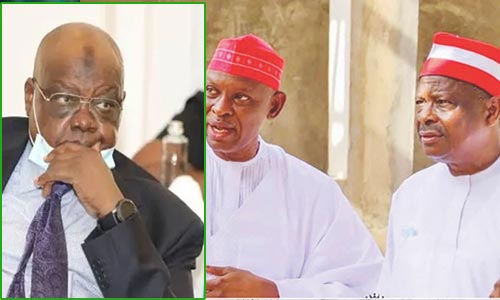
A retired Justice of Nigeria’s Supreme Court, Hon. Justice Musa Muhammad Dattijo, has issued a pointed clarification following claims by former Kano State governor and national leader of the New Nigeria People’s Party (NNPP), Rabiu Musa Kwankwaso, that he visited the homes of Supreme Court justices to plead over Governor Abba Yusuf’s election dispute.

Justice Dattijo stressed that he was speaking strictly with respect to himself, insisting that at no time did he meet Kwankwaso or Kano State Governor Abba Yusuf, whether in connection with the election or any other matter, while he served on the apex court.
His statement follows recent remarks by Kwankwaso alleging that after the 2019 Kano governorship election was declared inconclusive, he personally took Yusuf to the residences of all Supreme Court justices to seek intervention.
Speaking to supporters at his residence in a video shared by his media aide, Saifullahi Hassan, Kwankwaso had disclosed: “I had forgotten that in 2019, I took him to the homes of all the Supreme Court justices in Nigeria to beg them. The governor and I met them in their villages and towns.”
However, Kwankwaso did not mention the names of the specific justices he claimed to have visited.
In a statement made available to Law & Society Magazine, Justice Dattijo, who retired on October 27, 2023, challenged Kwankwaso to provide specifics of the alleged visits, while making it clear that his response should not be interpreted as a blanket denial on behalf of the judiciary.
“I speak only for myself,” the retired justice said, noting that he was a serving Justice of the Supreme Court at the time and never held such a meeting with Kwankwaso or Governor Abba Yusuf.
He added that if Kwankwaso maintains his claim, he should state when and where such meetings occurred, who was present, and which justices were involved, stressing that careless generalisations risk damaging the integrity of judicial officers who may have had no involvement whatsoever.
Justice Dattijo cautioned politicians against indiscriminately dragging judicial officers into partisan disputes, warning that such claims, whether substantiated or not, feed public cynicism toward the courts.
While acknowledging that public perception of Nigeria’s judiciary has deteriorated over the years, he reiterated a position he articulated in his valedictory speech, where he described public attitudes toward the courts as “witheringly scornful and monstrously critical.”
However, he underscored that judicial accountability must be pursued through evidence and due process, not sweeping political narratives.
“My intervention is not intended to defend or indict anyone else,” he said. “It is simply to clarify that I was not part of any such engagement.”
Justice Dattijo invoked the 1999 Constitution, noting that while freedom of expression is guaranteed, it is not without limits particularly where statements risk harming the reputation of others or undermining public institutions.
He also framed his response within his personal faith, citing Qur’an Chapter 4 (An-Nisa), Verse 135, which enjoins believers to stand firmly for justice, even against themselves or those close to them.
He warned that societies unravel when wrongdoing is ignored, tolerated, legitimised, and ultimately celebrated before those who resist it are punished.
Quoting organisational psychologist Adam Grant, Justice Dattijo stressed that integrity requires loyalty to principles rather than personalities, adding that judicial reform must be grounded in honesty, restraint, and collective responsibility.
Kwankwaso had expressed these claims in the context of deep political disappointment over the defection of Kano State Governor Abba Yusuf to the All Progressives Congress (APC), describing the move as a painful betrayal.
Speaking to supporters, Kwankwaso said Yusuf’s defection marked the greatest political letdown of his life, adding that it would have been preferable for the governor to align with a new political platform rather than defect to what he described as “political enemies.”
According to Kwankwaso, the defection amounted to handing over the NNPP’s mandate in Kano to adversaries, despite the political struggles they endured together in the past.
Kwankwaso revisited the events surrounding the 2019 Kano governorship election, which was declared inconclusive by the Independent National Electoral Commission (INEC), leading to a supplementary poll and eventual litigation that culminated at the Supreme Court.
“Injustice. In my entire life, I cannot remember where such a thing has ever been done before,” Kwankwaso said in Hausa.
Recalling the period, Kwankwaso disclosed that he personally made efforts to seek intervention from members of the Supreme Court during the legal battle, though he did not provide specific details about which justices were involved or when exactly the visits occurred.
Kwankwaso said the memory resurfaced during a conversation with former Senate President, Pius Anyim, whom he said contacted him when the election dispute began.
“There’s an Igbo man named Pius Anyim, former Senate President. When the issue started, he called me immediately. Before we even finished greetings, he asked if what he was hearing was true. He held his head,” Kwankwaso recounted.
In the 2019 election, Yusuf, then the Peoples Democratic Party (PDP) candidate, initially led with 1,014,353 votes, ahead of then-Governor Abdullahi Ganduje of the APC, who polled 953,522 votes. With over 100,000 votes cancelled, INEC declared the election inconclusive.
Following a supplementary election across 28 local government areas, Ganduje was declared winner. The Supreme Court later dismissed Yusuf’s appeal in January 2020, affirming Ganduje’s victory.
Kwankwaso and Yusuf later left the PDP for the NNPP, on whose platform Yusuf won the 2023 Kano governorship election, largely backed by the Kwankwasiyya political movement.
In 2023, Yusuf returned to power on the NNPP platform. Although his victory was overturned by both the election tribunal and the Court of Appeal, the Supreme Court in January 2024 reinstated him, faulting the lower courts and restoring cancelled votes.
That ruling remains one of the most consequential and closely watched electoral decisions of Nigeria’s recent democratic history.
Governor Yusuf announced his resignation from the NNPP last Friday, citing deepening internal crises and prolonged leadership disputes within the party.
The controversy unfolds amid political upheaval in Kano following Governor Abba Yusuf’s defection from the NNPP to the ruling All Progressives Congress (APC).
Kwankwaso, however, accused his former ally of handing over the NNPP’s mandate to political opponents.
Justice Dattijo’s clarification has sharpened the debate, not by closing it, but by drawing a careful line between personal denial and institutional judgment.
The retired justice’s decision to speak out, despite not being specifically named by Kwankwaso, underlined the sensitivity of the allegations and their potential impact on public confidence in the judiciary.
His insistence that he is speaking only for himself, and not on behalf of other justices, leaves open the question of whether other members of the Supreme Court bench at the time may have had such encounters with Kwankwaso and Governor Yusuf.
As political tensions rise, Justice Dattijo’s message is a narrow but pointed one: claims involving the judiciary must be precise, evidence-based, and responsibly framed, lest they further weaken public trust in an institution already under strain.
The retired justice’s intervention highlights the delicate balance between political freedom of expression and the need to protect the integrity of judicial institutions from potentially damaging generalizations.
By challenging Kwankwaso to provide specific details including dates, locations, names of justices, and witnesses present Justice Dattijo has effectively shifted the burden of proof back to the NNPP leader.
Justice Dattijo’s statement emphasizes that while judicial accountability is essential, it must be pursued through proper channels with concrete evidence, rather than through sweeping political claims made in the heat of partisan disputes.
His warning that “careless generalisations risk damaging the integrity of judicial officers who may have had no involvement whatsoever” resonates particularly strongly in Nigeria’s current political climate, where allegations of judicial corruption and interference are frequently made but rarely substantiated with specific evidence.
As of the time of this report, Kwankwaso had not responded to Justice Dattijo’s challenge to provide specifics of the alleged visits to Supreme Court justices’ homes, including details of when and where such meetings took place and which justices were present.
 Interested buyers are encouraged to place their orders and enquiries via:
0704 444 4777, 0704 444 4999, 0818 199 9888
Website: www.alexandernigeria.com
Interested buyers are encouraged to place their orders and enquiries via:
0704 444 4777, 0704 444 4999, 0818 199 9888
Website: www.alexandernigeria.com
 Reimagine your practice with the power of AI “...this is the only Nigerian book I know of on the topic.” — Ohio Books Ltd
Authored by Ben Ijeoma Adigwe, Esq., ACIArb (UK), LL.M, Dip. in Artificial Intelligence, Director, Delta State Ministry of Justice, Asaba, Nigeria.
Bonus:
Get a FREE eBook titled “How to Use the AI in Legalpedia and Law Pavilion” with every purchase.
Reimagine your practice with the power of AI “...this is the only Nigerian book I know of on the topic.” — Ohio Books Ltd
Authored by Ben Ijeoma Adigwe, Esq., ACIArb (UK), LL.M, Dip. in Artificial Intelligence, Director, Delta State Ministry of Justice, Asaba, Nigeria.
Bonus:
Get a FREE eBook titled “How to Use the AI in Legalpedia and Law Pavilion” with every purchase.
How to Order: 📞 Call, Text, or WhatsApp: 08034917063 | 07055285878 📧 Email: benadigwe1@gmail.com 🌐 Website: www.benadigwe.com
Ebook Version: Access directly online at: https://selar.com/prv626
_______________________________________________________________________ [A MUST HAVE] Evidence Act Demystified With Recent And Contemporary Cases And Materials
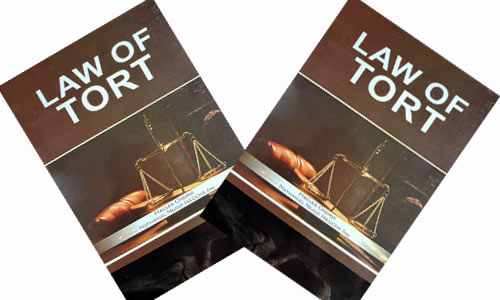 The book, titled The Law of Torts in Nigeria: A Functional Approach, authored by Professor Hagler Sunny Okorie Ph.D and Ikeocha, Nathaniel Ngozi Esq, offers law students, practitioners, and academics a comprehensive guide to understanding and applying tort law in Nigerian courts. Interested buyers can place orders via the following contact numbers: 08028636615, 08037667945, 08032253813, or +234 902 196 2209.