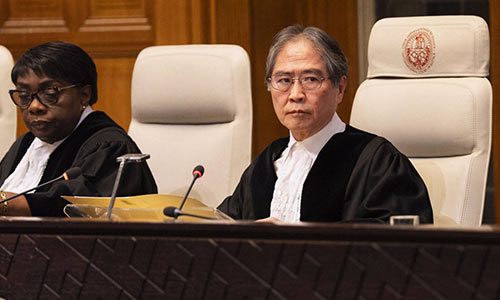
The International Court of Justice (ICJ) has ruled that Myanmar committed genocide against the Rohingya Muslim minority during a military crackdown that killed thousands of civilians and forced more than 730,000 people to flee to neighbouring Bangladesh.

The United Nations’ highest court, sitting in The Hague, Netherlands, delivered judgment on Thursday, November 19, 2026, in a case instituted by The Gambia against Myanmar in 2019 over alleged violations of the 1948 Convention on the Prevention and Punishment of the Crime of Genocide.
In a nine-to-six decision, the court held that Myanmar was responsible for genocide committed against the Rohingya population in northern Rakhine State, marking the first time the ICJ has found a state directly responsible for genocide.
Delivering the judgment, ICJ President Yuji Iwasawa declared that Myanmar had violated its international obligations under the Genocide Convention.
The court found that Myanmar “has committed genocide against the Rohingya group in northern Rakhine state, in violation of its obligations under the Genocide Convention”.
The judgment followed years of legal proceedings arising from military operations that drove hundreds of thousands of Rohingya civilians from their homes, particularly during the 2017 crackdown.
The Gambia had approached the ICJ in 2019, accusing Myanmar of carrying out a systematic campaign intended to destroy the Rohingya population and seeking a declaration that the country had breached its obligations under the Genocide Convention.
The West African country also requested orders requiring Myanmar to stop unlawful acts targeting the Rohingya and ensure accountability for those responsible.
Myanmar, however, maintained that its military operations were undertaken in response to attacks on police installations by members of the Arakan Rohingya Salvation Army (ARSA).
The court rejected Myanmar’s justification after examining evidence of killings, sexual violence, attacks on children and the forced flight of civilians.
During the reading of the judgment, Iwasawa said evidence presented before the court established that approximately 10,000 Rohingya had been killed by Myanmar’s security forces.
“The Court finds that Myanmar’s security forces killed thousands of Rohingya civilians, perpetrated widespread acts of sexual violence as well as acts of extreme violence against children and attacked fleeing Rohingya as they sought to flee in large numbers to Bangladesh,” he stated.
The court also considered evidence of widespread destruction of Rohingya communities and other measures directed against the minority population.
Iwasawa explained that the pattern of atrocities demonstrated more than an ordinary military operation, as the evidence established an intention to destroy a substantial part of the Rohingya population.
According to the judgment, the “only reasonable inference” from the widespread atrocities committed by Myanmar’s security forces was that they acted with the intention of destroying a substantial part of the Rohingya group.
The court consequently found that the necessary genocidal intent had been established.
The ICJ also ruled that Myanmar had failed to discharge its responsibility to prevent genocide, particularly when armed civilians participated alongside security forces in the military campaign.
“Myanmar thus violated its obligation to prevent genocide,” the court stated.
The ruling established Myanmar’s international responsibility for violations of the Genocide Convention, including killings and other acts intended to destroy the protected minority group.
Beyond the declaration of responsibility, the ICJ ordered Myanmar to provide reparations and restitution for the damage caused by its internationally wrongful acts.
Iwasawa explained that Myanmar was under an obligation to address the consequences of the genocide and take measures aimed at restoring the rights and welfare of the affected population.
The court identified appropriate restitution measures as including facilitating the safe and voluntary return of Rohingya refugees to their homes, restoring or replacing collective property destroyed during the military operations and assisting families in tracing missing relatives.
It also directed measures to ensure proper burials for the dead, physical and psychological rehabilitation for those who suffered injuries and trauma, and protection against further persecution.
The court’s decision also addressed the need for accountability and measures to prevent similar violations from occurring in the future.
The judgment represents a major legal victory for the Rohingya community, which has faced decades of discrimination, displacement and violence in Myanmar.
Before the 2017 crackdown, members of the minority had already experienced restrictions affecting their citizenship, freedom of movement and other fundamental rights.
The military operations subsequently forced hundreds of thousands of people to seek refuge in Bangladesh, where many remain in overcrowded camps.
According to United Nations figures cited in the report, more than 1.3 million Rohingya remain displaced across South and Southeast Asia, including approximately 1.2 million living in refugee camps in Cox’s Bazar, Bangladesh.
The humanitarian situation has remained difficult, with displaced families confronting insecurity, declining assistance and dangerous journeys in search of safety.
Reacting to the ruling, human rights lawyer Toby Cadman described the judgment as an important development in international law, particularly because of the demanding legal requirements for establishing genocide.
He explained that proving genocide requires more than demonstrating that serious atrocities occurred, as the law also requires evidence of a specific intention to destroy a protected group, in whole or in part.
“The court is guided by the genocide convention and what the genocide convention states and it is a high threshold,” Cadman said.
The judgment was also welcomed by human rights organisations, including Amnesty International, which expressed hope that it would advance accountability for the atrocities committed against the Rohingya.
“We hope this ruling marks the beginning of a long overdue process of accountability in Myanmar,” Amnesty International stated.
The organisation maintained that crimes under international law must be properly investigated and that individuals suspected of responsibility should face justice.
Cadman, however, cautioned that the judgment did not automatically resolve the humanitarian and legal challenges arising from the atrocities.
He noted that further developments could depend on international responses, including possible action by the United Nations Security Council, sanctions and other measures aimed at securing compliance.
The ruling concludes the substantive international legal dispute brought by The Gambia in 2019, although questions concerning enforcement, accountability and the future of displaced Rohingya remain.
While the ICJ determines the international responsibility of states rather than the criminal guilt of individuals, its judgment establishes that Myanmar violated its obligations under the Genocide Convention.
The decision also places Myanmar under an obligation to provide reparations, facilitate restitution and take appropriate measures to protect the Rohingya from further persecution.
For Rohingya refugees who fled their homes following the military operations, the judgment represents judicial recognition of the atrocities they suffered and establishes a legal basis for demanding remedies and accountability.
However, the practical implementation of the court’s orders, particularly the safe return of displaced persons and the provision of reparations, remains a major challenge.
[A MUST HAVE] Evidence Act Demystified With Recent And Contemporary Cases And Materials

Available now for NGN 40,000 at ASC Publications, 10, Boyle Street, Onikan, Lagos. Beside High Court, TBS. Email publications@ayindesanni.com or WhatsApp +2347056667384. Purchase Link: https://paystack.com/buy/evidence-act-complete-annotation
______________________________________________________________________ “Enhance Legal Practice With Authoritative Reports” — Alexander Payne Offers Comprehensive Law Reports, Spanning Over A Century Of Nigerian Jurisprudence Interested buyers are encouraged to place their orders and enquiries via:
0704 444 4777, 0704 444 4999, 0818 199 9888
Website: www.alexandernigeria.com
“A Comprehensive Guide To Evidence Law” — Releases Second Edition In Three Volumes, Covering 4,051 Cases
For enquiries and orders, contact: 08035526491 Email: jerryamadisilk@gmail.com
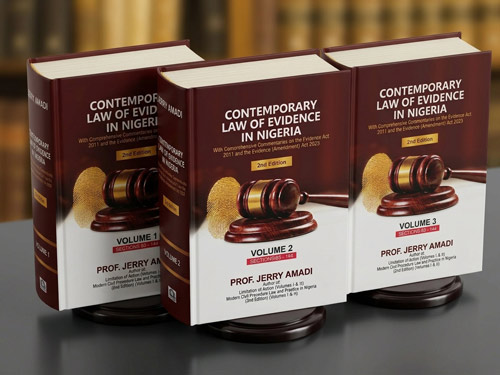 Prof. Jerry Amadi’s Evidence Law, Second Edition (2026), contains 3,314 pages in three volumes, covering the Evidence Act 2011, its 2023 amendment, and 4,051 Nigerian and English cases.