

Bizplus Consulting Services Limited has approached the Federal High Court in Abuja, seeking orders restraining the Judicial Service Committee of the Federal Capital Territory (FCT) and the National Judicial Council (NJC) from screening, shortlisting, recommending or presenting the Director of Enforcement of the FCT High Court, Mr. Chukwuemeka Tony Ubani, for appointment as a judge over allegations of administrative misconduct and contradictory official representations.

The company is also seeking an interlocutory injunction preventing Ubani from taking further steps to advance his candidacy for judicial appointment pending the determination of the substantive suit.
The legal action follows a dispute arising from the attempted enforcement of a judgment obtained by Bizplus against the Benue State Government, during which the company alleged that Ubani initially authorised enforcement arrangements but subsequently disassociated himself from the operation.
In the originating summons and accompanying motion on notice, both dated October 20, 2026, and sighted by TheNigerialawyer, Bizplus asked the court to determine whether an individual facing unresolved allegations concerning administrative integrity, institutional candour and professional conduct should be permitted to proceed through the judicial appointment process.
The court documents, filed at the Abuja Judicial Division of the Federal High Court, name Ubani as the first defendant, the Judicial Service Committee of the FCT as the second defendant, the NJC as the third defendant and the President of the Federal Republic of Nigeria as the fourth defendant.
The originating summons invokes Section 251(1)(g) and (r) of the 1999 Constitution, as amended, Order 3 Rules 6 and 7 of the Federal High Court (Civil Procedure) Rules 2019, and the inherent jurisdiction of the court.
The accompanying motion for interlocutory injunction was brought pursuant to Order 26 Rules 1 and 2 of the same Rules and the court’s inherent jurisdiction.
In the substantive action, the company is asking the court to declare that strict adherence to administrative procedures, institutional honesty and transparency are essential requirements for appointment to the Bench of the High Court of the FCT.
It further seeks a declaration that Ubani’s alleged telephone disclaimer of an earlier authorised judgment enforcement exercise amounted to a breach of administrative integrity and institutional accountability sufficient to disqualify him from judicial appointment.
Bizplus also wants an order directing the Judicial Service Committee and the NJC to suspend any ongoing or future screening, shortlisting, interviewing, evaluation or recommendation of Ubani until the substantive suit is determined and the administrative petition against him is conclusively resolved.
In addition, the company seeks a perpetual injunction restraining the two judicial bodies from forwarding Ubani’s name to the President for appointment as a High Court judge unless an independent investigation clears him of the allegations.
The company maintained that allowing a candidate facing unresolved questions concerning administrative conduct to proceed through the appointment process could undermine public confidence in the judiciary.
Bizplus anchored its claims on Section 153 and Paragraph 21(c) of the Third Schedule to the Constitution, alongside the Revised NJC Guidelines governing judicial appointments.
It argued that candidates for judicial office must possess high moral character, transparency, administrative integrity and professional discipline.
The company contended that the constitutional and institutional requirements governing judicial appointments should prevent the advancement of a candidate whose administrative conduct is the subject of an unresolved integrity complaint.
The dispute originated from Suit No. FCT/HC/CV/3693/2025, *Bizplus Consulting Services Ltd & Anor. v. Government of Benue State & Anor.*, in which Bizplus and Mauritz Walton Limited pursued enforcement proceedings against the Benue State Government.
According to the documents, the High Court of the FCT, presided over by Justice Bello Kawu, granted a Garnishee Order Absolute on December 4, 2025.
The order arose from proceedings involving the Benue State Government, its Attorney-General and several financial institutions joined as garnishees.
The court subsequently issued a Writ or Warrant of Execution on December 5, 2025, to facilitate enforcement of the judgment.
However, on December 8, 2025, the Court of Appeal, Abuja Division, issued an interim order directing the parties to maintain the status quo.
The legal effect of that order subsequently became a point of disagreement during the enforcement process.
Bizplus maintained that, under the administrative procedures governing judgment execution within the FCT High Court, the Director of Enforcement could not initiate enforcement arrangements without prior written approval from the Chief Judge.
The company alleged that on May 4, 2026, Ubani issued an official letter requesting assistance to enforce the judgment against the Benue State Government.
According to the affidavit accompanying the originating summons, the letter represented that Ubani was acting on an administrative directive from the Chief Registrar and that there was no pending adverse application or legal impediment preventing enforcement of the judgment sum.
The execution was initially scheduled to commence on May 5, 2026.
Bizplus argued that the issuance of the letter suggested that the necessary administrative approvals had been obtained and that the Director of Enforcement was acting within the established judicial hierarchy.
However, the company alleged that the position changed during an attempted enforcement exercise at the premises of United Bank for Africa Plc on September 4, 2026.
According to the affidavit, UBA resisted the enforcement and relied on its interpretation of the Court of Appeal’s status quo order to justify withholding the judgment sum.
The operation was subsequently suspended to allow the competing legal positions to be examined.
Bizplus alleged that during subsequent discussions concerning the suspended enforcement, it was informed that Ubani had been contacted by telephone and had denied authorising the particular operation.
The company described the alleged denial as inconsistent with the official letter of May 4, 2026, and the administrative approvals which, it maintained, should have preceded the enforcement arrangements.
In its originating summons, Bizplus asked the Federal High Court to determine whether the alleged telephone disclaimer amounted to a deliberate contradiction of the authority of the FCT High Court’s judicial leadership or an act of administrative deception.
It also asked whether the alleged inconsistency between the May 4 written communication and the September 4 telephone disclaimer violated the standards of moral character, transparency and consistency expected of a candidate seeking appointment to the Bench.
The company further questioned whether advancing such a candidate through the judicial appointment process would be compatible with administrative accountability and the institutional integrity of the judiciary.
Bizplus maintained that the complaint was not merely about the outcome of the enforcement exercise but concerned the reliability of official representations made by a senior judicial administrative officer.
It argued that the alleged contradiction raised questions that should be investigated before any recommendation for judicial appointment.
The company also relied on an administrative petition submitted to the relevant judicial authorities, including the NJC, challenging Ubani’s conduct and suitability for judicial office.
In the affidavit supporting the originating summons, Dr. Maurice Ibe, an authorised representative of Bizplus, stated that the company had submitted a formal petition concerning Ubani’s administrative honesty, candour and fitness for judicial elevation.
Ibe further stated that he had information which he believed to be reliable indicating that Ubani was undergoing screening and consideration for appointment as a judge of the FCT High Court.
He expressed concern that the judicial appointment process could be concluded before the allegations were investigated and resolved.
According to the company, allowing the process to proceed could create a situation in which the court’s eventual decision would no longer provide an effective remedy.
Consequently, Bizplus filed a motion on notice seeking interlocutory orders to preserve the subject matter of the suit.
The first relief in the motion seeks to restrain the Judicial Service Committee of the FCT and the NJC, whether acting through their committees, officers, members or agents, from further screening, interviewing, shortlisting, evaluating, recommending or presenting Ubani for appointment as a judge pending the final determination of the originating summons.
The second relief seeks an order suspending or freezing the legal effect of any screening, evaluation, shortlisting or recommendation already undertaken in relation to Ubani.
Under that request, the company wants the court to stay the implementation of any administrative step arising from the appointment process until the substantive action is determined.
The third relief seeks to restrain Ubani personally from presenting himself to the Judicial Service Committee or the NJC, or taking further steps to advance his candidacy for elevation to the Bench.
Bizplus also asked the court to make any further orders considered appropriate in the circumstances.
In the grounds supporting the motion, the company maintained that its substantive suit raised serious constitutional and legal questions concerning judicial appointments.
It argued that the pending administrative complaint against Ubani involved allegations that should be examined before his candidacy could be advanced.
The company further contended that the alleged inconsistency between his earlier written communication and subsequent telephone disclaimer raised questions about the reliability of administrative approvals and official representations.
Bizplus insisted that a precautionary order was necessary to prevent the judicial appointment process from overtaking the litigation.
It argued that the balance of convenience favoured temporarily suspending the screening of one candidate rather than allowing an appointment that could later become the subject of further legal controversy.
The company maintained that the proposed suspension would not disrupt the entire judicial appointment process, as the requested orders concerned only Ubani’s candidacy.
In contrast, it argued that proceeding with the appointment before resolving the allegations could cause damage to public confidence in the judiciary.
Bizplus also undertook to compensate the defendants for any costs, damages or financial losses arising from the injunction if the court subsequently determined that the application was frivolous, unmeritorious or ought not to have been granted.
In the written address supporting the motion, counsel to the company urged the court to preserve the status quo pending the determination of the substantive issues.
The company argued that interlocutory relief was necessary to ensure that the eventual judgment would not be rendered ineffective by the completion of the appointment process.
The originating summons and motion were accompanied by affidavits and supporting materials, including the Garnishee Order Absolute of December 4, 2025, the Writ or Warrant of Execution dated December 5, 2025, the Court of Appeal’s status quo order of December 8, 2025, the official enforcement correspondence dated May 4, 2026, and documentary material relating to the administrative petition.
The originating summons also contains an affidavit of non-multiplicity of actions in which Ibe stated that the company had not maintained another pending proceeding involving the same defendants, questions and reliefs.
However, a separate court document obtained alongside the new processes shows that Bizplus had earlier filed a notice of discontinuance in another Federal High Court action involving Ubani and the judicial appointment authorities.
The notice, dated October 2, 2026, and bearing a Federal High Court registry stamp dated October 6, 2026, relates to Suit No. FHC/ABJ/CS/2174/2026.
In that earlier action, Bizplus was listed as plaintiff, while Ubani, the Judicial Service Committee of the FCT, the NJC and the Attorney-General of the Federation were named as defendants.
The notice expressly stated that the company wished to discontinue the suit against all the defendants.

[A MUST HAVE] Evidence Act Demystified With Recent And Contemporary Cases And Materials
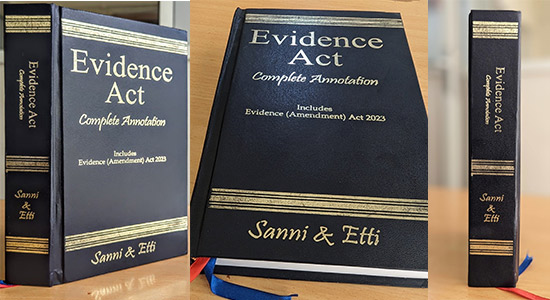
Available now for NGN 40,000 at ASC Publications, 10, Boyle Street, Onikan, Lagos. Beside High Court, TBS. Email publications@ayindesanni.com or WhatsApp +2347056667384. Purchase Link: https://paystack.com/buy/evidence-act-complete-annotation
______________________________________________________________________ “Enhance Legal Practice With Authoritative Reports” — Alexander Payne Offers Comprehensive Law Reports, Spanning Over A Century Of Nigerian Jurisprudence Interested buyers are encouraged to place their orders and enquiries via:
0704 444 4777, 0704 444 4999, 0818 199 9888
Website: www.alexandernigeria.com