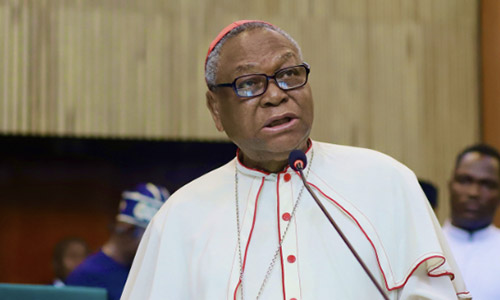
Archbishop Emeritus of Abuja, John Cardinal Onaiyekan, has proposed a seven-point overhaul of Nigeria’s electoral system, including a new method for appointing the Chairman and commissioners of the Independent National Electoral Commission, special election tribunals, legal standing for voters to challenge results, conclusion of election cases before inauguration, independent candidacy, a presidential run-off system and stricter rules against lawmakers defecting from their parties.

Onaiyekan made the proposals on Thursday while delivering the keynote address at the 22nd All Nigeria Editors Conference (ANEC 2026) organised by the Nigerian Guild of Editors in Enugu.
The conference, attended by more than 500 editors and other stakeholders, has the theme “The Ballot, the Media and the Task of Keeping Democracy Alive,” with a sub-theme examining the detection and debunking of artificial intelligence-driven disinformation before, during and after elections.
Onaiyekan said the ultimate purpose of democracy should be to produce a government freely chosen by citizens and committed to the common good, stressing that democratic government depended not merely on elections but also on respect for established rules, institutions, checks and balances.
“The ultimate objective is to install a government that is freely chosen by the people and that works for the common good of the people,” he said.
The Cardinal, who described himself as an 82-year-old Nigerian who had watched the country’s hopes of greatness repeatedly elude it, said he was addressing the subject from the perspectives of both a citizen and a religious leader.
He expressed concern about the quality of Nigeria’s electoral process since the return to civilian rule in 1999, arguing that the country needed a stronger legal and institutional framework to ensure that election outcomes genuinely reflected the choices made by voters. In his full keynote address, he said it appeared to him that the quality of elections had been deteriorating rather than improving — an assessment he presented as his view of Nigeria’s electoral experience.
A central plank of Onaiyekan’s reform proposal was the appointment process for INEC leadership.
He questioned whether an electoral commission could be fully independent when its chairman and commissioners depended on appointments involving presidents and governors who were themselves political actors.
“We need to review the method of appointment of the INEC, the Chairman and the commissioners. They should not depend on Mr. President and the governors, who are themselves contestants in elections,” he said in his keynote address.
Onaiyekan said Nigeria should examine arrangements adopted elsewhere to strengthen institutional independence, arguing that legislative approval of appointments had, in his assessment, become largely routine.
He was particularly critical of state electoral commissions, alleging that their structure and appointment process left them vulnerable to control by state governments.
His comments amounted to a proposal for reform rather than a finding that particular INEC officials had acted improperly.
The Cardinal’s second major proposal was the establishment of a special election tribunal dedicated exclusively to electoral disputes, with strict timelines to prevent election litigation from dragging on for extended periods.
He also proposed a change in the evidential burden in appropriate election disputes.
According to Onaiyekan, where the conduct of an election is directly challenged, INEC should bear greater responsibility for demonstrating that the election was properly conducted rather than leaving the entire burden on the petitioner.
“We need to set up a special election tribunal whose duty will be to do nothing else but to settle all election cases with minimum delay,” he said, adding that in such proceedings “the onus of proof should now be squarely on INEC where charged.”
That proposal would represent a departure from the general position reflected in Nigerian election litigation, where a petitioner challenging a declared result ordinarily carries the burden of proving the allegations relied upon.
Third, Onaiyekan called for ordinary voters to be given legal standing to challenge election results where they believed their votes had not been properly counted.
He argued that the electoral process ultimately belonged to voters and questioned why only candidates and political parties should be permitted to initiate election petitions.
“While the candidates have a right to complain in the tribunal, we too should have the right to present our case if we believe that the votes we cast have not been properly counted,” he said.
His fourth proposal was that major election petitions should be concluded before successful candidates are sworn into office.
Onaiyekan argued that allowing an elected official to assume office and thereafter defend the disputed mandate while exercising the powers and resources associated with that office could raise questions about fairness.
He said a specially structured electoral tribunal, operating under firm deadlines, could make it possible for litigation to be concluded before inauguration.
His fifth proposal was the introduction of independent candidates, particularly at the local government level.
The Cardinal argued that a community should be able to support a respected person for elective office without forcing that individual to first secure the platform of a political party.
He said independent candidacy could reduce what he described as “the tyranny of the political parties and their ruthless godfathers.”
Sixth, Onaiyekan proposed changing the presidential election system so that a candidate would need to obtain at least 50 per cent of votes cast to win outright.
Where no candidate reached the threshold on the first ballot, he proposed that the two leading candidates proceed to a second-round election.
“For the presidential election, we should insist on at least 50% of all votes cast before declaring any victory,” he said in the full address, arguing that a run-off would provide the eventual winner with a broader electoral mandate.
The Constitution currently uses a different formula for determining a presidential winner, involving the highest number of votes cast together with specified geographic-spread requirements. Onaiyekan’s 50-per-cent proposal would therefore require a change to the existing constitutional framework rather than being a description of the present rule.
His seventh proposal concerned cross-carpeting by lawmakers.
He called for stricter rules requiring a legislator who changes from the political party under which he or she was elected to another party to return to the constituency and seek a fresh mandate in a by-election.
Onaiyekan argued that constituents should not simply watch a representative change political affiliation without being given an opportunity to decide whether they wished to continue being represented by that person under a different party platform.
Beyond the seven proposals, Onaiyekan raised broader concerns about Nigeria’s electoral institutions and political culture.
He criticised what he described as a “do-or-die” attitude among some politicians, arguing that elections were too often treated as contests for power, wealth and influence rather than mechanisms through which citizens choose representatives.
He said ordinary citizens could consequently become “pawns” in political struggles.
On INEC, the Cardinal questioned the structural independence of an institution established and funded by government while politicians controlling government were also participants in elections.
“INEC is supposed to be independent by definition, Independent National Electoral Commission. But it is doubtful how independent it is or can be,” he said.
That was Onaiyekan’s institutional criticism; the report does not establish that the current commission or its officials acted under the direction of any political actor.
He also criticised the use of state resources for partisan activities and questioned statements by politicians claiming they could “deliver” all votes in particular states to candidates.
According to him, such rhetoric raised a basic question about whether individual citizens remained free to make electoral choices according to their consciences.
Onaiyekan additionally raised concerns about the scale and visibility of security deployments during elections.
While acknowledging the responsibility of security agencies to ensure peaceful polling, he argued that a heavy presence of armed operatives, sirens and other demonstrations of force could intimidate citizens and discourage participation.
He contrasted that with his experience of elections in Italy, where, according to him, people went to polling stations, voted and resumed their daily activities without an atmosphere resembling a country at war.
The Cardinal also addressed the growing role of the judiciary in electoral contests.
He said courts and election tribunals were necessary for resolving disputes but argued that election winners should fundamentally be determined by voters at polling stations.
“The judiciary is not to determine elections about who wins, but rather to adjudicate disputes when they arise,” Onaiyekan said.
He expressed concern that Nigeria had witnessed elections whose eventual outcomes were substantially shaped by court decisions and said the use of legal technicalities had affected public perceptions of electoral justice.
His comments came at the same editors’ conference where immediate past Nigerian Bar Association President Mazi Afam Osigwe, SAN, separately raised concerns about what he called the “judicialisation of the electoral process,” saying courts had become frequently involved in determining election outcomes. These were separate assessments by the two speakers rather than judicial findings.
Onaiyekan also criticised the National Assembly for what he described as insufficient attention to comprehensive electoral reform and alleged that politicians had learnt how to exploit loopholes in the existing framework.
He acknowledged, however, that with the 2027 elections approaching, there might be limited time to carry out all the structural reforms he proposed before the polls.
He therefore urged political actors and electoral institutions to work within the existing legal framework to conduct the forthcoming elections, while directing his seven-point programme principally to the National Assembly that would emerge after the 2027 elections.
The Cardinal also devoted part of his address to the role of journalism in democratic governance.
He said the media should give Nigerians reliable information about the state of the country, hold public officers accountable and report government policies fairly while retaining the freedom to subject them to critical scrutiny.
“A free press is necessary for a genuine democracy,” he said.
Onaiyekan urged media organisations to maintain independence from governments, businesses and other interests capable of exerting financial or political pressure.
He also acknowledged the changing communications landscape, noting the growth of social media and artificial intelligence alongside newspapers, radio and television.
The Cardinal said emerging technology offered opportunities but also carried risks if deployed without proper controls, a theme also addressed at the conference by INEC Chairman Prof. Joash Amupitan, SAN, and the Obi of Onitsha, Igwe Nnaemeka Alfred Achebe, who separately warned about AI-generated electoral misinformation.
Onaiyekan further called on Christian and Muslim leaders to use their influence to promote good governance instead of seeking political patronage.
He said religion could contribute positively to democratic development where religious leaders emphasised justice, honesty, accountability and adherence to the rule of law.
He equally stressed the importance of the character of those who seek political office, saying leadership should be grounded in honesty, commitment to the common good and respect for just laws.
“Power belongs to the people,” Onaiyekan said, adding that those entrusted with political authority should exercise it with responsibility to both citizens and God.
[A MUST HAVE] Evidence Act Demystified With Recent And Contemporary Cases And Materials

Available now for NGN 40,000 at ASC Publications, 10, Boyle Street, Onikan, Lagos. Beside High Court, TBS. Email publications@ayindesanni.com or WhatsApp +2347056667384. Purchase Link: https://paystack.com/buy/evidence-act-complete-annotation
______________________________________________________________________ “Enhance Legal Practice With Authoritative Reports” — Alexander Payne Offers Comprehensive Law Reports, Spanning Over A Century Of Nigerian Jurisprudence Interested buyers are encouraged to place their orders and enquiries via:
0704 444 4777, 0704 444 4999, 0818 199 9888
Website: www.alexandernigeria.com
Interested buyers are encouraged to place their orders and enquiries via:
0704 444 4777, 0704 444 4999, 0818 199 9888
Website: www.alexandernigeria.com