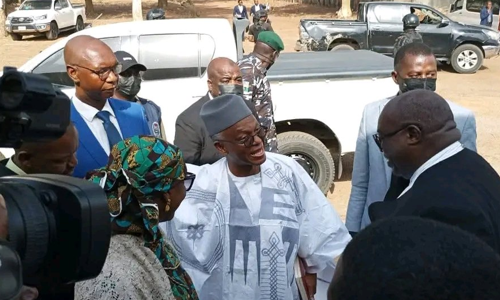
The Federal High Court sitting in Kaduna has granted bail to former Kaduna State Governor Nasir El-Rufai over corruption charges filed by the Independent Corrupt Practices and Other Related Offences Commission but ordered that the former governor remain in the custody of the anti-graft agency until all bail conditions, described by the judge as “strict and extensive,” are fully met.

Justice Rilwanu Aikawa admitted El-Rufai to bail in the sum of N200 million with two sureties in like sum, imposing a set of conditions that include the requirement for a senior civil servant and a recognised traditional ruler as sureties, the deposit of passports, a gag order barring El-Rufai from making public comments about the case, and mandatory attendance at all court sittings.
The ruling came after a dramatic day that saw the former governor shuttled between two courts in Kaduna — first to the Kaduna State High Court, where a separate bail ruling was adjourned to April 21 due to the presiding judge’s bereavement, and then to the Federal High Court where Justice Aikawa delivered the bail ruling.
Justice Aikawa, who had adjourned the matter from April 1 to consider arguments from both the prosecution and defence, set the following conditions for El-Rufai’s bail.
The former governor was admitted to bail in the sum of N200 million with two sureties in like sum. The sureties must deposit their international passports with the court. One surety must be a civil servant not below Grade Level 15 in the federal or state civil service. The other surety must be a recognised traditional ruler. El-Rufai is barred from making any public comments relating to the case. And he must attend all court sittings without fail.
The court explicitly ruled that El-Rufai must remain in ICPC custody until all the bail conditions are fully met meaning the former governor will continue to be detained until he is able to produce sureties who meet the court’s stringent requirements, deposit the required documentation, and satisfy all other conditions.
The condition barring El-Rufai from making public comments about his case is particularly significant. The former governor has been known for his combative public posture, and since his detention, his family members, political associates, and lawyers have made multiple public statements about the case.
The gag order effectively silences El-Rufai on all matters relating to his prosecution — a restriction that, if enforced, would prevent him from publicly responding to allegations, giving media interviews about the charges, or making political statements connected to the case.
Whether the gag order extends to his lawyers and family members speaking on his behalf is a question that may require further clarification from the court.
Earlier on Tuesday, proceedings at the Kaduna State High Court in a separate ICPC case against El-Rufai were stalled when the presiding judge, Justice Darius Khobo, was unable to deliver his ruling on El-Rufai’s bail application as earlier scheduled.
The adjournment was attributed to the judge’s bereavement, which prevented him from preparing the ruling in time.
El-Rufai’s counsel, Ubong Akpan, expressed understanding about the delay.
“His Lordship was bereaved and he was unable to put the ruling together. So, we understand these things happen,” Akpan stated.
He expressed optimism ahead of the rescheduled ruling on April 21: “So the ruling has been adjourned to Tuesday next week. The ruling on the motion for bail. So, fingers crossed.”
The State High Court case involves charges of abuse of office, fraud, intent to commit fraud, and conferring undue advantage, originally filed under Charge No. KDH/KAD/ICPC/01/26. El-Rufai was initially arraigned alongside the Managing Director of TMDK Terminal Limited, Amadu Sule, on March 18, 2026.
However, in a notable development on Monday, the prosecution amended the charges, dropping Sule from the case entirely and narrowing the trial to El-Rufai alone. The reasons for dropping the co-defendant were not publicly disclosed.
After the State High Court adjournment, El-Rufai was moved to the Federal High Court for the separate proceedings before Justice Aikawa — a sequence that his counsel described as evidence of a deliberate prosecutorial strategy.
Akpan accused the ICPC of engaging in “phased litigation” against his client, noting that proceedings were now ongoing in both the state and federal courts simultaneously.
The accusation suggests the defence views the ICPC’s decision to file separate charges at two different courts as a strategy designed to keep El-Rufai entangled in multiple legal proceedings, making it more difficult and more expensive for him to mount a comprehensive defence while ensuring that even if one case falters, the other continues.
The Federal High Court proceedings are based on a 10-count charge that covers a wide range of allegations spanning El-Rufai’s eight-year tenure as Kaduna governor from 2015 to 2023.
The charges include excessive severance payment of N289.8 million — far above the lawful entitlement of approximately N20 million; money laundering involving suspicious financial inflows; receipt of foreign currency from questionable sources; diversion of more than $1 million from a World Bank loan; irregular award of an N11 billion light rail contract to an allegedly unregistered company for a project never executed; a N4.61 billion CCTV contract awarded in violation of procurement laws; conferring undue advantage in a $22.475 million contract; land fraud along the Kaduna-Zaria Expressway; unlawful revocation and reallocation of land; and conspiracy to obstruct justice by allegedly offering financial inducements to investigators in Nigeria and abroad, including in Dubai and Cairo.
While El-Rufai’s lawyer declined to comment when approached by journalists after the Federal High Court proceedings, the former governor’s son, Bello El-Rufai, confirmed that his father had been granted bail.
Hayatudeen Makarfi, a chieftain of the African Democratic Congress, also confirmed the development, noting that the bail came with multiple conditions including financial requirements, landed property, and the involvement of a recognised traditional ruler as surety.
Makarfi stressed that the conditions must be met before the former governor can regain his freedom, adding that El-Rufai would remain in ICPC custody pending compliance.
El-Rufai’s actual release from custody depends on how quickly the bail conditions can be satisfied.
The requirement for a recognised traditional ruler as surety is unusual and potentially challenging. The surety must be willing to stake N200 million and deposit their international passport with the court — a significant personal commitment that may limit the pool of traditional rulers willing to take on the responsibility.
Similarly, the requirement for a civil servant not below Grade Level 15 — a senior director-level position in the civil service requires finding a serving government official willing to stand as surety for a former governor facing corruption charges, a step that could have career implications for the civil servant.
The financial requirement of N200 million bail with sureties in like sum, combined with the documentary requirements, means El-Rufai’s release could take days or even weeks, depending on the speed at which compliant sureties are identified and the necessary documentation assembled and verified by the court.
The situation of a former state governor being prosecuted simultaneously in two different courts by the same anti-corruption agency with separate bail applications, different judges, different charges, and different timelines is unusual even by the standards of Nigeria’s complex anti-corruption landscape.
The Federal High Court has now granted bail with strict conditions. The State High Court bail ruling is pending until April 21. Even if El-Rufai satisfies the Federal High Court bail conditions and secures release, the State High Court proceedings continue independently.
The defence’s characterisation of the arrangement as “phased litigation” suggests it will become a point of legal contention as the cases progress — potentially forming the basis for future applications arguing prosecutorial abuse of process or multiplication of proceedings.
El-Rufai remains in ICPC custody pending compliance with the bail conditions. His legal team is expected to work urgently to identify and present sureties who meet the court’s requirements.
The State High Court bail ruling is scheduled for April 21, 2026. If granted, El-Rufai would need to satisfy two separate sets of bail conditions from two different courts.
The substantive trial on the 10-count charge at the Federal High Court will proceed once arraignment formalities are completed and a trial date is fixed. The State High Court case will follow its own timeline.
For El-Rufai, who has now spent over two months in detention since his initial arrest by the EFCC on February 16, 2026, Tuesday’s bail ruling represents progress toward freedom but with conditions strict enough to ensure that freedom remains conditional and closely supervised by the court.
[A MUST HAVE] Evidence Act Demystified With Recent And Contemporary Cases And Materials

Available now for NGN 40,000 at ASC Publications, 10, Boyle Street, Onikan, Lagos. Beside High Court, TBS. Email publications@ayindesanni.com or WhatsApp +2347056667384. Purchase Link: https://paystack.com/buy/evidence-act-complete-annotation
______________________________________________________________________ “Enhance Legal Practice With Authoritative Reports” — Alexander Payne Offers Comprehensive Law Reports, Spanning Over A Century Of Nigerian Jurisprudence Interested buyers are encouraged to place their orders and enquiries via:
0704 444 4777, 0704 444 4999, 0818 199 9888
Website: www.alexandernigeria.com
Interested buyers are encouraged to place their orders and enquiries via:
0704 444 4777, 0704 444 4999, 0818 199 9888
Website: www.alexandernigeria.com