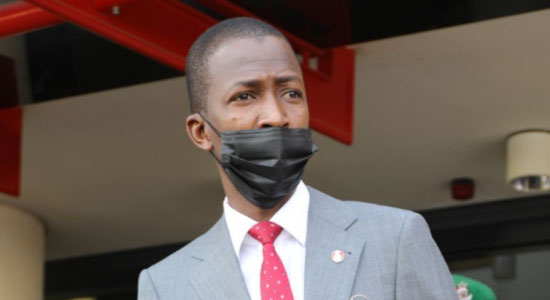
The Chairman of the Economic and Financial Crimes Commission, EFCC, Abdulrasheed Bawa, has cautioned members of the public not to drag the commission into business transactions gone awry.

Mr Bawa gave the advice while speaking as one of the panelists at the Alao Aka- Bashorun Memorial Lecture on Thursday in Lagos, stressing that the commission was not a debt recovery agency.
The lecture is part of the activities to commemorate the Nigerian Bar Association, NBA, Ikeja Branch, Law Week 2021.
Mr Bawa, represented by Anselm Ozioko, the Head of the Legal Department of the EFCC, spoke on the topic; “Our Role in the Effective Implementation of Nigeria’s Anti-Corruption Law”.
He said that there was a general misconception by members of the public that the EFCC was a debt recovery agency and urged the public to stop asking the anti-graft agency to recover debts.
“I state with all sense of responsibility that members of the public, including legal practitioners in the course of carrying out recovery for their clients, should stop urging us (the commission) to do so.
“I must also state that in the course of investigating a financial crime, it is possible that a sum of money transferred from the account of a nominal complainant, may be recovered as an exhibit.
“In certain circumstances, the exhibits may be released to the complainant or the said exhibit will be used for the prosecution of the suspect in court.
“At the end of a successful prosecution, the court may grant a Restitutive Order for the nominal complainant, in which the exhibit will be released to nominal complainant pursuant to the court Order,” Mr Bawa said.
He said that when the EFCC was approached by fraud victims, they typically expect the organisation to freeze bank accounts of suspects, make them forfeit their assets and release the assets to them (victims).
The chairman said when the EFCC followed due process and did not act in line with the expectations of the victims, they become disoriented.
Mr Bawa said that despite best efforts of the EFCC, international online trading platforms like Paypal, have not restored Nigeria to its payment platform due to the nefarious activities of fraudsters.
Commenting on the roles of lawyers during interrogation, the chairman said that they were to observe and not interfere with interrogations by the EFCC and that they were not to stand as sureties for suspects in EFCC custody.
“The EFCC has in some situations prosecuted lawyers who deposited their Call to Bar Certificates to stand sureties for suspects because their client jumped bail.
“In some cases, we reported such legal practitioners to the Legal Practitioners Disciplinary Committee.
“It is not your responsibility as a lawyer to bail anyone, you recommend that someone is fit and proper to be a surety not you, as a lawyer,” he said.
Mr Bawa said that in many instances, lawyers have made attempts to frustrate investigations by filing fundamental rights suits against the EFCC when their clients are served with invitation letters.
“As a lawyer, you cannot stop a law enforcement agency from carrying out its statutory duties,” he said.
Also speaking at the forum, Layi Babatunde (SAN) queried why heads of government agencies should go to heads of courts to ensure that their matters are heard in a particular manner.
“Take for instance, the Assets Management Corporation of Nigeria (AMCON), they do this all of the time. Imagine how it will appear if bank debtors do the same.
“This should not be taken lightly at all because no litigant has a right to go and discuss their case with the court, behind the other party’s back. That is corruption.
“The EFCC should look into it and we, as lawyers should not sit idle and allow it to happen. It is a form of intimidation.
“If we continue this way, foreign investors will not have faith in our judicial system,” Mr Babatunde said. NAN
[A MUST HAVE] Evidence Act Demystified With Recent And Contemporary Cases And Materials

Available now for NGN 40,000 at ASC Publications, 10, Boyle Street, Onikan, Lagos. Beside High Court, TBS. Email publications@ayindesanni.com or WhatsApp +2347056667384. Purchase Link: https://paystack.com/buy/evidence-act-complete-annotation
______________________________________________________________________ “Enhance Legal Practice With Authoritative Reports” — Alexander Payne Offers Comprehensive Law Reports, Spanning Over A Century Of Nigerian Jurisprudence Interested buyers are encouraged to place their orders and enquiries via:
0704 444 4777, 0704 444 4999, 0818 199 9888
Website: www.alexandernigeria.com
Interested buyers are encouraged to place their orders and enquiries via:
0704 444 4777, 0704 444 4999, 0818 199 9888
Website: www.alexandernigeria.com