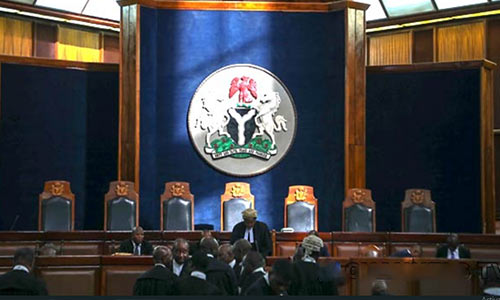
The Supreme Court has finally laid to rest the controversy over which court, between the National Industrial Court of Nigeria and states’ High Courts, has jurisdiction to entertain tortious cases arising in an employment setting.

In a judgment delivered on Friday, the Supreme Court also settled several conflicting judgments delivered on the issue by the Court of Appeal, which had been sources of confusion for many litigants and lower courts.
The case, which involved the tort of defamation, was referred to the Supreme Court by the Court of Appeal by virtue of Section 295(3) of the Constitution.
In deciding the case, the Supreme Court did not lay down a blanket rule excluding all tort claims from the jurisdiction of the NICN.
Rather, the apex court reaffirmed settled principles governing jurisdiction, namely, that jurisdiction is determined by the claimant’s pleadings and the true character of the cause of action.
In a unanimous decision, the Supreme Court’s seven-member panel, led by the Chief Justice of Nigeria (CJN), Justice Kudirat Kekere-Ekun, noted that the decisive inquiry is whether the claim, as framed, falls within the constitutional ambit of Section 254C of the Constitution.
It proceeded to make the following clarifications:
*Where a claim for defamation arises in circumstances connected with employment, the court must examine whether determining the claim necessarily involves the construction or enforcement of a contract of employment; the adjudication of rights and obligations flowing from that contract; or matters relating to labour relations, employment rights, or working conditions as constitutionally circumscribed.
*If the alleged defamatory statements are so intertwined with the employment relationship that their truth or falsity cannot be determined without recourse to the employment contract or duties arising therefrom, jurisdiction properly vests in the National Industrial Court.
*Conversely, where a defamation claim exists independently as a tort, does not require interpretation or enforcement of an employment contract, and is directed against a party outside any employer-employee relationship with the claimant, such a claim falls outside the NICN’s jurisdiction and within the general jurisdiction of the state High Court.
The Supreme Court held that defamation remains a distinct tortious cause of action, historically and jurisprudentially rooted in the general law of tort.
It further held that the mere fact that an allegedly defamatory statement is made in the context of employment does not, without more, transmute such a claim into a labour or employment dispute within the contemplation of Section 254C of the Constitution.
The apex court stated that the only qualification recognised is where defamation arises as an ancillary claim to a substantive labour or employment dispute and, upon a careful examination of the pleadings, is found to be inextricably bound up with the principal employment claim.
It added that in such circumstances, the National Industrial Court may competently entertain it under Section 254C(1)(a) as a cause or matter connected with labour or employment.
In reaffirming this approach, the apex court drew upon established jurisprudence, which underscores that the country’s adjudicatory tradition recognises and accommodates ancillary claims only where they are so inextricably connected with the main cause of action that they cannot stand independently without fragmenting the dispute.
The apex court further held that a claim for termination of employment constitutes a principal claim, adding that where such a claim is properly before the NICN, any ancillary claim for defamation arising from or connected with the termination may validly fall within its jurisdiction.
It held that the combined effect of Section 254C(1) of the Constitution is that once a dispute is labour-centred or employment-related in substance, jurisdiction is exclusively reserved for the National Industrial Court, irrespective of how the claim is framed.
The court stressed that no other court may validly assume jurisdiction over such matters, and proceedings commenced elsewhere would be constitutionally incompetent, adding that the inquiry is not formalistic but substantive.
Justice Stephen Adah, who delivered the judgment of the court, held that: “It is resolved that tortious claims, including defamation, do not fall within the scope of labour and employment matters contemplated by Section 254C of the Constitution and are properly justiciable before the regular courts, upon a substantive examination of the alleged defamatory publications.”
Justice Adah said the decision did not exclude tortious claims per se from the National Industrial Court, but rather establishes a principled and context-sensitive distinction grounded in the pleadings and the constitutional scope of Section 254C.
He added that the jurisdictional question remains fact-sensitive and must be resolved upon a careful examination of the true nature of the dispute.
The decision, the judge said, should be understood as reaffirming a constitutional and substance-driven approach to jurisdiction, rather than as laying down a categorical exclusion of defamation claims from the NICN.
The judgment was on the appeal marked: SC/CV/899/2025 between Emma Elegbe and Lolu Elegbe against HP International School Ltd, Kemi Balogun, Lynda Adeyemi-Hastrup, and Iyefe Oludoyi, which was a referral from the Court of Appeal, Lagos Division.
Besides Justices Kekere-Ekun and Adah, other members of the panel were Justices John Okoro, Helen Ogunwiju, Adamu Jauro, Jummai Sankey, and Obande Ogbuinya.
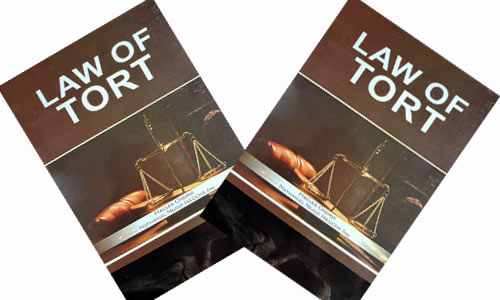 The book, titled The Law of Torts in Nigeria: A Functional Approach, authored by Professor Hagler Sunny Okorie Ph.D and Ikeocha, Nathaniel Ngozi Esq, offers law students, practitioners, and academics a comprehensive guide to understanding and applying tort law in Nigerian courts. Interested buyers can place orders via the following contact numbers: 08028636615, 08037667945, 08032253813, or +234 902 196 2209.
_______________________________________________________________________
The book, titled The Law of Torts in Nigeria: A Functional Approach, authored by Professor Hagler Sunny Okorie Ph.D and Ikeocha, Nathaniel Ngozi Esq, offers law students, practitioners, and academics a comprehensive guide to understanding and applying tort law in Nigerian courts. Interested buyers can place orders via the following contact numbers: 08028636615, 08037667945, 08032253813, or +234 902 196 2209.
_______________________________________________________________________
 ARTIFICIAL INTELLIGENCE FOR LAWYERS: A COMPREHENSIVE GUIDE
Reimagine your practice with the power of AI “...this is the only Nigerian book I know of on the topic.” — Ohio Books Ltd
Authored by Ben Ijeoma Adigwe, Esq., ACIArb (UK), LL.M, Dip. in Artificial Intelligence, Director, Delta State Ministry of Justice, Asaba, Nigeria.
Bonus:
Get a FREE eBook titled “How to Use the AI in Legalpedia and Law Pavilion” with every purchase.
ARTIFICIAL INTELLIGENCE FOR LAWYERS: A COMPREHENSIVE GUIDE
Reimagine your practice with the power of AI “...this is the only Nigerian book I know of on the topic.” — Ohio Books Ltd
Authored by Ben Ijeoma Adigwe, Esq., ACIArb (UK), LL.M, Dip. in Artificial Intelligence, Director, Delta State Ministry of Justice, Asaba, Nigeria.
Bonus:
Get a FREE eBook titled “How to Use the AI in Legalpedia and Law Pavilion” with every purchase.
How to Order: 📞 Call, Text, or WhatsApp: 08034917063 | 07055285878 📧 Email: benadigwe1@gmail.com 🌐 Website: www.benadigwe.com
Ebook Version: Access directly online at: https://selar.com/prv626
________________________________________________________________________ The Law And Practice Of Redundancy In Nigeria: A Practitioner’s Guide, Authored By A Labour & Employment Law Expert Bimbo Atilola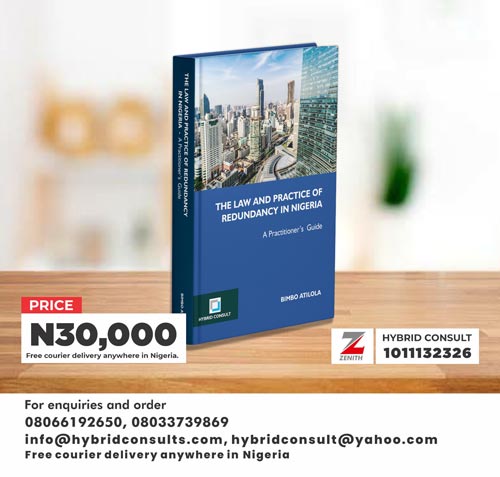 _______________________________________________________________________
[A MUST HAVE] Evidence Act Demystified With Recent And Contemporary Cases And Materials
_______________________________________________________________________
[A MUST HAVE] Evidence Act Demystified With Recent And Contemporary Cases And Materials