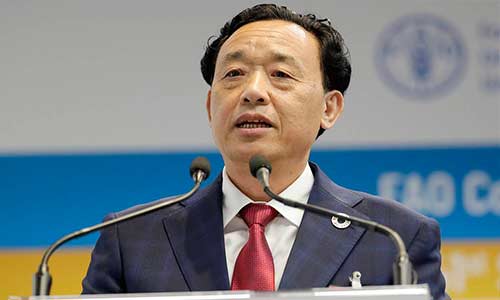
The Director-General of the Food and Agriculture Organisation (FAO) of the United Nations, QU Dongyu, has called for immediate actions to minimise disruption to food supply chains.

In a statement issued by QU Dongyu titled ‘Keeping global food chains alive is crucial amid COVID-19 crisis’, he said coherent response is needed globally to prevent the outbreak of coronavirus from triggering food crisis.
“To reduce the risk of an even greater toll – shortage of food for millions, even in affluent countries – the world must take immediate actions to minimize disruptions to food supply chains.
“A globally coordinated and coherent response is needed to prevent this public health crisis from triggering a food crisis in which people cannot find or afford food.
“For now, COVID-19 has not entailed any strain on food security, despite anecdotal reports of crowded supermarket sieges.
“While there’s no need for panic – there is enough supply of food in the world to feed everyone – we must face the challenge: an enormous risk that food may not be made available where it is needed,” he said.
He noted that restriction of movement may impede farmers from farming, and food processors from processing, as well as a shortage of fertiliser Veterinary medicine and other farm inputs, could affect food production.
“The COVID-19 outbreak, with all the accompanying closures and lockdowns, has created logistical bottlenecks that ricochet across the long value chains of the modern global economy.
“Restrictions of movement, as well as basic aversion behaviour by workers, may impede farmers from farming and food processors (who handle most agricultural products) from processing. Shortage of fertilisers, veterinary medicines and other input could also affect agricultural production.
“Closures of restaurants and less frequent grocery shopping diminish demand for fresh produce and fisheries products, affecting producers and suppliers, especially smallholder farmers, with long-term consequences for the world’s increasingly urbanised population, be they in Manhattan or Manila.
“Uncertainty about food availability can induce policymakers to implement trade-restrictive measures in order to safeguard national food security,” QU Dongyu said.
Furthermore, he said given the experience of the 2007-2008 global food price crisis, the world know that such measures can only exacerbate the situation.
He further noted that export restrictions put in place by exporting countries to increase food availability domestically could lead to serious disruptions in the world food market, resulting in price spikes and increased price volatility.
“In 2007-2008, these immediate measures proved extremely damaging, especially for low-income food-deficit countries and to the efforts of humanitarian organisations to procure supplies for the needy and vulnerable.
“We should all learn from our recent past and not make the same mistakes twice. Policymakers must take care to avoid accidentally tightening food-supply conditions.
“While every country faces its own challenges, collaboration – between governments and the full gamut of sectors and stakeholders – is paramount. We are experiencing a global problem that requires a global response.
“We must ensure that food markets are functioning properly and that information on prices, production, consumption and stocks of food are available to all in real-time. This approach will reduce uncertainty and allow producers, consumers, traders and processors to make informed decisions and to contain unwarranted panic behaviour in global food markets.
“The health impacts of the unfolding COVID-19 pandemic on some of the poorest countries are still unknown. Yet, we can say with certainty that any ensuing food crisis as a result of poor policy-making will be a humanitarian disaster that we can avert.
“We already have 113 million people experiencing acute hunger; in sub-Saharan Africa, a quarter of the population is undernourished. Any disruptions to food supply chains will intensify both human suffering and the challenge of reducing hunger around the world.
“We must do everything possible to not let that happen. Prevention costs less. Global markets are critical for smoothening supply and demand shocks across countries and regions, and we need to work together to ensure that disruptions of food supply chains are minimised as much as possible,” he added.
[A MUST HAVE] Evidence Act Demystified With Recent And Contemporary Cases And Materials

Available now for NGN 40,000 at ASC Publications, 10, Boyle Street, Onikan, Lagos. Beside High Court, TBS. Email publications@ayindesanni.com or WhatsApp +2347056667384. Purchase Link: https://paystack.com/buy/evidence-act-complete-annotation
______________________________________________________________________ “Enhance Legal Practice With Authoritative Reports” — Alexander Payne Offers Comprehensive Law Reports, Spanning Over A Century Of Nigerian Jurisprudence Interested buyers are encouraged to place their orders and enquiries via:
0704 444 4777, 0704 444 4999, 0818 199 9888
Website: www.alexandernigeria.com
Interested buyers are encouraged to place their orders and enquiries via:
0704 444 4777, 0704 444 4999, 0818 199 9888
Website: www.alexandernigeria.com