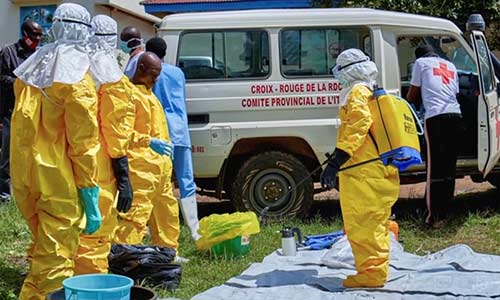
Health workers in the Democratic Republic of Congo are battling to contain a worsening Ebola outbreak amid rising infections, community resistance, violent attacks on treatment centres, insecurity, displacement and shortages of medical supplies.

The outbreak, caused by the rare Bundibugyo strain of Ebola, has been described as increasingly difficult to control, with the World Health Organization raising the national risk level in DR Congo to “very high.”
Congolese authorities said more than 900 suspected cases and over 119 suspected deaths had been recorded, although health officials fear the real figures may be higher because the outbreak likely spread for weeks before it was detected.
The outbreak was first officially declared on May 15 after health authorities were alerted to a high-mortality illness in Ituri Province, eastern Congo. The first known case involved a nurse who showed symptoms on April 24 in Bunia before being buried in Mongbwalu, a gold-mining town where several unexplained deaths had already been reported.
The response has been complicated by attacks on Ebola treatment centres in Rwampara and Mongbwalu, two areas with high case counts. In one incident, local youths reportedly burned a treatment centre while trying to retrieve the body of a friend who had died, accusing foreign aid workers of lying about Ebola.
Health authorities have since banned funeral wakes and gatherings of more than 50 people in parts of northeastern Congo to limit transmission. Armed soldiers and police are also guarding some burials being carried out by aid workers because bodies of Ebola victims can remain highly contagious.
Community mistrust has become one of the biggest obstacles to the response. Some residents believe the outbreak is real and are seeking information on how to protect themselves, while others still suspect that Ebola is fabricated.
Eastern Congo is already one of the world’s worst humanitarian crisis zones, with violence by several armed groups, including the Allied Democratic Forces and Rwanda-backed M23 rebels, disrupting health services and humanitarian access.
Ituri, the epicentre of the outbreak, has nearly one million displaced persons, raising fears that Ebola could spread into crowded camps around Bunia. Cases have also been reported in North Kivu and South Kivu, where M23 rebels control parts of the territory, further complicating the response.
Uganda has also recorded confirmed Ebola cases after infected persons reportedly travelled from Congo into the country. Ugandan authorities have since halted flights to and from Congo and restricted land border crossings.
Aid groups say the outbreak is being worsened by severe shortages of protective equipment, testing kits, body bags and materials needed for safe burials. Health experts have linked the shortages partly to international aid cuts, especially from the United States and other wealthy countries.
The Bundibugyo strain responsible for the current outbreak has no approved vaccine or specific treatment, unlike the more common Zaire strain, which has caused many of Congo’s previous Ebola outbreaks.
Doctors Without Borders had earlier warned that insecurity in Ituri had forced health workers to flee, leaving overwhelmed facilities and worsening conditions in affected communities.
Congo’s Health Minister, Roger Kamba, has appealed for more funding and international support, warning that the virus does not respect borders.
“The virus knows no borders, it knows no race, it knows no tribe. The virus affects us all,” he said.
Health officials and aid agencies are now racing to expand treatment centres, strengthen surveillance, trace contacts and rebuild trust in affected communities as fears grow that the outbreak could spread further across the region.
[A MUST HAVE] Evidence Act Demystified With Recent And Contemporary Cases And Materials

Available now for NGN 40,000 at ASC Publications, 10, Boyle Street, Onikan, Lagos. Beside High Court, TBS. Email publications@ayindesanni.com or WhatsApp +2347056667384. Purchase Link: https://paystack.com/buy/evidence-act-complete-annotation
______________________________________________________________________ “Enhance Legal Practice With Authoritative Reports” — Alexander Payne Offers Comprehensive Law Reports, Spanning Over A Century Of Nigerian Jurisprudence Interested buyers are encouraged to place their orders and enquiries via:
0704 444 4777, 0704 444 4999, 0818 199 9888
Website: www.alexandernigeria.com
Interested buyers are encouraged to place their orders and enquiries via:
0704 444 4777, 0704 444 4999, 0818 199 9888
Website: www.alexandernigeria.com