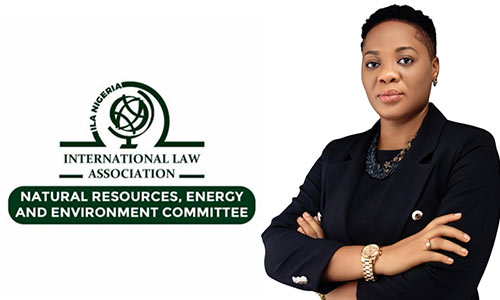
The Natural Resources, Energy and Environmental Law Committee of the International Law Association, Nigeria Branch, has called for stronger institutional accountability, effective enforcement of environmental laws, equitable climate finance and inclusive governance to address Africa’s growing environmental challenges.

The call was made during the World Environment Day Dialogue 2026, convened virtually by the Committee under the theme, “From Commitment to Action: Rethinking Environmental Governance in Africa.”
The dialogue brought together legal practitioners, environmental experts, policymakers, academics, researchers, development partners, civil society representatives, students and other stakeholders from across Africa and beyond to examine the continent’s environmental governance challenges and practical pathways for reform.
Participants noted that although many African countries have adopted environmental laws, policies and international commitments, weak implementation, poor enforcement and inadequate accountability remain major obstacles to meaningful environmental progress.
They stressed that Africa must move beyond declarations and policy commitments to measurable, accountable and community-centred environmental action.
In her welcome address, Chairman of the NREEL Committee, Oluwaseyi Ebenezer, highlighted the increasing threats posed by biodiversity loss, pollution, land degradation, unsustainable resource use and climate-related risks across African communities.
She said environmental sustainability cannot be separated from economic development, public health, social justice and intergenerational equity.
Delivering a goodwill message, President of the International Law Association, Nigeria Branch, Prof. Damilola Olawuyi, SAN, emphasised the importance of law, institutions and multi-stakeholder collaboration in advancing environmental protection and sustainable development.
Olawuyi noted that with only a few years left to the 2030 Sustainable Development Goals target, stronger action and a change in mindset are required to address pollution, climate change, biodiversity loss, deforestation, environmental contamination and unsustainable resource use.
In his keynote address, former Director-General of the Nigerian Institute of Advanced Legal Studies, Prof. Muhammed Tawfiq Ladan, said Africa’s environmental crisis is not primarily caused by the absence of laws, but by weak implementation, poor monitoring and inadequate enforcement of existing obligations.
Ladan called for stronger and more independent institutions, effective enforcement of environmental laws, greater accountability by governments and corporations, enhanced public participation, regional cooperation, climate-resilient development planning and sustainable natural resource management.
He also urged sustained investment in environmental education and institutional capacity building.
The panel sessions featured Wycliffe Amakobe, Gibrilla Kamara, Dr. Otuawe Moro and Dr. Elen de Paula Bueno, with Luper Daniel Saror as moderator.
The speakers discussed governance, accountability, environmental justice, community participation, compliance, climate finance and the future of environmental action in Africa.
They identified weak institutional capacity, fragmented financing, poor inter-agency coordination, inconsistent policy implementation, limited political commitment and weak monitoring systems as major barriers to environmental progress across the continent.
The dialogue called for increased investment in regulatory and judicial capacity, including specialised training for judges and environmental regulators to improve enforcement outcomes.
Participants also highlighted the need for technology-driven compliance monitoring, stronger accountability institutions, reliable environmental data systems and greater use of financial assurance mechanisms in high-risk sectors such as mining and other extractive industries.
On community engagement, the speakers said participation must go beyond consultation. They called for genuine involvement of local communities in environmental planning, decision-making, implementation and monitoring, especially in areas where environmental risks directly affect livelihoods.
On climate finance, participants observed that inequitable access to funding remains a major obstacle to climate adaptation and mitigation in developing countries.
They called for reforms to the international financial system to improve representation, access, transparency and timely disbursement of climate finance to countries most affected by climate change.
The dialogue recommended that African governments should prioritise the implementation and enforcement of existing environmental laws and policies, strengthen inter-agency coordination, improve environmental data systems, build institutional capacity and promote transparent monitoring and accountability mechanisms.
It also encouraged private sector actors to strengthen Environmental, Social and Governance practices by integrating sustainability into governance, operations and investment decisions.
Participants further called for expanded environmental education, research, innovation and youth participation across Africa as part of long-term efforts to promote environmental sustainability and climate action.
The dialogue ended with a call for stronger partnerships among governments, regional organisations, academia, civil society, development partners and the private sector to address Africa’s shared environmental challenges.
The NREEL Committee reaffirmed its commitment to promoting informed dialogue, legal reform, practical policy solutions and collaborative action that contribute to sustainable development across Nigeria and the African continent.
The Committee also expressed appreciation to the keynote speaker, panellists, moderator and participants for their contributions to the dialogue and the collective call for transformative environmental governance in Africa.
[A MUST HAVE] Evidence Act Demystified With Recent And Contemporary Cases And Materials

Available now for NGN 40,000 at ASC Publications, 10, Boyle Street, Onikan, Lagos. Beside High Court, TBS. Email publications@ayindesanni.com or WhatsApp +2347056667384. Purchase Link: https://paystack.com/buy/evidence-act-complete-annotation
______________________________________________________________________ “Enhance Legal Practice With Authoritative Reports” — Alexander Payne Offers Comprehensive Law Reports, Spanning Over A Century Of Nigerian Jurisprudence Interested buyers are encouraged to place their orders and enquiries via:
0704 444 4777, 0704 444 4999, 0818 199 9888
Website: www.alexandernigeria.com
Interested buyers are encouraged to place their orders and enquiries via:
0704 444 4777, 0704 444 4999, 0818 199 9888
Website: www.alexandernigeria.com