The Supreme Court declared on Thursday that it was unconstitutional for state governors to hold funds allocated for local government administrations.
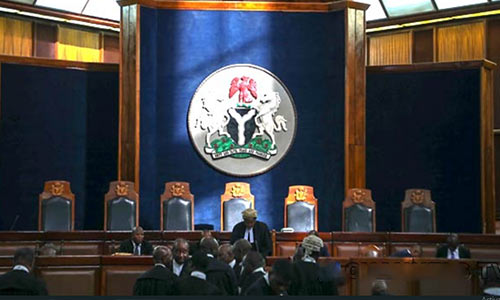
The seven-man panel, consisting of Justices Emmanuel Agim, Centus Nwosu, Amina Adumein, Mohammed Tsammani, Yusuf Tukur, Tijjani Abiru, and Uwani Musa Abba Garba, in the judgment delivered by Justice Emmanuel Agim, declared that the 774 local government councils in the country should have managed their funds themselves.
The apex court held that the power of the government was portioned into three arms of government, the federal, the state and the local government.
The court further declared that a state government had no power to appoint a caretaker committee and a local government council was only recognisable with a democratically elected government.
“A democratically elected local government was sacrosanct and non-negotiable,” the court said.
The judgment held that the use of a caretaker committee amounted to the state government taking control of the local government and was in violation of the 1999 Constitution.
The court ruled that state governments were perpetuating a dangerous trend by refusing to allow democratically elected local government councils to function, instead appointing their loyalists who could only be removed by them
The court stated that it was the local government that should have received and managed funds meant for local government.
Justice Agim declared, “I held that the state’s retention of the local government funds was unconstitutional.
“Demands of justice required a progressive interpretation of the law. It was the position of this court that the federation could pay LG allocations to the LGs directly or pay them through the states.
“In this case, since paying them through states had not worked, justice of this case demanded that LG allocations from the federation account should henceforth have been paid directly to the LGs.”
The judgment held that the local government council funds must have been paid to only democratically elected local government councils stating that “anything other than this would be taken as a gross misconduct.”
“A declaration that the state government had no power or control to keep the local government council money or funds.
“A declaration that the local government council was entitled to the local government allocation.
“An order of injunction restraining the defendants by themselves, agents or privies from spending local government allocation.
“A declaration that no state government should have been paid any money meant for the local government.
“An immediate compliance to this judgement,” the apex court declared.
Justice Agim dismissed the objections filed by state governors.
The Attorney General of the Federation, Lateef Fagbemi (SAN), had filed a lawsuit on behalf of the Federal Government, seeking to grant full autonomy and direct funding to all 774 local government councils in the country.
The AGF, in the suit predicated on 27 grounds, had urged the apex court to issue an order prohibiting state governors from unilateral, arbitrary and unlawful dissolution of democratically elected local government leaders.
The FG further contended that Nigeria as a federation, was a creation of the 1999 Constitution with the President as the Head of the Federal Executive arm of the Federation and had sworn to uphold and give effects to the provisions of the Constitution.
The 36 state governments, through their attorneys general, had filed a counterclaim, arguing that the Supreme Court lacked the jurisdiction to hear the case.
They claimed that the AGF lacked the locus standi to institute the suit for the local governments.
In Thursday’s ruling, Justice Agim affirmed that the AGF had the legal authority to initiate the lawsuit and uphold the constitution.
Justice Agim said, “I held that the plaintiff’s request was hereby approved and all the reliefs granted.”
[pdf-embedder url=”https://thenigerialawyer.com/wp-content/uploads/2024/07/Agim-Judgment-TheNigeriaLawyer.pdf” title=”Agim Judgment TheNigeriaLawyer”]
[pdf-embedder url=”https://thenigerialawyer.com/wp-content/uploads/2024/07/Nwosu-Judgment-TheNigerialawyer.pdf” title=”Nwosu Judgment TheNigerialawyer”]
[pdf-embedder url=”https://thenigerialawyer.com/wp-content/uploads/2024/07/Adumein-Judgment-TheNigeriaLawyer.pdf” title=”Adumein Judgment TheNigeriaLawyer”]
[pdf-embedder url=”https://thenigerialawyer.com/wp-content/uploads/2024/07/Tsammani-Judgment-TheNigeriaLawyer.pdf” title=”Tsammani Judgment TheNigeriaLawyer”]
[pdf-embedder url=”https://thenigerialawyer.com/wp-content/uploads/2024/07/Tukur-Judgment-TheNigerialawyer.pdf” title=”Tukur Judgment TheNigerialawyer”]
[pdf-embedder url=”https://thenigerialawyer.com/wp-content/uploads/2024/07/Abiru-Judgment-TheNigeriaLawyer.pdf” title=”Abiru Judgment TheNigeriaLawyer”]
[pdf-embedder url=”https://thenigerialawyer.com/wp-content/uploads/2024/07/Garba-Judgment-TheNigeriaLawyer.pdf” title=”Garba Judgment TheNigeriaLawyer”]
[A MUST HAVE] Evidence Act Demystified With Recent And Contemporary Cases And Materials

Available now for NGN 40,000 at ASC Publications, 10, Boyle Street, Onikan, Lagos. Beside High Court, TBS. Email publications@ayindesanni.com or WhatsApp +2347056667384. Purchase Link: https://paystack.com/buy/evidence-act-complete-annotation
______________________________________________________________________ “Enhance Legal Practice With Authoritative Reports” — Alexander Payne Offers Comprehensive Law Reports, Spanning Over A Century Of Nigerian Jurisprudence Interested buyers are encouraged to place their orders and enquiries via:
0704 444 4777, 0704 444 4999, 0818 199 9888
Website: www.alexandernigeria.com
Interested buyers are encouraged to place their orders and enquiries via:
0704 444 4777, 0704 444 4999, 0818 199 9888
Website: www.alexandernigeria.com
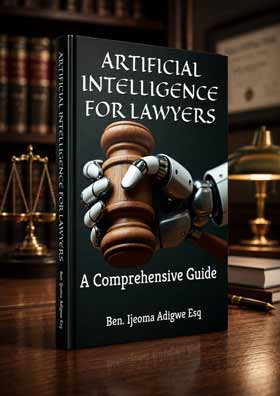 The book also examines Nigeria's legal ecosystem, focusing on the LPELR and NBA AI Guidelines. As a bonus, every purchase comes with a FREE eBook titled: How to Use the AI Features in LegalPedia and LawPavilion.
Ohio Books Ltd praises the publication, stating:
"....this is the only Nigerian book I know of on the topic."
How to Order:
📞 Call, Text, or WhatsApp: 08034917063 | 07055285878
📧 Email: benadigwe1@gmail.com
🌎 Website: www.benadigwe.com
Ebook Version: Access it directly online at https://selar.com/prv626
Authored by Ben Ijeoma Adigwe Esq., ACIarb (UK), LL.M, Dip. in Artificial Intelligence, Director at the Delta State Ministry of Justice, Asaba, Nigeria.
______________________________________________________________________
The book also examines Nigeria's legal ecosystem, focusing on the LPELR and NBA AI Guidelines. As a bonus, every purchase comes with a FREE eBook titled: How to Use the AI Features in LegalPedia and LawPavilion.
Ohio Books Ltd praises the publication, stating:
"....this is the only Nigerian book I know of on the topic."
How to Order:
📞 Call, Text, or WhatsApp: 08034917063 | 07055285878
📧 Email: benadigwe1@gmail.com
🌎 Website: www.benadigwe.com
Ebook Version: Access it directly online at https://selar.com/prv626
Authored by Ben Ijeoma Adigwe Esq., ACIarb (UK), LL.M, Dip. in Artificial Intelligence, Director at the Delta State Ministry of Justice, Asaba, Nigeria.
______________________________________________________________________